Why a Cross-Border Seller Should Care About an API Aggregator for Agents
Cross-border e-commerce has a dirty secret: our most important data is locked inside subscription silos that price us like enterprise software but serve us like a vending machine. You want keyword volume for a new Amazon listing? That’s a $139/month seat on a tool that bundles 40 features you’ll never touch. You need ad library intelligence for TikTok Shop competitor research? That’s another login, another OAuth handshake, another forgotten password reset. Meanwhile, the AI agents we’re all being told to adopt for listing optimization or repricing can’t access any of it, because the APIs are either undocumented, overpriced, or buried under a decade of legacy SaaS cruft. The launch of Treg isn’t just another dev tool—it’s a direct challenge to the subscription economy that has been quietly taxing our margins for years. If you’ve ever paid for a full-priced SaaS suite just to use one endpoint, or watched your VA spend a week on API setup instead of actually doing the work, this is the product you should be dissecting this week.
The Problem: SaaS Bundles Are a Tax on Your Operational Flexibility
Let me paint the picture most operators live in. You’re running a DTC brand on Shopify and you want to enrich your customer list with social profiles. You sign up for a lead enrichment tool. You pay for a tier that includes firmographics, technographics, and maybe some intent data you never use. The price is set for a team of five, not for a solo operator who needs 2,000 lookups a month. Then you need competitor pricing data from Amazon Seller Central, so you buy another subscription. Then you need TikTok ad library data, so you buy a third. Before you know it, your tooling stack costs more than your warehouse rent, and you’re still missing the integration layer that would let your internal dashboards talk to each other.
The founder of Treg, Jason Zhou, describes this exact frustration in the launch post: the data an agent needs for real work—keyword volume, backlinks, ad libraries, enrichment—either sits inside SaaS bundles priced for humans, or requires days of OAuth app setup & verification. He’s not wrong. I’ve burned entire weekends on OAuth verification callbacks for Google Ads APIs, only to have the token expire a week later because I didn’t set up the refresh flow correctly. This is the hidden tax on cross-border operations: not the subscription fee itself, but the opportunity cost of the time spent wiring it all together.
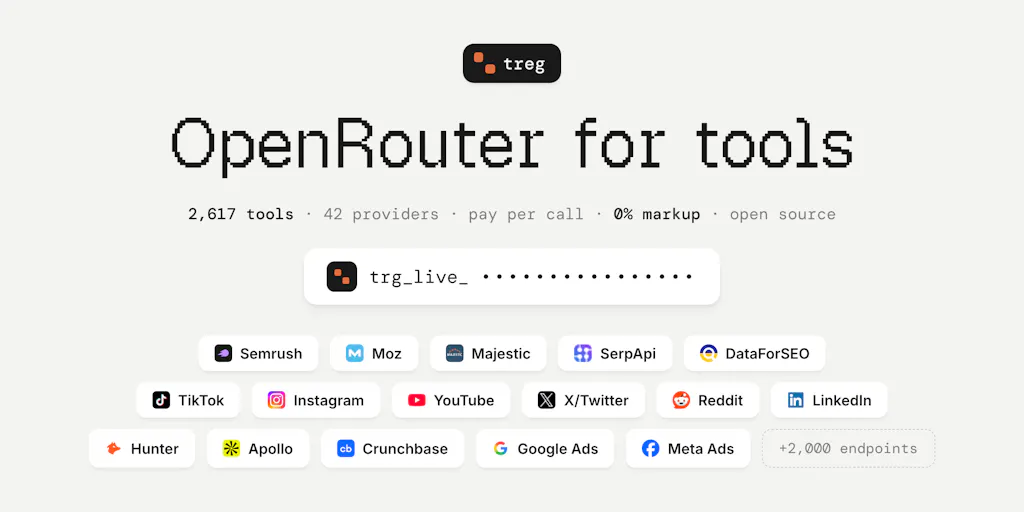
Treg’s answer is to flip the model from vendor-based to task-based. Instead of asking “which tool should I buy?”, you ask “what task do I need done?” The platform exposes a catalog of roughly 2,600 agent-friendly tools across about 40 providers—covering SEO/GEO, social, leads, ads, and scraping. You search by task, see the price per request, see the expected response shape, and call it. No subscription. No 40-feature bundle you’ll never open. Just a per-call price that matches what you’d pay if you had the subscription anyway, with a 0% markup claim that is worth scrutinizing.
How Treg Differs from the Incumbent Tooling Stack
To understand why this matters, compare it to how we currently buy data. Let’s take Helium 10 for Amazon sellers. You pay a monthly fee for a suite that includes Cerebro, Black Box, and Xray. It’s powerful, but it’s a walled garden. The data doesn’t export cleanly into your own models, and the API access is restricted to higher tiers. If you want to feed keyword data into a custom AI model for listing generation, you’re either screen-scraping or paying for an enterprise plan that was never designed for you.
Treg is the opposite. It positions itself as a proxy that relays the real upstream request and injects credentials server-side. Your agent never holds a secret, and they claim they don’t model the upstream API, so they survive provider changes. That last point is significant. In the cross-border space, platforms like TikTok Shop and Etsy change their API schemas frequently. A tool that hard-codes those schemas breaks every quarter. A tool that acts as a pass-through layer, even if it’s just a thin wrapper, has a better chance of staying alive because it doesn’t try to be the source of truth.
The other differentiator is the OAuth handling. The launch post highlights that they handle the painful OAuth setups for Google/Meta ads, social posting, and Business Profile. For a cross-border operator, this is the difference between actually running ads and spending the morning in a developer console. If you’ve ever tried to connect a Meta Ads account to a third-party reporting tool, you know the pain of app review, permissions, and the dreaded “token expired” email. Treg’s approach—connect once, let every teammate’s agent act—is the right architecture. It treats authentication as infrastructure, not as a per-user feature.
What Cross-Border Sellers Can Borrow from Treg’s Philosophy
You don’t have to adopt Treg to benefit from the thinking behind it. The first lesson is about your own tooling stack: stop buying suites, start buying outcomes. If you’re paying for a $200/month SEO tool and you only use the keyword research module, you’re overpaying by 80%. The second lesson is about your internal data pipelines. The future is not “one tool for everything,” it’s “many tools, one task-based interface.” You should be building your own mini-Treg—a simple internal dashboard that hits the endpoints you actually use, with your own keys, and nothing else.
The third lesson is about AI adoption. Most cross-border sellers are still treating AI as a chat interface—asking ChatGPT to write a product description. That’s table stakes. The real leverage comes when your AI agents can *act*—pull competitor pricing, check inventory levels, adjust ad bids. But agents are only as good as their access to data. Treg’s model of task-based API access is the missing link. If you’re building an agent to monitor your eBay listings and auto-adjust prices based on competitor data, you need that data delivered in a structured, per-call format, not buried in a weekly PDF export.
Why Amazon Sellers Should Care More Than Shopify Ones
If you’re a Shopify seller, your data is relatively clean. Shopify has a well-documented API, and most apps integrate natively. Your pain point is more about marketing data—ads, social, email. Treg’s catalog of ad libraries and social tools is directly relevant.
But if you’re an Amazon FBA seller, your pain is existential. Amazon’s API is notoriously restrictive. You can’t get competitor keyword volume without a third-party tool. You can’t get accurate search volume trends without paying for a subscription. Treg’s catalog includes keyword volume and backlink data, which means you can potentially get the same data you’d get from Jungle Scout or Helium 10, but only pay for the specific queries you run. For a seller with 50 SKUs, that’s not a marginal difference—it’s the difference between profitable research and a fixed cost that eats your margin.
The catch is that Amazon data is often the most heavily guarded. I’m skeptical that Treg has cracked the code on getting clean Amazon search volume data at a per-call price that undercuts the incumbents. If they have, that’s a game-changer. If they haven’t, then Amazon sellers will still need a subscription tool for the core keyword research, and Treg becomes a supplementary tool for the long tail of ad library and social data.
Where the Math Breaks
The “0% markup on unit price” claim is the one I’d stress-test first. In the launch comments, Gal Dayan raises a sharp question about the proxy architecture: if every request and response body for leads, ads, and scraping data passes through Treg’s infrastructure, what’s the logging and retention policy? Is it truly zero-log passthrough, or is there a window where payloads are kept for debugging billing disputes? That’s not a hypothetical concern. If you’re routing customer data or audience lists through a third-party proxy, you need to know where that data lands. GDPR and EU AI Act compliance are not optional for sellers shipping to Europe, and Nico Lumma asks exactly that in the comments.
The math also breaks if you’re a power user. If you run thousands of lookups a day, a per-call model could easily exceed the cost of a flat subscription. The 0% markup only helps if you’re a low-volume, high-variety user. For a large operation that does 10,000 backlink lookups daily, you’d be better off with a dedicated API plan from a provider like Ahrefs that gives you a bulk discount. Treg is a great fit for the mid-tail, not the enterprise.
The Open-Source Angle and What It Means for Your Stack
Treg is open source under AGPL and self-hostable. This is a double-edged sword. On one hand, it means you can run it on your own infrastructure and avoid the data passthrough concern entirely. On the other hand, AGPL is a viral license—if you modify and distribute it, you have to open-source your changes. For most cross-border operators who just want a tool, that’s fine. But if you’re building a proprietary internal system that you might eventually sell, you need to be careful about how you use the code.
The open-source angle also invites a question about sustainability. The launch post says they started this as an internal tool. That’s the best origin story for a product like this—it was built to solve a real problem, not to chase a market. But the per-call pricing model, combined with open-source availability, means their revenue depends on sellers who would rather pay for convenience than run their own instance. That’s a viable business, but it’s not a high-margin one. I’d watch whether they pivot to a hybrid model—free self-hosted version, paid managed version—because that’s where the real growth is.
What I’d Watch / Test Next
If you’re an operator reading this, here’s what I’d do this week, not next month. First, sign up for Treg and run a single test query. Pick a task you actually do—say, “backlinks for a competitor domain”—and see if the result quality matches what you get from your current subscription tool. The launch comments mention a user who spent less than $1 and got useful analytics for TikTok and Instagram, plus a best practices breakdown. That’s the right way to evaluate this: small spend, real task, direct comparison.
Second, map out which of your current SaaS subscriptions you only use for one or two endpoints. List those endpoints. Then check if Treg’s catalog covers them. If it does, you have a negotiation lever with your current vendor—or a reason to cancel. Third, if you have any technical capability, spin up the self-hosted version and test the OAuth handling with a sandbox account. The proxy-injects-credentials approach is the most valuable part of the product, and you should verify it works before you trust it with production data.
Finally, watch the space. Ryan Hoover’s comment on the launch page about product discovery changing because APIs will primarily serve agents is the clearest signal that this is not a niche product—it’s the direction the entire industry is heading. Whether Treg survives or gets absorbed by a larger platform, the shift to task-based, per-call pricing is coming. The sooner you structure your tooling stack around that reality, the less you’ll pay in the long run.