Why a 360 Camera Launch Should Matter to Your Product Roadmap
Let’s be honest: when a hardware brand like Insta360 drops a new flagship, most cross-border sellers scroll past it. We think, “That’s a consumer electronics play, not an Amazon FBA opportunity. I don’t sell action cams.” That’s a mistake. The Insta360 Luna Ultra launch isn’t just a spec sheet flex; it’s a masterclass in solving a real operational pain point that plagues every DTC brand and marketplace seller: the cost and friction of creating visual content that converts. Whether you’re listing on Amazon, building a Shopify storefront, or running TikTok Shop ads, your bottleneck isn’t product quality—it’s the speed and cost of producing lifestyle media that doesn’t look like garbage. This launch signals a shift in how we can capture product demos, user-generated content, and immersive storefronts without hiring a film crew. We should be paying attention to the underlying tech, not the camera body itself.
The Content Bottleneck is the Real Problem
Let’s talk about the actual pain point this product addresses. For a cross-border operator, the “content flywheel” is often broken. You need images for Amazon A+ Content, video for TikTok organic, and 3D models for Shopify product pages. Traditionally, that’s three separate production pipelines. You either spend $500+ per SKU on a professional photoshoot, or you buy a cheap 360 camera and spend hours in post-production stitching and reframing footage that still looks amateurish.
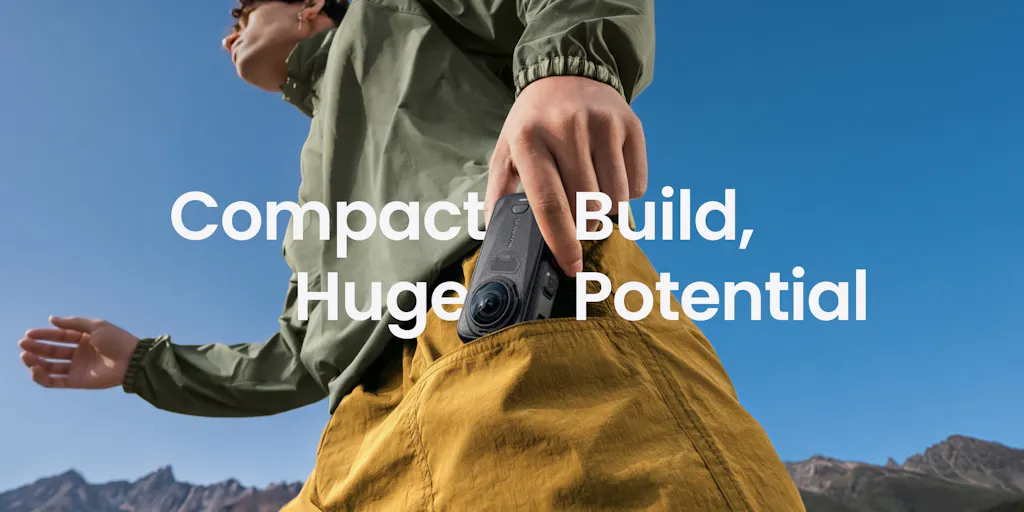
The Insta360 Luna Ultra attacks this specific workflow friction. The hunter’s description frames it as “three cameras merged into one pocket-sized body.” That’s not just marketing fluff; it’s a workflow consolidation. The first mode is the traditional flagship 360 camera with dual 1⁄1.1” Sony sensors, 8K50fps, and native Dolby Vision. That’s your high-res capture for hero shots. But the second mode—InstaFrame 2.0—is where it gets interesting for us. It allows the device to “work like a gimbal camera, directly outputting stabilized 4K flat video without any reframing.” That kills the post-production bottleneck. You shoot, and you get a usable file. That’s a massive time saver for a lean DTC team.
Why Amazon sellers should care more than Shopify ones
Shopify sellers have the luxury of embedding custom video and interactive 3D models easily. Amazon is a more rigid environment. You’re fighting for conversion on a listing page where the media is often static. The Luna Ultra’s third party feature—the POV Head Tracker—is a game-changer for capturing authentic, first-person demos. Imagine a listing video where the camera follows the reviewer’s gaze as they unbox a product and use it. That level of immersion is currently reserved for expensive rigs. If you are selling on Amazon, where video is a high-converting differentiator, offloading this production cost is a direct margin play.
How It Differs From the Incumbents
To understand the value, we have to compare it to the tools we currently use. The obvious incumbent is the GoPro ecosystem. GoPros are great for action, but they are notoriously bad for “scene capture.” They have a narrow field of view unless you buy a bulky Max. The Insta360 Ace Pro 2, the predecessor on the Product Hunt page, was already an 8K AI-powered action cam. But the Luna Ultra is pivoting away from the “action cam” label and moving toward “scene capture.”
The other incumbent is the traditional gimbal, like the DJI Osmo series. Those require you to physically move the camera to get a shot. The Luna Ultra’s InstaFrame 2.0 mode essentially replaces the need for a gimbal and a 360 camera. You get the stability of a gimbal with the flexibility of a 360 sensor. For a seller, this means you can hand this to a non-technical employee or a UGC creator, and they can produce a stable, professional-looking video without needing to learn how to balance a gimbal or edit in a complex NLE like Adobe Premiere. It lowers the skill floor for content creation.
The “Borrow This” Strategy for E-commerce
We aren’t just here to look at the hardware; we need to extract the playbook. The most compelling feature in the launch copy isn’t the camera—it’s the software workflow. The AI Director is described as being able to “edit your 360 footage while the camera charges.” That is a friction-killer.
For cross-border sellers, this is the exact same logic as using Klaviyo for email automation—you want the system to do the heavy lifting while you sleep. The “AI Director” is essentially a post-production assistant. It offloads the most tedious part of content creation: editing. In a cross-border context, where your team might be spread across time zones and you’re relying on overseas freelancers for editing, this local processing is huge. It means you don’t need to ship huge 8K files to a freelancer in another country just to get a cut-down for TikTok Shop. The camera does the rough cut locally.
Where the math breaks
Here is where I have to put on my operator hat and look at the ROI. The hardware is impressive, but the cost of entry is high. While the price isn’t disclosed on the Product Hunt page, we know the previous Ace Pro 2 launched at a premium price point. If the Luna Ultra is priced above $500, the math gets tricky for a small seller. You have to ask: “How many SKUs can I shoot to justify this?” If you’re a single-product seller, the ROI is negative. You’re better off using a service like Helium 10 to optimize your existing listings and buying stock photos. But if you are a brand with a catalog of 20+ SKUs and you constantly need fresh creative for Meta Ads, the unit economics start to make sense. The speed of iteration—shooting, charging, and getting an AI-edited draft—compresses your creative testing cycle from weeks to days.
The 3D Angle and Future-Proofing
We need to talk about the “3D Time Capsule.” The description mentions it uses “Gaussian Splatting to turn captured spaces into 3D scenes.” This is the most forward-looking feature, and honestly, the one most sellers will ignore until it’s too late.
For those of us selling on platforms like Shopify or Etsy, 3D models are becoming a conversion lever. Customers want to see a product “in their space” before buying furniture or home decor. Usually, generating a 3D model requires photogrammetry rigs or expensive CAD software. If the Luna Ultra can capture a room and generate a splat scene that you can export, you could theoretically offer a “view in your room” feature without hiring a 3D artist. This is the kind of differentiation that wins the buy box or reduces returns on high-ticket items. It’s also a potential asset for Amazon if they ever expand their 3D viewing options beyond their current limited set.
The “Head Tracker” as a UGC Weapon
The POV Head Tracker is another feature that sounds gimmicky but has a specific use case for us. In the world of TikTok Shop, authenticity beats production value. The trend is moving toward “creator POV” videos. The Head Tracker allows the camera to follow where you look, which simulates a human’s natural perspective. This is perfect for “day in the life” content or “packing an order” videos. It gives the viewer a sense of presence that a static tripod shot can’t. If you are managing a network of micro-influencers, this tool allows them to produce content that feels intimate and native to the platform, which is what the algorithm rewards.
Where It Falls Short for the Operator
Now, let’s be critical. The launch page is thin on specifics regarding battery life and file management. The description mentions “while the camera charges,” which implies the AI editing happens on-device. That’s great for processing, but it raises a question: Does the on-device processing drain the battery faster? For a seller shooting a trade show or a warehouse tour, battery life is critical. If the camera dies after 30 minutes of 8K capture, it’s useless for long-form content.
Furthermore, the pricing is not disclosed. In the cross-border space, we know that hardware margins are brutal. If Insta360 prices this too high, it becomes a niche tool for YouTubers, not a viable tool for SMBs. My judgment call is that the “AI Director” and “Gaussian Splatting” are the true value props, but they are only useful if the software ecosystem is open. If Insta360 locks the 3D export into a proprietary format that doesn’t integrate with standard e-commerce 3D viewers, the feature is dead on arrival for us. We need to see if they offer an SDK or a plugin for common 3D commerce platforms.
What I’d Watch / Test Next
If you’re a seller with a content budget, here is what I would do this week:
- Audit your current UGC pipeline. Calculate the cost per usable video minute you are currently paying. If it’s above $50, this device is worth a second look.
- Wait for the reviews on the InstaFrame 2.0 mode. Specifically, look for tests that show the file output. If it outputs a standard MP4 with a standard color profile that works with CapCut or DaVinci Resolve, it’s a buy. If it requires proprietary software, skip it.
- Test the 3D export. Do not buy this for the 3D feature until you see someone successfully upload a Gaussian Splat file to a Shopify storefront. If that workflow is smooth, this becomes a game-changer for furniture and home goods sellers.
- Check the secondary market. Insta360 products hold value, but they also release new models frequently. Watch for the “Ace Pro 2” to drop in price on the used market. The Ace Pro 2 is still a capable 8K camera and might give you 80% of the content value for 50% of the cost.
The takeaway is simple: Stop looking at hardware launches as consumer toys. Look at them as tools to unlock operational efficiency. The Luna Ultra is trying to solve the content production bottleneck. If it succeeds, it’s not just a camera; it’s a margin-saving tool. If it fails, it’s a lesson in feature creep. Either way, the direction it points—AI-assisted editing and 3D capture—is where e-commerce content is heading. Get ahead of it now.