Why a DM Agent That Recovers Failed Payments Matters More Than Another Chatbot
Every cross-border seller I know is drowning in the same paradox: traffic costs keep climbing, yet the conversation layer where buyers actually decide is still a graveyard of unanswered DMs, abandoned carts, and payment links that expired while the customer was still thinking. We’ve optimized listings, squeezed ad creative, and automated email flows to death. But the moment a potential buyer slides into Instagram DMs or WhatsApp with a question about sizing, shipping time, or whether the discount code stacks — we go dark. That’s not a support gap; that’s a revenue leak. The product being discussed here, Ninjō AI, isn’t trying to be another generic AI chatbot bolted onto your helpdesk. It’s an attempt to turn the DM thread itself into a revenue engine — one that qualifies, closes, and even chases declined payments inside the conversation. For anyone selling across borders, where time zones and language barriers already stretch your team thin, this is the exact friction point worth watching.
The Problem Nobody’s Dashboard Solved
Let’s be honest about what most AI sales tools have delivered so far. They’ve given us better email sequences, smarter ad targeting, and chatbots that can finally tell a customer their order status without a meltdown. But the high-intent conversation — the one where a customer has already clicked, already asked, already raised their hand — has remained stubbornly human-dependent. You still need a VA in Manila or a sales rep in Austin to personally reply, qualify, and send the payment link. And that’s where the funnel dies at scale.
The team behind Ninjō AI — led by Lorenzo Cappucci, who’s been building AI sales agents for creators and coaches in LatAm for two years — frames it as an infrastructure problem, not a prompt problem. They started as a tiny agency hand-building agents, then scaled to 45+ clients and 150+ agents in production, handling millions of DMs across Instagram and WhatsApp. The insight that clicked for them was that the agent’s intelligence — the prompt templates, KPI rubrics, anti-patterns, and playbooks — was the real product, not the dashboard. So they built what they call Cortex, a system that creates, tests, analyzes, and improves agents, and then exposed it all through an MCP server.
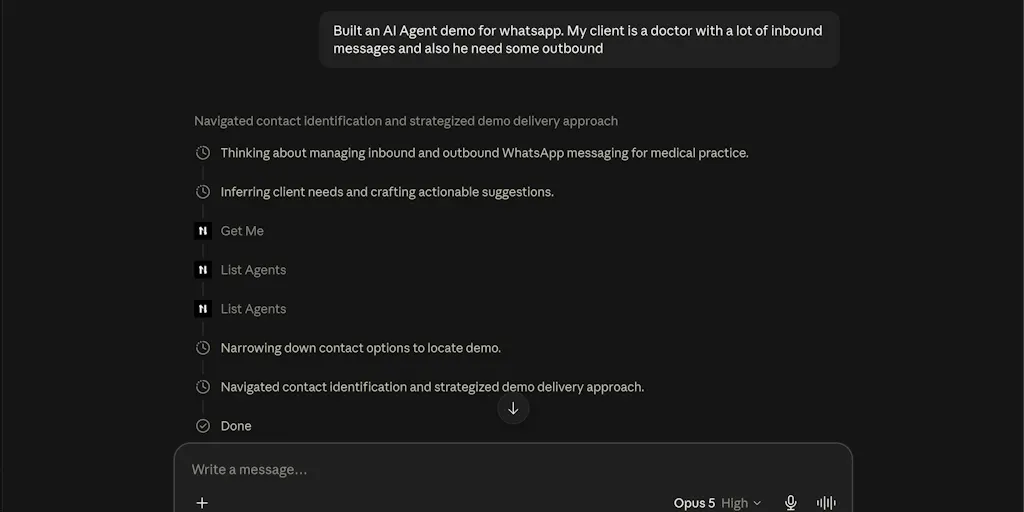
For a cross-border operator, this reframing matters. Most SaaS tools give you a dashboard and call it a day. You’re expected to figure out the workflows, the edge cases, and the tone of voice yourself. Ninjō is betting that the accumulated intelligence — the stuff that took them 1.9 million conversations to learn — is the moat. Open Claude, Claude Code, Codex, or ChatGPT, and you can tell it to “build me an agent for my client’s launch — qualify fast and send the payment link,” and it ships, connected to real DMs, verified, and reversible.
How It Actually Differs from the Incumbents
The comparison that matters here isn’t to generic chatbot platforms like Intercom or Zendesk. It’s to the new wave of AI sales development representatives (SDRs) and the older playbook of chat automation. Tools like HubSpot’s ChatSpot or Drift have been doing conversational marketing for years, but they’re built around website chat widgets and lead capture forms. They assume the customer is on your site, filling out a form, and willing to talk to a bot in a browser tab. That’s a very different environment from Instagram DMs or WhatsApp threads, where the conversation is personal, asynchronous, and already happening on the customer’s turf.
Ninjō’s approach is channel-native. It lives where the customer already is. The agency client running product launches over WhatsApp is a perfect example: in one 4-day launch, a single agent handled 839 conversations and closed $65K in sales. But the part that should make every seller sit up is the payment recovery. The agent chased declined payments one by one in the chat and recovered 47 of them. For anyone who’s run a flash sale or a limited drop, you know the pain of a customer who wants to buy but whose card gets declined — and then just gives up. A human team physically cannot keep up with that volume inside a launch window, but an agent can.
The other difference is the “boring” use case that most clients actually run: ads → DM → high-ticket call. Paid ads push straight into Instagram or WhatsApp DMs, the agent qualifies the lead and books the call, and a human closes. One client sits at 200+ booked calls a month, every month, generating roughly $200K. This is the pattern that compounds. It’s not a launch spike; it’s a recurring revenue machine. For DTC brands selling high-ticket items — furniture, premium electronics, specialized gear — this could replace a significant chunk of your paid media inefficiency.
Why Amazon Sellers Should Care More Than Shopify Ones
Here’s a contrarian take: most of the buzz around AI agents is aimed at Shopify store owners running branded DTC funnels. But the operators who should be paying closest attention are Amazon FBA sellers who think they don’t “do” DMs. You absolutely do — you just don’t control the channel. Amazon’s Buyer-Seller Messaging is a constrained, policy-heavy environment, but it’s still a conversation layer. If an agent can recover declined payments on WhatsApp, it can nudge a buyer who left a question on a listing. The same infrastructure that qualifies a high-ticket lead on Instagram can handle post-purchase follow-up, review requests, and even the dreaded “where is my package” flood that eats your VA’s day.
The catch is compliance. Amazon monitors every message, and you can’t have an agent firing off unapproved responses. But the playbook — the accumulated intelligence about what to say, when to say it, and how to escalate — is transferable. The tooling might be built for open channels, but the methodology is channel-agnostic. If Ninjō or a competitor builds a compliant version for marketplace messaging, that’s the moment Amazon sellers should stop ignoring this category.
What Cross-Border Sellers Can Steal From This Playbook
You don’t need to buy Ninjō to benefit from what they’ve learned. The case studies they published are a masterclass in where conversational AI actually creates margin. Here’s what I’d extract:
1. The declined payment recovery loop. This is the sleeper hit. Most sellers treat a declined card as a lost sale. Ninjō’s agent treated it as a conversation to continue. It chased each declined payment individually, in the chat, and recovered 47. That’s not a feature; it’s a mindset shift. For cross-border sellers, where payment failures are significantly higher due to bank fraud filters and currency issues, this alone could recover 3-5% of revenue.
2. The qualification-first approach. The agent isn’t trying to close in the DM. It’s qualifying and booking a call. That’s a critical distinction. For high-ticket items, the DM is the filter, not the finish line. The most repeatable use case — ads → DM → booked call → human closes — is exactly how you should structure your own sales funnel if you’re selling anything above $200.
3. The “send a license plate and get a real quote” interaction. The insurance broker example is the most exciting one because it’s not a sales pitch; it’s a utility. The agent pulls live quotes from 6 carriers, 29 options across 5 tiers, right inside the chat. No form, no link, no redirect. For cross-border sellers, imagine a customer in Germany asking about import duties and delivery time — and getting a real, calculated answer in the conversation instead of a link to a shipping policy page. That’s the difference between a chatbot and a sales agent.
Where the Math Breaks
The numbers Ninjō published are impressive, but let’s stress-test them. The $750K+ in sales generated and 1.9 million conversations handled are real production numbers, but they’re spread across 45+ clients and 150+ agents. That’s roughly $16K per client in generated sales. For a creator or coach selling high-ticket offers, that’s meaningful. For a cross-border e-commerce brand moving thousands of units at $30 AOV, that math doesn’t translate directly.
The economics also depend on the channel. Instagram and WhatsApp DMs are high-intent, low-friction channels. The buyer has already seen the ad, already clicked, and already typed a message. That’s a warm lead. The agent isn’t creating demand; it’s converting existing demand more efficiently. If you’re running cold traffic on TikTok Shop or Etsy, where the buyer’s intent is different, the agent’s effectiveness will drop.
And there’s the AI-slop fatigue question, which a commenter raised directly — people are getting sick of obvious AI patterns. Cappucci’s response is telling: the problem is mass-produced content nobody asked for, while their agents work 1:1 in DMs where the person already raised their hand. That’s a fair distinction, but it puts a huge burden on the agent’s ability to sound human. If it fails, it doesn’t just lose a sale; it damages the brand.
The MCP Bet and What It Means for Your Tooling Stack
The most strategic move here isn’t the agent itself — it’s the decision to expose everything through an MCP server. For the uninitiated, MCP (Model Context Protocol) is the emerging standard that lets AI models access external tools and data. By building their entire operation on Claude Code and then exposing it via MCP, Ninjō is betting that the future isn’t a standalone SaaS dashboard but an infrastructure layer that any AI assistant can plug into.
This is where cross-border sellers should pay attention. Your tooling stack is already a Frankenstein of Shopify, Amazon Seller Central, Helium 10, Klaviyo, and a dozen other point solutions. The promise of MCP is that your AI assistant — whether it’s Claude, ChatGPT, or something else — can orchestrate all of them from a single conversation. “Check inventory, adjust the ad budget, and reply to this customer’s DM” becomes one command, not three separate logins.
Ninjō’s bet is that the dashboard is dead. The future is a chat interface that can see everything and act on everything. For a DTC operator juggling TikTok Shop and Etsy alongside Amazon and your own store, that’s an appealing vision. Whether Ninjō is the company that delivers it is less important than the direction it signals.
Why the “Human-Like” Claim Is the Hardest Part
Cappucci says their agents “read as human” and that they’ve invested heavily in solving that problem because they started with creators, where the agent had to represent an actual person. That’s a high bar. A creator’s audience knows their voice, their humor, their quirks. An agent that sounds like a generic sales bot will get called out instantly. The fact that they’ve been running 150+ agents in production for two years suggests they’ve iterated on this more than most.
But here’s my skepticism: “reads as human” is a moving target. As AI-generated content becomes more prevalent, people’s tolerance for AI patterns drops. What sounded human six months ago now feels robotic. The bar keeps rising, and maintaining that illusion at scale — across different languages, cultures, and communication styles — is a perpetual arms race. For cross-border sellers, this is doubly hard because you’re not just mimicking a brand voice; you’re navigating cultural nuances in multiple languages.
What I’d Watch / Test Next
If you’re a cross-border operator and this category interests you, here’s what I’d do this week:
Run a controlled test on payment recovery. Pick your highest-velocity product and your most common payment failure reason. Set up a manual or semi-automated process to follow up with declined-payment customers via email or DM within 24 hours. Measure the recovery rate. If it’s above 3%, invest in a tool that automates it. Ninjō’s free 1,000 messages with code PRODUCTHUNT is a low-risk way to test their agent on a real campaign.
Map your DM-to-sale funnel. If you’re running ads on Instagram or TikTok that drive DMs, audit how those conversations are handled today. Are they answered within an hour? Do they qualify leads or just answer questions? If you’re losing leads to slow response times, an agent that books calls while you sleep is worth the experiment.
Watch the MCP ecosystem, not just Ninjō. The specific product is less important than the protocol. If MCP becomes the standard way AI assistants interact with your e-commerce stack, the tools that expose their data and actions via MCP will win. Start asking your SaaS vendors — Shopify, Klaviyo, Helium 10 — about their MCP roadmap. The ones that drag their feet will become the next legacy software.
The DM layer is the last unautomated frontier in e-commerce. We’ve automated the storefront, the checkout, and the email follow-up. But the conversation where buyers actually decide — that’s still a human job. Ninjō is one of the first products I’ve seen that treats it as infrastructure, not a chatbot. Whether they nail the human-likeness problem at scale remains to be seen. But the direction is right, and the economics are compelling enough to test.