The biggest margin leak in cross-border e-commerce rarely shows up on a P&L statement. It sits in your phone: a contact list full of people you met once at a trade show, or in the week a shipment went sideways, or on an onboarding call you can no longer reconstruct. Persodex — a small iOS contacts app from a solo maker named Alexander Kaiser — has no repricer, no ads module, no logistics dashboard. That’s exactly why it deserves a senior operator’s attention. It treats “I saved this person but forgot why” as a design failure, not a memory problem. Cross-border sellers run on relationships brokered across messaging apps, trade-show hallways, and buried email threads, and most of the context around those relationships evaporates by peak season. The product is beside the point. The philosophy behind it is the whole point.
The “Tom Berlin” problem is your supplier list
The launch thread opens with a confession prompt: What’s the worst contact in your phone?. The maker’s own answer is a contact named Tom Berlin: “We probably met at a conference. Maybe at the airport. I kept his number because I thought I’d remember. I didn’t.”
Every cross-border seller has a Tom Berlin, usually several. There’s the factory owner you met at a trade-fair booth and saved as “Lily — Dongguan.” There’s the freight forwarder you added in a hurry the night a container got stuck at port, filed under a first name and nothing else. There’s the TikTok Shop category manager whose comments once saved your account health, now indistinguishable from a spam contact. Each of those entries is a margin point. And the cost of losing their context isn’t embarrassment — it’s renegotiating from zero, with a counterpart who remembers the terms you forgot.
That’s the problem Kaiser says he built Persodex to solve. He’s been self-employed for over 15 years, and over time his address book became “little more than a list of names.” He could usually remember who someone was, but not where they’d met, what they’d talked about, which company the person worked for at the time, or why the number was saved in the first place. The important context, he says, was scattered “across notes, messages, Instagram, and my own memory.”
Now superimpose the cross-border operation onto that confession. Your phone book isn’t a phone book; it’s a book of business. WeChat and WhatsApp hold supplier negotiation history. Your inbox holds the follow-ups where pricing actually settled. Your memory holds the tone of the relationship — which vendor gave ground easily, which QC agent is forgiving, which account manager is two weeks from quitting. When that context dies, margin dies with it.
The reason this is a design problem rather than a personal failing is that the “personal CRM” category already failed at it. Kaiser says he tried several, and they all felt like business software: “Too many fields. Too many features. And almost all of them wanted me to move my contacts into their own system.” That line should land hard on anyone who has watched a free-trial CRM become a part-time data-entry job. The promise of pipeline visibility turns into unpaid labor, and the database dies as soon as the discipline does.
That’s what makes Persodex worth a close read. Not because it’s e-commerce tooling — it isn’t. But because it is a contrarian answer to the question every seller keeps getting wrong: where should relationship data actually live?
The no-lock-in architecture is the product
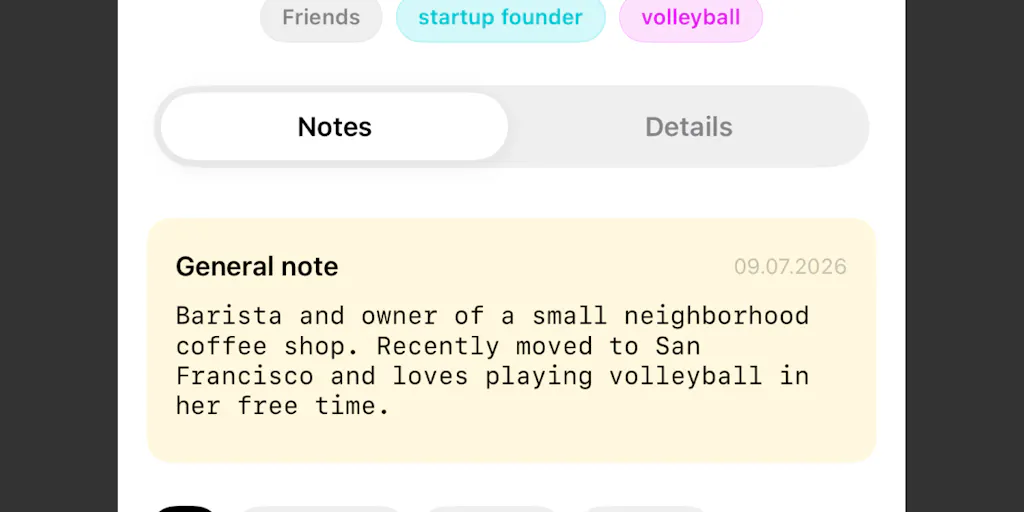
The real product is not the interface. It’s the data architecture. Persodex works directly with the native iOS address book. Notes are stored in the existing notes field, tags are saved as native contact groups, and the data remains accessible even without Persodex installed. Kaiser’s stated principle: “I did not want to create another platform people would feel locked into.”
To appreciate how contrarian that is, look at the tools competing for the same job. Clay and its AI-enrichment peers are superb products. They also want to become the system of record for your relationships. You import your contacts, accept their data model, connect an enrichment workflow — and then you live inside their database. You can export the rows, but you can’t export the context, because the context was built inside their fields and their automations.
Persodex makes the opposite bet: Apple’s contacts database is the system of record. iCloud syncs it. Any phone app can read it. Cancel Persodex and your notes, groups, and tags remain exactly where they were — because they were never Persodex’s to begin with. That’s a kill-switch guarantee delivered through architecture, not through a trust page. It’s the difference between a tool that says “we’ll export your data on request” and a tool that physically cannot hold it hostage.
The analogy sellers will recognize immediately: it’s the difference between building a brand “on” a marketplace and building “around” one. The first is a lease. The second is an asset. Persodex treats relationship data the second way.
Why Amazon sellers should care more than Shopify ones
This pain is not uniform across the industry. A Shopify DTC brand runs on systems — the customer list sits in the email platform, ads live in the ad account, agencies work in project-management tools. Losing contact context there costs a few follow-ups.
An Amazon Seller Central operation runs on ministries. Vendor managers, SCOT contacts, account-health specialists, IP attorneys, and reinstatement agents rotate through your business like officials rotating through a government. The person who hinted at the exact structure of a Plan of Action that would get your listing restored, or the rep who knew why a reimbursement claim kept bouncing, is a contact whose value is defined entirely by context: which ASIN, which case ID, which promise. If that context sits in a phone entry labeled “Sarah (amz),” you’re one job change away from starting the appeal from zero.
That’s why Persodex’s philosophy matters more to Amazon sellers than to Shopify brands. It makes the contact entry itself the institutional memory — no separate CRM for a contractor to forget to update. And “tags as native contact groups” is exactly the lightweight segmentation an Amazon operator needs: one group for account-health reps, one for freight forwarders, one for compliance brokers. You don’t need a pipeline. You need a labeled memory that outlives the account manager.
What a cross-border operator should actually copy
I’m not recommending the app as the purchase. The iOS-only footprint alone excludes anyone running a team on Android or shared work phones. Copy the principles instead, because they transfer for free.
First: native beats platform. The most durable tool in your stack is the one that modifies a system you already depend on. For sellers, this means favoring tools that write into your existing operating reality — your marketplace, your email provider, your accounting software — over tools that ask you to move your world into theirs. When a salesperson says “you’ll need to migrate your data,” what they actually mean is “you’ll need to invest enough that leaving becomes painful.”
Second: privacy is a strategy, not a policy. Kaiser says privacy has always been extremely important to him — “perhaps that’s just my German side ;)” — and he refused to build an in-app mail reader because it didn’t feel right for user privacy. For a cross-border operator, your supplier list, unit costs, and landed-cost math are the crown jewels. The moment you dump them into a free “AI sourcing” platform, you’ve turned your margin into someone else’s training data. Paying for software that wants less of your data is not a cost. It’s a moat.
Third: tags as groups is the cheapest segmentation system you already own. Persodex maps tags to native contact groups, so segmentation lives in the operating system, not inside an app. You have the same mechanic in WeChat labels, email labels, and marketplace tags. Most sellers don’t need another CRM to tier suppliers. They need three groups — “core,” “scalable backup,” “never again” — and the discipline to move one contact when the relationship changes. The tool was never the bottleneck. The habit was.
The kill-switch test for every SaaS you buy
Here’s the filter to steal from Persodex’s architecture. Before you subscribe to any new piece of e-commerce software — a repricer, a review-management suite, an AI sourcing assistant, a multi-channel planner — ask: if this company dies tomorrow, or I cancel today, what do I actually keep?
The most common honest answer is “a CSV with the relationships stripped out.” Persodex’s answer is: everything. The contacts, the notes, the group membership — all of it lives in a schema owned by the operating system. The app is an interface, not a landlord. If a tool can’t pass the kill-switch test on your own data, you’re not buying software. You’re renting a database with extra steps.
Where the math breaks
Now the part senior operators actually need: the ceiling.
As launched, Persodex has no auto-enrichment. When a commenter — clearly burned by abandoned personal CRMs — asks whether context enriches itself from where you interact with someone, Kaiser is admirably direct: “right now, you have to feed it.” He explains that Apple doesn’t allow reading from mail.app or messages.app without a Mac companion, and that he deliberately avoided hooking into mail accounts because it didn’t feel right on privacy grounds.
Respect the honesty. But check the math: the problem Persodex set out to solve was context scattered “across notes, messages, Instagram, and my own memory.” Native notes fix the notes-and-memory slice. They do nothing for messages or Instagram — and for an e-commerce operator, that’s where the money talks. A supplier’s last message about a price adjustment is the context. The QC agent’s voice note is the context. A hand-typed notes field is a reminder, not a system. If you have to feed it by hand, it will go stale by September.
The most accurate comment on the page belongs to Artem Fedorovich: “Personal CRMs never stick for me because of upkeep, contacts go stale the second I stop manually tagging. That’s usually the line between a tool I keep and one I drop in a month.” That’s the obituary for every hand-fed system ever sold to merchants — and the same reason the supplier spreadsheet dies every March.
The product’s honesty is also its glass ceiling. It asks you to maintain the exact thing the entire CRM industry is trying to automate away. Its defense is that the data stays native and portable, so walking away costs nothing. A fair trade for a solo operator with fifty meaningful contacts. For a supplier base of five thousand relationships across a ten-person team, it isn’t a system — it’s a diary.
And the no-lock-in promise has a seam. A commenter with real Contacts-framework experience asks whether group membership shows up empty or duplicated on a second device right after an iCloud sync, since groups sync separately from contact records. The maker’s answer: the app creates groups and tags within the contacts database itself, so it doesn’t have those issues. Plausible. But “works on my machine” is a launch-day story, not a vendor certification. Before betting real relationship data on a workaround for platform sync behavior, test it with two devices, a team, and a month of actual use.
The upkeep tax decides which tools you still use
Zoom out and the lesson is about the upkeep tax. Every cross-border operator I know has a graveyard of abandoned SaaS subscriptions — a keyword tool, a repricer, a feedback-software license — bought with good intentions and killed by the cost of feeding the data. Persodex is unusual because it admits the tax exists. No auto-enrichment, no slick automations, just a native container you maintain yourself. That honesty makes it a good product. It also makes it a small one. Tools that require manual feeding are habits, and habits don’t survive peak season. If your supplier-context system needs daily manual effort, it isn’t a system yet.
What I’d watch / test next
Start with the audit. Scroll your phone for the contact that is a name and nothing else. If it’s a supplier or an account manager, write one honest note in the native notes field: date, company, role, and one fact that changes the next negotiation — “promised 18-day lead time; net-30 above 5,000 units; QC via third-party inspection.” No new software. You’ve just implemented the only part of Persodex’s philosophy that transfers everywhere.
Then run the kill-switch test on your next SaaS purchase. Ask what survives a cancellation. If the export is a spreadsheet with the relationships missing, walk away.
If you’re a solo operator on iOS, Persodex is worth a test — the maker’s launch comment offers 25% off the Lifetime plan. But test the exit as hard as the entry: add a note, create a tag group, uninstall, and see what actually survives.
And watch for the Mac companion. The maker named it as the missing piece for auto-enrichment. If it ships, the upkeep tax shrinks and the product becomes a real relationship-infrastructure bet. Until then, treat it as a reminder to the whole industry: context is not a feature you buy. It’s a discipline you practice.