The Verification Layer Is Coming for Your Product Research Stack
Cross-border sellers have spent the last two years bolting generative AI onto every step of the workflow — listing copy, ad angles, supplier emails, review mining — and most of it works fine right up until it doesn’t. The failure mode is always the same: the model produces something plausible, you ship it, and the error surfaces three weeks later in a returns spike or an Amazon policy violation. So when a tool shows up whose entire pitch is “every claim is checked against the source, and you can see the exact supporting quote behind each value,” I pay attention — not because I need a systematic review tool, but because that architecture is exactly what’s missing from the AI layer in e-commerce. That’s the lens I read Curie through when it landed on Product Hunt, and it’s the lens I’d suggest you use too.
What Curie Actually Does, Stripped of the Science Packaging
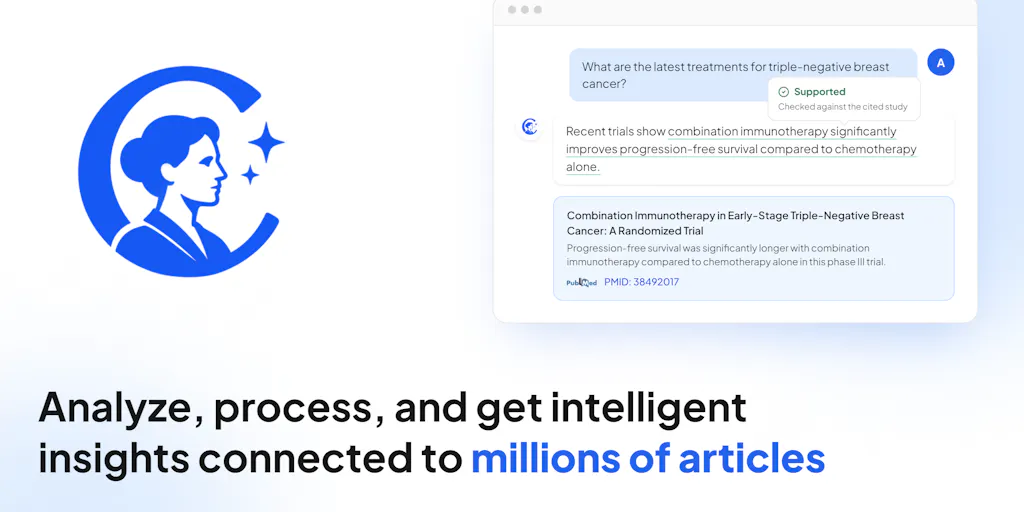
Curie is a research tool built by solo developer Víctor Madarnás, developed over more than a year in collaboration with the University of Barcelona and research institutions across Europe, and opened to the public in September. On the surface it’s a scientific literature tool: you point it at a research question, it searches across multiple scientific databases simultaneously, and it returns answers where each claim is traced back to its source text.
The maker’s origin story, told in his own launch comment, is the part worth stealing. He was embedded with Biost3, a bioinformatics and statistics research team, and watched researchers burn their days on dense paper review. The diagnosis he landed on: the problem wasn’t finding papers, it was holding entire articles in your head at once — cognitive overload — compounded by the fact that generic AI gives you plausible hallucinations instead of verified answers. His framing of the gap is precise: “Most tools aren’t even connected to actual scientific literature, but research demands rigorous biological interpretations grounded in peer-reviewed evidence.”
So Curie does three things beyond search:
- Claim-level verification. Every claim in an answer is checked against the source text, and you can see the exact supporting quote — or, critically, that there isn’t one.
- Structured data extraction. It pulls structured values out of papers with the quote behind every value, so a number is never orphaned from its context.
- Full systematic reviews. Protocol, screening, PRISMA workflow, with the human approving each decision rather than the model deciding autonomously.
That third one is the tell. This is not a chatbot with a search plugin. It’s a workflow tool that assumes a human is accountable for the output and builds the audit trail around that assumption.
Why the “show me the quote or admit there isn’t one” design is the whole product
Most AI tools in the seller stack optimize for fluency. Curie optimizes for falsifiability. The distinction matters enormously when you’re making decisions with money attached. A listing generator that invents a certification your supplier doesn’t have is a liability. A keyword tool that hallucinates search volume is a budget leak. The moment a tool is willing to say “there is no supporting quote for this claim,” it becomes something you can actually delegate to — because you know its failure mode is visible rather than silent.
How It Stacks Up Against What You’re Probably Already Using
The obvious competitor question came up in the launch thread, and it’s the right one. Richard Kaplan asked directly how Curie compares to Consensus and Consensus MCP. The maker’s answer is refreshingly narrow rather than defensive: “Consensus is a strong pick, but if you need to trust and reuse what comes back, that’s where Curie is aimed.” He positions Curie as “more about what happens after the search.”
That’s a real distinction and it maps cleanly onto the e-commerce tool landscape.
| Layer | Science equivalent | E-commerce equivalent | What it’s good at | Where it breaks |
|---|---|---|---|---|
| Search / retrieval | Consensus, Google Scholar | Helium 10, Jungle Scout | Finding candidates | No verification of downstream claims |
| Generation | Generic LLMs | ChatGPT, Jasper | Speed, volume | Confident fabrication |
| Verification + audit | Curie | largely unfilled | Trusting and reusing output | Narrow scope, manual approval overhead |
Look at that bottom row. In the Amazon and Shopify tool stack, the verification layer is basically empty. Helium 10 and Jungle Scout tell you what keywords exist and roughly how they perform, but they don’t trace a claim back to evidence. Your copywriting tools generate, they don’t verify. Your review-analysis tools summarize, they don’t cite. Curie’s contribution isn’t the science — it’s the demonstration that “verified against source, with the quote attached” is a viable product architecture, not a research paper.
Why Amazon sellers should care more than Shopify ones
Shopify operators have more margin for creative latitude. If your DTC landing page copy is a little loose with a benefit claim, you eat a refund and move on. Amazon sellers live under a different regime entirely. Listing claims get policed. Compliance language around supplements, cosmetics, and anything touching health gets scrutinized. A single unsupported claim in a bullet point can mean a suppressed listing, and a suppressed listing is not a marketing problem, it’s a cash-flow problem.
Now think about how most Amazon sellers currently generate listing copy: paste your competitor’s reviews and your supplier’s spec sheet into a general-purpose model, ask for bullets, ship it. The model has no obligation to distinguish between what your supplier claimed and what’s true, and no mechanism to show you the difference. A Curie-style workflow — where every extracted spec carries the quote it came from, and where a missing quote is flagged rather than smoothed over — is worth more to an Amazon operator than a Shopify one, because the downside of an unverified claim is asymmetric.
Where the math breaks: Curie’s manual-approval design is a feature in science and a tax in e-commerce. If you’re approving every extracted value across a 500-SKU catalog, you’ve just built yourself a data-entry job. The architecture only pays off when the stakes per claim are high enough to justify the human in the loop.
What Cross-Border Sellers Should Actually Borrow From This
I don’t think most sellers should go sign up for a scientific literature tool. I do think three things in Curie’s design are directly portable to how you run your stack.
1. Demand source-traceability from every AI tool you pay for. When you evaluate a listing optimizer, a review analyzer, or a supplier-vetting tool, ask the same question the maker built Curie around: can it show me the exact source behind each claim, and will it tell me when there’s no source? If the answer is “it just generates,” you’re buying fluency, not accuracy. That’s fine for a first draft and dangerous as a final one.
2. Build the verification step into your supplier and product research, not just your copy. The cognitive-overload diagnosis applies directly to product research. A serious product-research session means holding supplier quotes, review complaints, competitor pricing, freight estimates, and margin math in your head simultaneously — which is exactly the overload Curie was built to relieve. Structured extraction with a quote behind every value is a better mental model for your sourcing spreadsheet than a wall of pasted notes.
3. Treat “there isn’t one” as a first-class output. This is the most underrated idea in the whole launch. Every tool in your stack defaults to producing something. A tool that’s willing to return “no supporting evidence found” is telling you where to look. In supplier vetting, that’s the difference between “the factory says it’s BSCI audited” and “the factory says it’s BSCI audited and here’s the certificate number you can verify.” One of those is a claim. The other is evidence.
The tooling-stack angle: where this fits alongside Klaviyo, Shopify, and the rest
If you run a real stack — Shopify for storefront, Klaviyo for retention, Amazon Seller Central for marketplace, a TikTok Shop or Temu channel for volume — you already have generation tools layered on top of each. What you don’t have is a verification layer sitting between generation and publication. Curie is a proof of concept that such a layer can exist as a standalone product. My bet is that within a year, the tools you already pay for will start shipping citation features, because the market is about to stop rewarding confident output and start rewarding accountable output.
Where My Judgment Says It Falls Short
I’ll be direct about the gaps, because the launch thread only surfaced one of them.
Scope is narrow by design. Curie is built for peer-reviewed scientific literature. That’s a defensible beachhead, but it means the tool is useless to a seller out of the box. The transferable value is the architecture, not the product. Anyone who reads this launch and thinks “great, I’ll use this for product research” is going to be disappointed — it won’t index supplier databases, review platforms, or marketplace data.
The manual-approval model doesn’t scale to commerce volume. Full systematic reviews with human approval of each decision is correct for science, where a single review might inform a paper. It’s wrong for a 2,000-SKU catalog where you need throughput. The design trades speed for trust, and most sellers need the opposite trade most of the time.
Pricing and commercial terms aren’t disclosed in the launch material, so I can’t tell you whether the economics work for an operator use case. That’s a real gap for anyone evaluating it as a template rather than a purchase.
The “likely AI” comment problem. One of the early replies on the launch — from Audrey T — carries a “Likely AI” tag. I’m not going to litigate whether that’s fair, but it’s worth noting that a product whose entire pitch is verified human-accountable output launched into a comment section where the engagement itself was flagged as possibly synthetic. The irony is instructive: verification is hard, and even the platforms hosting the conversation struggle with it. That’s not a knock on Curie. It’s a reminder that the trust problem is bigger than any single tool.
What I’d Watch / Test Next
Three concrete moves for this week.
First, audit one AI tool in your stack for traceability. Pick the one you rely on most for decisions with money attached — probably your keyword tool or your listing generator — and run a test: ask it for a specific claim and see whether it can show you the source. If it can’t, you now know exactly where your silent-failure risk lives.
Second, add a “source” column to your product-research spreadsheet. For every spec, price, or supplier claim you record, note where it came from and whether you can point to the document. This is a zero-cost version of what Curie does, and it will immediately expose which of your assumptions are actually evidence.
Third, watch whether the incumbents ship citations. If Helium 10, Jungle Scout, or the copywriting tools start adding source-traceability features in the next two quarters, that confirms the thesis: verification is becoming table stakes. If they don’t, the opening stays wide for a founder who ports Curie’s architecture to the seller stack. Either way, the direction of travel is clear — the next competitive edge in cross-border tooling isn’t generating more, it’s proving what you generated is real.


