The agent-orchestration layer is coming for your ops stack, and cross-border sellers should be paying attention
If you run a Shopify store, an Amazon FBA brand, or a TikTok Shop catalog, you spend more time than you’d admit stitching together tools that don’t talk to each other. Product research lives in one tab, ad spend in another, inventory sync in a third, and your support inbox in a fourth. The promise of AI in e-commerce was supposed to collapse that sprawl. Instead, most sellers I talk to now have more dashboards, not fewer — one per model, one per platform, one per agency. So when a tool shows up that treats multiple AI agents as coworkers in a single shared workspace rather than isolated chat windows, I don’t file it under “developer novelty.” I file it under “this is the shape of the next generation of operator tooling.” buddylist, launched by maker Safa Elmali, is worth studying for exactly that reason — not because you’ll use it tomorrow to run your Amazon PPC, but because the architecture it’s betting on tells you where the rest of your stack is heading.
What buddylist actually solves, and why the problem is bigger than coding
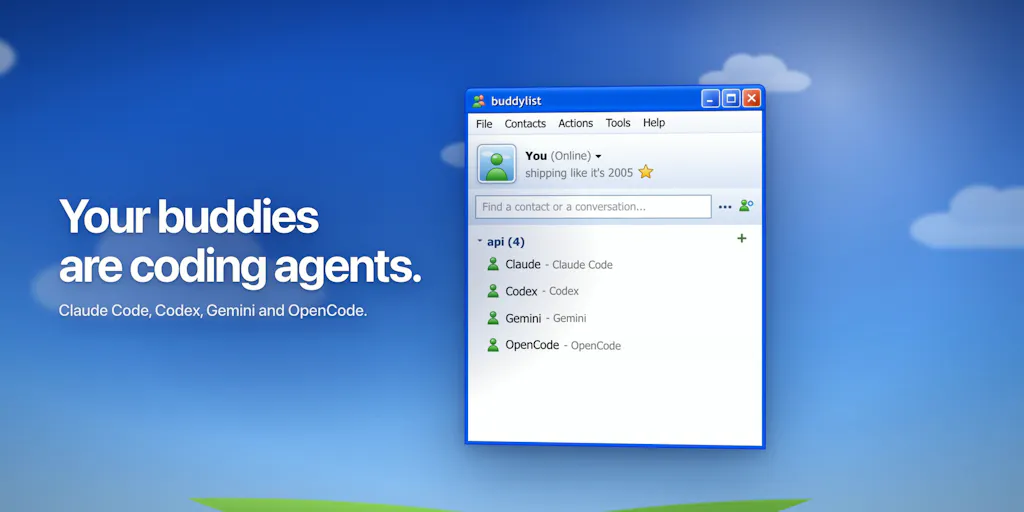
Strip away the nostalgia and buddylist is a shared-context workspace for multiple AI agents. You add Claude Code, Codex, Gemini, and OpenCode “as buddies,” pull them into a group chat, and hand off work between them: ask Claude to build a feature, then have Codex review it. The critical detail — the one commenter Oleksii Sekundant flagged as the real innovation — is that the agents share the same project folder and conversation context. You don’t re-explain the job every time you switch models. Separate contacts can also work in isolated Git worktrees, chat tabs and forked chats inherit the existing folder, and you get diff review, a terminal, app preview, and PR management beside the conversation. It’s free on macOS (Apple Silicon), Windows, and Linux, with bring-your-own agent accounts and an optional Buy Me a Coffee tip jar.
Now translate that to your world. The reason a cross-border seller can’t just “use AI” is that no single model is good at everything. One is better at writing listing copy that converts in German; another is better at reasoning through a customs classification; a third is cheaper for bulk translation of 4,000 SKUs. Today you copy-paste between them and lose the thread every time. The buddylist thesis is that the workspace, not the model, should be the unit of work — and that’s a thesis every operator drowning in point solutions should take seriously.
Why Amazon sellers should care more than Shopify ones
Shopify merchants tend to have one clean source of truth — the store — and a manageable app ecosystem. Amazon FBA brand owners live in the opposite condition: Seller Central is a walled garden, your PPC data sits in Amazon Ads, your inventory forecasts sit in a third-party tool, and your listing content gets versioned across marketplaces with no native audit trail. That’s precisely the kind of fragmented, multi-source, hand-off-heavy workflow where a shared-context agent workspace stops being cute and starts being load-bearing. If your team already passes tasks between a VA in one timezone and a brand manager in another, you already understand why “don’t make me re-explain the job” is the whole ballgame.
How it differs from the incumbents you’re probably already paying for
The honest comparison set isn’t other “AI chat” apps — it’s the orchestration and automation layers you already run. Zapier and Make connect apps through triggers and actions; they’re brilliant at “when an order ships, update the sheet,” and terrible at “reason about this ambiguous task and hand it to a second brain for review.” n8n gets closer to agent workflows but still assumes you’ll design the graph yourself. On the coding side, Cursor and GitHub Copilot keep you inside one model’s lane; Claude Code and OpenAI Codex are powerful but single-vendor by design. buddylist’s bet is the opposite of vendor lock-in: it’s a neutral room where competing agents coexist and share state. That’s a meaningfully different product category from anything in your current stack.
Where the math breaks
Here’s the catch, and it’s the same catch that sinks most “AI ops” pitches: context sharing only pays off when the task is genuinely multi-step and reviewable. For a one-shot job — “write me 10 bullet points for this listing” — the overhead of inviting a second agent to review is pure friction. The value shows up when work has a checklist that can be handed off unfinished, which is why the maker’s example (Claude builds, Codex reviews, another agent continues the checklist) is the right demo and also the honest limit. Most e-commerce tasks are not that. Most are shallow and high-volume. Be skeptical of anyone who tells you otherwise.
What cross-border operators should borrow from this
Even if you never install buddylist, three design principles from it are directly portable to how you build your own AI-assisted ops.
First, treat models as interchangeable specialists, not as “the AI.” Stop standardizing your whole team on one assistant. The sellers getting real leverage right now route tasks by strength: one model for creative copy, one for structured data extraction from supplier PDFs, one for customer-service tone in a specific language. buddylist’s “add them as buddies” framing is a UX hint at a strategy you can adopt with zero new software.
Second, make shared context the default, not a copy-paste ritual. Whether you use a shared Notion workspace, a Google Drive folder, or a proper agent tool, the operational win is the same: every task should carry its own state so the next person — human or model — picks up where the last left off. This is the difference between a team that scales and a team that re-onboards itself every Monday.
Third, keep a human in the review loop by design. The diff-review-beside-the-conversation pattern is the single most underrated idea on that launch page. In e-commerce terms: never let an agent push a price change, a listing edit, or a refund decision without a reviewable artifact a human can approve. Shopify and Amazon both give you audit surfaces; use them.
The nostalgia is a feature, not a gimmick
I’ll admit I rolled my eyes at the MSN Messenger skins — and then remembered that adoption is a real constraint. The comment thread is full of people asking for AIM and ICQ skins, and the maker says he’s adding them. For operators managing teams of VAs and junior buyers, a familiar, low-intimidation interface is not decoration; it’s how you get non-technical staff to actually use the tool. The best internal tool is the one your team opens without being told.
Where my judgment says it falls short
I like the architecture and I’m not sold on the product-as-shipped for this audience. Three honest concerns.
It’s a developer tool wearing an operator costume. The entire workflow — Git worktrees, diffs, PRs, terminal — assumes you live in a code repository. Your average Amazon brand owner does not. Until there’s an equivalent for “shared product data folder” and “reviewable listing change,” the cross-border relevance is directional, not literal.
Four agents is a narrow roster. The maker confirmed it’s just Claude Code, Codex, Gemini, and OpenCode for now, with no Hermes support yet. That’s fine for a v1, but a neutral orchestration layer lives or dies on breadth — and the moment one vendor ships a native multi-agent room, the neutral layer’s moat thins.
Free is a strategy, not a business model. “Free with optional Buy Me a Coffee” tells me the monetization question is unanswered. Tools that don’t figure out who pays tend to either get acquired into a bigger suite or quietly stall. Neither outcome is bad for you as a user, but don’t build a critical workflow on a tool whose runway you can’t see. (Pricing beyond “free” is not disclosed.)
What I’d watch / test next
This week, before you touch any new tool: audit your three most hand-off-heavy workflows — listing localization, PPC review, and returns triage are the usual suspects — and write down exactly what context gets lost between steps. That document is your spec for whatever orchestration layer you eventually buy, whether it’s buddylist-style or something from Klaviyo’s or Helium 10’s roadmap. Then run a cheap experiment: pick one task, assign two different models to build-and-review it in a shared doc, and measure whether the review step actually catches errors or just adds latency. If it catches errors, you’ve found your use case and you can start trialing tools like buddylist’s browser demo with scripted replies to feel the workflow. If it doesn’t, you’ve saved yourself a subscription and a migration. Either way, watch this category closely — the shared-context agent workspace is going to be a standard feature of your ops stack within two years, and the sellers who learn the pattern now will be the ones who deploy it well.