Why a Desktop Voice Studio Actually Matters for Cross-Border Sellers
Every cross-border operator I know has hit the same wall: you need voiceover for a TikTok Shop ad, a product demo video, or a YouTube tutorial, and the moment you open ElevenLabs or a similar cloud tool, you start watching a meter tick up. Every retake of a sentence costs you credits. Every tweak to pacing or pronunciation feels like you’re burning money on a preview. That’s not a tooling problem; it’s a pricing model problem that quietly shapes creative decisions. When regeneration costs money, you stop experimenting, and your ads sound like every other faceless brand. That’s why Vois, a desktop text-to-speech studio with unlimited generation on a flat subscription, deserves more than a passing glance from anyone running a serious content operation — especially if you’re producing multilingual assets for multiple marketplaces and need to iterate fast without a finance team approving every audio render.
The “Preview Tax” Is Killing Your Creative Testing
Let me name the pain precisely, because it’s the core of why Vois exists. The maker, Praney Behl, calls it the “preview tax” — the cost you pay every time you regenerate a paragraph just to hear how a small edit sounds. In a cloud tool like ElevenLabs, that tax is literal: per-character billing means every retake of the same line costs money again. For a seller producing a 60-second TikTok Shop ad in three languages, that’s not a rounding error. It’s the difference between testing five variations of a hook and settling for the first take because the meter is climbing.
Here’s the math that breaks: if you’re paying per character and you need to iterate on a 300-word script, each retake is a new charge. Most operators I know don’t actually count this because it’s spread across dozens of small charges, but it adds up to real money — and more importantly, it changes behavior. You stop trying a different voice, a slower pace, or a different emphasis because each attempt feels like a gamble. The result is content that’s “good enough” but never great. Vois’s answer is a subscription model where generation is unlimited. Retake a paragraph fifty times and your bill does not move. That’s not a feature; that’s a workflow unlock.
For cross-border sellers specifically, this matters more than for a random YouTuber. You’re often producing the same core message across multiple markets — a product demo for Amazon, a lifestyle spot for TikTok Shop, a longer explainer for Shopify. Each market needs its own voice, its own pacing, its own language. If every iteration costs money, you’ll default to the cheapest path, not the best one. Vois removes that friction, and that’s the real value proposition.
Why Amazon sellers should care more than Shopify ones
Shopify sellers can lean on a DTC brand voice and often have more creative latitude. Amazon sellers, by contrast, are locked into a listing page where video is becoming a conversion differentiator — think product demos, instructional clips, and A+ content. The platform’s algorithm increasingly rewards engagement, and a video with a flat, robotic voiceover gets swiped past. But Amazon sellers also operate on thinner margins and are notoriously cost-sensitive. A flat-rate tool where you can generate unlimited voiceovers for product videos, compare three different voices for your hero product, and keep everything local (no uploading proprietary product info to a cloud server) is a genuinely different proposition. It’s not just about cost; it’s about being able to A/B test ad creatives without a media buyer wincing at the TTS bill.
What Vois 2.x Actually Does Differently
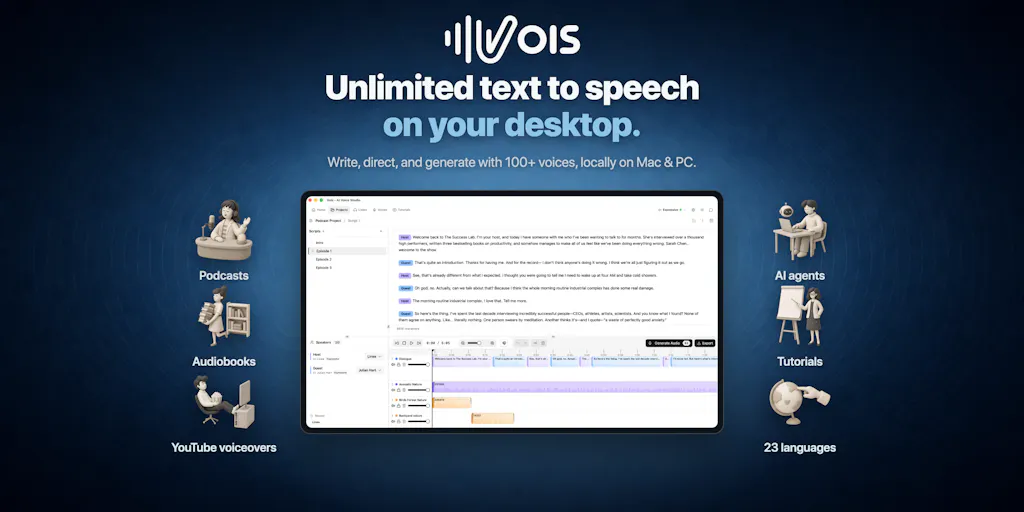
The Product Hunt launch page describes Vois 2.x as “an ElevenLabs alternative that runs on your own machine,” and that’s the headline. But the details matter more than the tagline. The current version ships with four engines: Fast for drafts (about 3x real time on CPU, 6x with GPU acceleration on Apple Silicon), Expressive for delivery, Multilingual for 23 languages, and Omni on the Pro tier for 600+ languages plus Voice Design. That’s a serious range. It also includes 100+ voices across 21 categories, voice cloning from about 15 seconds of clean audio with a consent step, a multi-speaker timeline with music and mastering, and one-click export.
The reviewer Brian Richards, who built a 15-platform comparison spreadsheet before signing up, highlighted the multi-speaker support with automatic recognition when importing scripts — a feature he says “very few TTS systems do at present.” That’s a meaningful differentiator for anyone producing podcasts, audiobooks, or multi-character content. But for cross-border sellers, the more interesting angle is the local generation. Scripts, voice samples, and generated audio stay on your machine. No uploads. No cloud exposure. If you’re working with unreleased product names or proprietary launch details, that’s a compliance win.
The pricing is aggressive: for launch week, Subscriber is $10/month and Pro is $14/month for the first 100 spots, applied automatically at vois.so, and the rate stays for life. That’s a fraction of what you’d pay for comparable cloud tools on a per-character basis, and it’s flat. The reviewer also noted there’s a free version with unlimited text and 10 generations a day, plus full audio export for $5 a go. That’s a low-friction way to test whether the tool fits your workflow before committing.
The CLI angle: where the agentic commerce workflow gets interesting
The most forward-looking feature for operators is the Vois CLI for AI agents. The maker’s comment explains that Claude, Codex, Cursor, or any agent that can run a shell command can create projects, generate batches, and export while you review the plan. There’s a skills page at vois.so/skills that shows how to wire this into an agent pipeline. For a cross-border operator, this is the seed of something bigger: imagine a workflow where your listing copy, ad script, and voiceover are all generated by an agent pipeline, reviewed by a human, and exported in one pass. That’s not a TTS tool anymore; it’s a content operations layer. The maker explicitly frames it as “your agent does the talking,” and that’s the direction the market is heading.
What Cross-Border Sellers Can Borrow From This Tool
Beyond the specific product, there are three operational lessons here that translate directly to how you run your content engine.
First, flat-rate pricing for creative tools is a strategic advantage, not just a cost saving. When your tooling charges per use, you’re implicitly taxing experimentation. Vois’s model — unlimited generation at a fixed cost — is the same logic that made Canva and Figma successful in their categories. For sellers, this means you can afford to test more hooks, more voices, more languages, and more variations of your product story. The volume of creative tests you can run is a competitive moat, and the pricing model determines how deep that moat goes.
Second, local-first processing is underrated for compliance and speed. If you’re operating in markets with strict data regulations — think GDPR in Europe or the emerging AI regulations — keeping your scripts and voice samples on your machine is a real advantage. You’re not uploading proprietary product information to a third-party server. You’re not worrying about where your audio files are stored or who has access to them. For sellers dealing with NDAs around product launches or working with sensitive brand assets, that’s a meaningful risk reduction.
Third, the multi-speaker timeline is a production workflow, not a toy. The reviewer’s point about automatic speaker recognition when importing scripts is worth sitting with. If you’re producing a podcast to build brand authority, or a multi-character demo for a game-related product, or even a customer testimonial-style ad with two voices, this feature collapses what used to be a multi-tool workflow into a single desktop app. That’s time saved, and time is the scarcest resource in a lean e-commerce operation.
Where the math breaks
It’s not all upside. The reviewer flagged that speed on Windows systems needs GPU acceleration and doesn’t yet compare with performance on Apple Silicon. The maker acknowledges this: “Windows doesn’t have GPU acceleration yet. It’s a top priority, not a ‘someday’ item.” For a seller running a Windows-based operation, that’s a real friction point. Draft generation at 3x real time on CPU is workable, but it’s not the seamless experience you’d get on a Mac. If you’re producing high volumes of content daily, that gap matters.
Also, while the multilingual engine covers 23 languages, and Omni pushes to 600+ on Pro, the quality across those languages isn’t uniform. The maker says more variety and finer control are coming, but for a seller targeting a specific market with a niche language, you’ll want to test the output quality before committing your brand voice to it. The tool is strong, but it’s not a universal replacement for a human voice actor in every language and register.
Where My Judgment Says It Falls Short
Let me be direct: Vois is a compelling tool, but it’s not a complete solution for every cross-border content need. The Windows performance gap is the most obvious limitation, and if you’re running a PC-based operation, you should factor that in. But there’s a deeper issue: the quality ceiling. Cloud tools like ElevenLabs have invested heavily in model quality and offer a breadth of voices and styles that a solo maker building locally will struggle to match. The reviewer’s comparison table includes ElevenLabs and NotevibesLM, and the feedback is positive for Vois, but “positive for the price” is not the same as “best in class.”
For a seller producing a high-stakes brand video — the kind you’d run as a paid ad on TikTok Shop or Amazon — the voiceover quality is a conversion factor. If Vois’s voices don’t hit the emotional register you need for a hero product launch, the unlimited generation doesn’t matter. You’ll still go back to a cloud tool or a human voice actor for that specific asset. The tool is best positioned for high-volume, mid-quality production: tutorials, product demos, social clips, and multilingual variations where consistency and iteration matter more than a single perfect take.
There’s also the question of ecosystem integration. Vois is a desktop app, which means it sits outside your cloud-based content pipeline. If you’re already using a stack that includes cloud storage, collaboration tools, and approval workflows, a local-first tool adds a manual step: you generate locally, then upload to your shared drive or DAM. That’s not a dealbreaker, but it’s friction. The CLI helps for agent-driven workflows, but for a human team, it’s an extra step compared to a cloud tool that writes directly to your shared folder.
What I’d Watch / Test Next
If I were running a cross-border content operation, here’s what I’d do this week, not next quarter.
First, grab the free tier and run a side-by-side test. Generate the same 60-second product script in Vois and in your current cloud tool of choice. Compare not just the audio quality, but the iteration experience. How many takes did you try? Did you stop because the meter was climbing, or because you were satisfied? That test will tell you more about your workflow than any spec sheet.
Second, wire the CLI into your agent pipeline. If you’re already using Claude or Cursor for content generation, point it at the Vois skills page and see if you can generate a batch of voiceovers from a spreadsheet of product names and descriptions. The goal is a proof of concept: can your agent produce a set of ad variations in different voices and languages while you review the plan? If it works, you’ve just automated a chunk of your creative production.
Third, set a budget for a multilingual test. Pick your top three target markets, generate the same ad script in each language using Vois, and run a small paid test on TikTok Shop or Amazon. Measure not just engagement but conversion. If the local voices convert as well as your cloud-generated ones, you’ve found a cost-efficient way to scale multilingual content. If they don’t, you’ll know exactly where the quality ceiling is.
Finally, watch the Windows GPU acceleration roadmap. The maker says it’s a top priority, and if it lands, the tool becomes much more viable for PC-based teams. Until then, if you’re on Windows, factor in the slower generation speed. If you’re on Apple Silicon, you’re in a better spot — the 6x real-time speed on the fast model is genuinely usable for production work.
Vois isn’t going to replace your entire content stack, but it’s a serious answer to a real problem: the tax on experimentation that cloud TTS pricing imposes. For sellers who need volume, iteration, and multilingual reach without watching a meter, it’s worth a serious look. The pricing alone — $10/month locked in for life during launch week — makes it one of the cheapest experiments you can run this year. And in a market where content velocity is a competitive advantage, that’s a bet worth making.