The Real Product Hunt Story for Cross-Border Operators Is the Privacy Stack, Not the Search Bar
Every cross-border operator I know runs the same losing game: supplier quotes buried in a WeChat thread, a freight forwarder’s rate sheet screenshotted three weeks ago, a TikTok Shop policy change someone pasted into Slack, a competitor’s Temu pricing page you swore you’d revisit. The tools we use to act on that information — Amazon Seller Central, Shopify admin, Klaviyo flows, Helium 10 dashboards — are mature. The tools we use to remember it are a browser history graveyard and a search bar that treats “that thing from Tuesday” as a query. So when a maker shows up on Product Hunt promising an on-device memory layer for the Mac, my ears prick up — not because I need another AI toy, but because the underlying architecture question (where does my operational memory live?) is the one most sellers haven’t asked yet.
What Earlyn Actually Is, Stripped of Launch-Day Spin
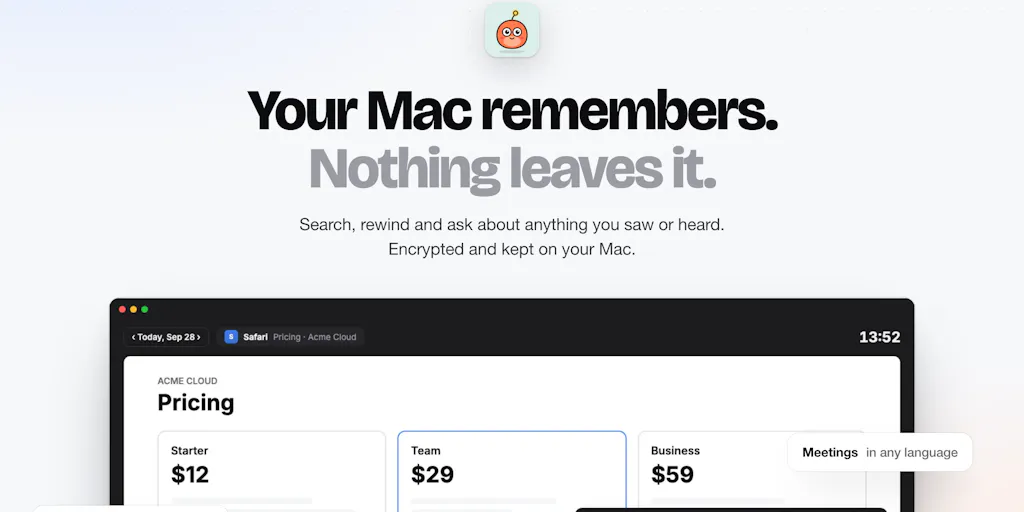
Earlyn is a macOS app from the maker Earlyn that continuously captures what’s on your screen — text and an image — encrypts it locally with SQLCipher and AES-GCM, and makes it searchable. It transcribes meetings in any language using Whisper running on your own machine, offers live translation in a side panel, and exposes your accumulated context to coding agents like Claude Code, Codex, and Cursor over MCP. It’s free for seven days, then $19/month. Recording only starts when you toggle it on; excluded apps, private browser windows, and password fields are never captured.
That’s the whole pitch. The interesting part isn’t the feature list — it’s the deployment model. Everything stays on the Mac. No screen goes to anyone’s server.
Why “on-device” is not a marketing word here
For a US-based solo founder, on-device is a nice-to-have. For a cross-border operator juggling a Shenzhen sourcing agent, a Turkish 3PL, a Vietnamese TikTok affiliate manager, and a US LLC bank account, on-device is closer to a compliance requirement. If you’re capturing supplier negotiation threads, landed-cost spreadsheets, and ad account screenshots, the last thing you want is that corpus sitting in a Series A startup’s S3 bucket that gets subpoenaed, breached, or sold in an acqui-hire. Earlyn’s architecture sidesteps that entire class of risk. That’s not paranoia; that’s the operating reality of running a business across four jurisdictions where data residency rules don’t line up.
The Problem It Solves Is Bigger Than “I Forgot a Link”
The maker’s stated origin story is mundane — losing a number in a document, a link someone posted, what was said on a call. But map that onto a seller’s week and the mundane becomes structural.
A cross-border operator’s day is a stream of ephemeral inputs: a WhatsApp voice note from a factory contact, a live pricing page from a competitor, a Zoom with a freight broker quoting a new lane, a screenshot of a Shopify payout discrepancy. None of these live in a system of record. They live in the operator’s head, and they decay fast. The tools that should capture them — CRM, Notion, ERP — require you to stop what you’re doing, decide what’s worth saving, and file it correctly. Nobody does that. Earlyn’s bet is that the filing should be automatic and the retrieval should be semantic.
Why Amazon sellers should care more than Shopify ones
Shopify merchants, especially DTC brands, tend to run a tighter stack — Klaviyo for email, Triple Whale or Northbeam for attribution, a decent helpdesk. Their data has a home. Amazon sellers live in a different world: Seller Central buries critical signals in dashboards that reset, Helium 10 and Jungle Scout give you snapshots you have to export or lose, and half your real intelligence comes from a competitor’s listing page you looked at once. The seller who can search “that BSR chart from last Thursday” or “the review that mentioned the hinge” without scraping anything is running a different game. Earlyn isn’t built for them, but it’s more valuable to them than to the average Product Hunt upvoter.
How It Compares to What’s Already Out There
The obvious comparison set splits into three buckets.
Screen recorders and time-trackers. Rewind AI pioneered the “record everything on your Mac” category and is the closest direct analog. Earlyn’s differentiators are the encryption specifics (SQLCipher, AES-GCM named explicitly), the Whisper-based multilingual transcription, and the MCP integration for coding agents. Rewind has more polish and a longer track record; Earlyn is more explicit about the privacy contract.
Meeting transcription tools. Otter.ai, Fireflies, Granola, and Fathom all solve the “what was said on the call” problem. Most upload audio to their servers. Granola is the closest philosophical cousin — it’s Mac-native and leans local — but it’s meeting-scoped, not screen-scoped. Earlyn’s pitch is that the meeting is just one input among many.
Knowledge and note tools. Notion, Obsidian, Mem, and Reflect all want to be your second brain. The problem is the same across all of them: capture is manual. You have to decide to save something. Earlyn removes that decision entirely, which is either its killer feature or its biggest liability, depending on your tolerance for ambient surveillance of your own machine.
What Cross-Border Sellers Can Borrow From This
Even if you never install Earlyn, three design principles here are worth stealing for your own operations.
Principle 1: Capture should be passive, retrieval should be semantic
Your sourcing team’s WeChat threads, your freight forwarder’s email quotes, your VA’s Slack updates — none of these are searchable across channels today. If you’re running more than one marketplace and more than one supplier, you have a retrieval problem disguised as a communication problem. The fix isn’t a better CRM; it’s a search layer that indexes everything you already have. Some operators do this crudely with a shared Notion database and a Zapier pipe. The Earlyn model suggests a better pattern: don’t ask humans to file, ask machines to index.
Principle 2: Multilingual transcription is an operational lever, not a convenience
The Whisper-on-device angle matters more for cross-border teams than the maker probably realizes. If your sourcing agent in Guangzhou is on a Mandarin call and your 3PL in Istanbul is on a Turkish call, and you’re on neither, the ability to search those transcripts later — in English — collapses a language barrier that currently costs you either a translator or a game of telephone. Most transcription tools charge per minute and upload to the cloud. The on-device model changes the cost structure and the compliance story simultaneously.
Principle 3: Give your AI agents your context, not just your prompts
The MCP integration is the sleeper feature. If you’re already using Claude Code or Cursor for anything — writing listing copy, generating ad variants, debugging a Shopify app — the bottleneck is context. You paste the same brand guidelines, the same supplier constraints, the same margin floors into every session. An MCP-exposed memory layer means your agent can pull from what you’ve already seen and decided. For a seller running TikTok Shop creative testing at volume, that’s a meaningful speedup. For a brand owner writing Amazon A+ content, it’s the difference between an agent that sounds like you and one that sounds like a chatbot.
Where My Judgment Says This Falls Short
I like the architecture. I’m skeptical of the positioning and the economics.
The $19/month question
Nineteen dollars a month is cheap for a US knowledge worker and expensive for what a cross-border operator will actually get out of it in month one. The value compounds — the more you’ve captured, the more useful the search — which means the trial period is structurally misaligned with the product’s payoff curve. Seven days is enough to see the UI; it’s not enough to feel the compounding. Compare that to how Rewind structures its trial, and you can see why retention in this category is brutal.
The accuracy claim is thin
The maker cites a test where the search “put the right result first in 12 of 12 queries, in English and Turkish.” That’s a demo, not a benchmark. Twelve queries is nothing. The reviewer who asked about partial-word and fuzzy search got the most honest answer in the thread — typos aren’t corrected yet. For a seller searching “that freight quote from the Turkish guy” three weeks later, typo tolerance and cross-language fuzzy matching aren’t edge cases; they’re the whole job.
The Mac-only constraint is a real ceiling
Cross-border operators are not a Mac monoculture. Your ops lead is probably on Windows. Your VA is on a Chromebook. Your sourcing agent is on a phone. A memory layer that only works on one person’s Mac doesn’t capture the team’s memory — it captures one node’s. That’s fine for a solo founder, limiting for anyone running a team of five or more.
The privacy story has a flip side
“Nothing goes to anyone’s server” is a strong promise, but it also means no cross-device sync, no team sharing, no web access. If your laptop dies, your memory dies with it — assuming you didn’t back up the encrypted store. For a seller whose entire competitive intelligence lives in this app, that’s a single point of failure dressed up as a feature.
What I’d Watch / Test Next
If you’re a cross-border operator curious about this category, here’s what I’d actually do this week — not install-and-forget, but run a structured two-week test.
First, before you touch Earlyn or any competitor, spend an hour listing the five questions you most often can’t answer because the information is scattered. “What did the factory quote us for the 500-unit run in March?” “Which TikTok creative had the best hook rate last month?” “What did the freight broker say about the new lane?” If those questions don’t exist, you don’t have a memory problem — you have a discipline problem, and no app fixes that.
Second, if the questions do exist, run Earlyn’s seven-day trial against a real workflow, not a demo. Turn it on during supplier calls, not during random browsing. Test the search with the queries you actually type, typos included, and note the failure rate honestly. The maker has already told you fuzzy matching is imperfect; find out whether your queries are the ones it handles.
Third, watch the MCP angle. If you’re already using Claude or Cursor for listing copy or ad generation, wire Earlyn in and measure whether the context actually improves output. That’s the feature most likely to justify the $19 — or to reveal that the integration is shallower than the launch post implies.
Finally, keep an eye on the competitive response. Rewind, Granola, and the note-taking incumbents all have the distribution to ship a similar on-device memory layer in a quarter. Earlyn’s window is the privacy-first, Mac-native, multilingual niche — and that’s a real niche, but it’s a niche. Whether it becomes a platform or a feature is the question that decides whether cross-border sellers should build a workflow around it or wait for the inevitable bundled version from whoever wins the category.