The agentic video editor is coming for your UGC pipeline — and WeftCut is the first one worth studying
Cross-border sellers don’t have a video problem anymore; they have a video volume problem. Between TikTok Shop creative iterations, Amazon A+ and Sponsored Brands video variants, Temu and SHEIN listing assets, and the endless Meta ad testing matrix, the bottleneck has quietly moved from “can we shoot it” to “can we cut, caption, and localize forty versions of it before the campaign window closes.” That’s why a small, unglamorous open-source launch caught my attention this week: WeftCut, a desktop editor built by a maker going by UncleChair, designed so that an MCP-compatible AI agent can drive the timeline while a human supervises. It is not a seller tool. But the architecture underneath it is exactly the shape that the next generation of creative ops stacks — for DTC, for marketplace brand owners, for anyone running paid social at scale — is going to take.
What WeftCut actually is, and what problem it’s really solving
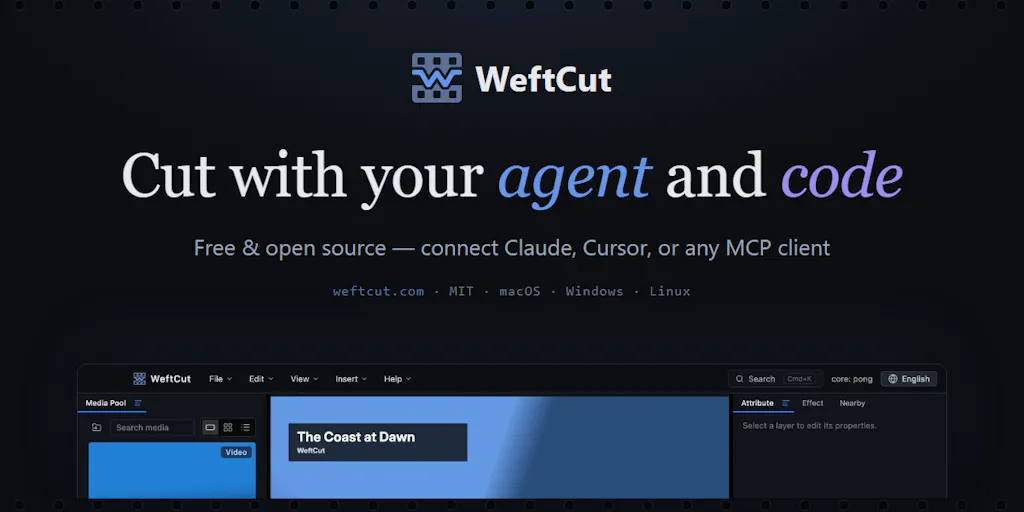
Strip away the launch-page framing and WeftCut is a bet on a specific workflow: your AI agent plans and executes edits, you watch them happen in a real timeline, and you can intervene by hand at any point without leaving the project. The maker’s own words are worth quoting because they’re unusually honest about the intent — he wanted “an editor my AI agent could actually drive, with a timeline I could keep watching and refining by hand” (source).
The mechanics:
- MCP-based agent connection. You connect an existing MCP-compatible agent, and it can trim clips, add captions, and animate elements inside the same project you’re viewing.
- Live changes with an activity log and checkpoints. Every agent action is visible, and you can restore a checkpoint when the direction goes sideways.
- Motifs. This is the genuinely interesting part. Motifs are animations written in HTML, CSS, and JavaScript that become editable layers on your timeline. An agent can generate an overlay for your footage; you then adjust the exposed controls in the editor like any other layer.
- Free and open source, with builds for Windows, macOS, and Linux. Still in active development.
The problem it’s solving isn’t “AI can’t edit video.” Plenty of tools claim that. The problem is that when AI edits video, the output is usually a black box — you get a rendered file, and if 90% of it is right and 10% is wrong, you’re re-prompting from scratch. WeftCut’s thesis is that the editable intermediate state is the product. The agent doesn’t hand you a video; it hands you a timeline you can still touch.
Why this matters more for Amazon and marketplace sellers than for Shopify DTC brands
Here’s a distinction that I think gets lost in the AI-editing conversation. A pure DTC brand on Shopify running paid social has one creative pipeline: concept → shoot → cut → launch → iterate on ad performance. An Amazon FBA brand owner has at least four pipelines that don’t talk to each other: Sponsored Brands video, A+ content modules, Brand Story assets, and whatever they’re pushing to TikTok or Instagram to drive off-Amazon traffic. Then add marketplace expansion — the same hero video needs a localized caption track for Amazon.de, a different aspect ratio for Temu listings, and a cutdown for SHEIN if you’re playing there.
That’s a versioning problem, not a creativity problem. And versioning is exactly where an agent that writes editable, parameterized overlays beats a human in Premiere Pro every single time. If the caption layer, the price callout, the “as seen on” badge, and the CTA button are all Motif-style code layers with exposed controls, then localizing a video is a matter of swapping variables — not reopening a project file and manually retyping text in six languages.
Where the math breaks
I want to be careful here, because the temptation with any agentic tool is to assume linear cost savings. It doesn’t work that way. The savings only materialize if the agent’s first-pass output is close enough that checkpoint-and-tweak is faster than starting over. If your agent produces a timeline that’s 60% correct, you’ve saved nothing — you’ve added a review step. The maker himself is candid that WeftCut overlaps heavily with ChatCut on features and that his differentiation is a matter of design priorities, not exclusive capability (source). That’s a refreshingly non-defensive answer, and it also tells you the moat here is workflow taste, not technology.
How it stacks up against the incumbents you’re probably already paying for
Let’s put WeftCut in the context of what a seller’s creative stack actually looks like today.
Against CapCut and Descript. CapCut owns the “fast, template-driven, mobile-first” lane and it’s genuinely good at it — for one-off social cuts. Descript owns the “edit video like a doc” lane and is excellent for talking-head content and podcast repurposing. Neither is built around an external agent driving the timeline. Both are closed pipelines: you work inside their paradigm. WeftCut’s open-source, MCP-first posture means the agent layer is pluggable — you’re not locked to whatever AI features the vendor decides to ship.
Against Runway and Pika. These are generative video tools — they create footage. That’s a different job. For a seller, generative video is useful for B-roll and concept mockups, not for the product-demo-and-testimonial content that actually converts on TikTok Shop or Amazon. WeftCut is an editor, not a generator, and that’s the right scope.
Against Adobe Premiere Pro with AI plugins. Premiere is where professional editors live, and the AI plugins bolted onto it are getting better. But Premiere’s model is still “human drives, AI assists.” WeftCut inverts it: “agent drives, human supervises.” For a seller with a two-person creative team and forty SKUs, the inverted model is the one that scales.
Against ChatCut. The direct competitor, and the one the maker acknowledges overlap with. If you’re evaluating both, the question to ask is which one gives you a better intervention surface — where can you, the operator, jump in and fix the one thing the agent got wrong without re-running the whole job. WeftCut’s answer is checkpoints plus editable code layers. Whether that’s actually better in practice is something you have to test on your own footage.
A sidebar on the open-source angle
Free and open source matters more for cross-border operators than it first appears. If you’re running creative ops across multiple markets, you have data residency questions, you have vendor-risk questions (what happens when a tool you depend on gets acquired or pivots?), and you have the very practical problem that your best editor is in one time zone and your best media buyer is in another. An open-source desktop tool you can self-host or fork is a different risk profile than a SaaS subscription that could double its price at renewal. That’s not a knock on SaaS — Klaviyo and Helium 10 earn their keep — it’s just a reminder that “free” is sometimes the least interesting thing about open source.
What cross-border sellers can borrow from this, even if they never install it
You don’t have to adopt WeftCut to steal its operating principles. Three things are worth porting into your own creative ops this quarter.
1. Treat your video assets as parameterized layers, not finished files. The Motif concept — animations as code that become editable timeline layers — is a specific implementation of a general idea: if your caption text, price badge, review quote, and CTA are variables rather than baked-in pixels, then localization and versioning become a spreadsheet exercise. You can approximate this today in After Effects with essential graphics templates, or in Figma for static assets, or in whatever your editor supports. The point is to stop treating “the German version” as a new project.
2. Build a checkpoint habit into your agent workflows, not just your video ones. The checkpoint-and-restore pattern WeftCut uses is the same pattern you should want from any AI tool touching your ad accounts, your listings, or your email flows. If an agent can change something, you need a visible log of what it changed and a one-click way to roll back. This is the single biggest gap in most sellers’ current AI adoption — they’ve given tools write access without giving themselves an undo button.
3. Separate the planning agent from the execution surface. WeftCut’s design explicitly assumes your agent of choice handles planning and execution while the editor stays lightweight and focused on preview and refinement. That’s a clean architectural principle. Applied to your broader stack, it means: don’t let one vendor own both the intelligence layer and the interface layer. Keep them swappable. The moment a single tool is both your strategist and your only window into the work, you’ve lost leverage.
Why Amazon sellers should care more than Shopify ones
I’ll say it plainly: if you’re a Shopify DTC operator with a strong in-house creative team, WeftCut is interesting but not urgent. You probably already have a workflow that works, and the switching cost is real. If you’re an Amazon FBA brand owner or a marketplace account manager juggling Sponsored Brands video, A+ modules, and off-Amazon social for the same SKU, the urgency is higher. Your creative volume is structurally higher, your per-asset budget is structurally lower, and your tolerance for re-rendering from scratch is basically zero. Agentic editing with a supervision layer is built for exactly that profile.
Where my judgment says it falls short
I’ll be direct, because the maker was direct with his own commenters and that earns the same in return.
No screen recording yet. A commenter — André J, who builds DiffSense — asked whether WeftCut could replace his Cap plus iMovie workflow, and the maker confirmed screen recording is planned but not built in, so it “wouldn’t replace your whole setup today” (source). For sellers, this matters more than it sounds. A huge share of product video is screen-recorded: app demos, store walkthroughs, ad-manager tutorials, unboxing overlays. Until that’s native, WeftCut is a second tool, not a replacement.
The agent quality is entirely on you. WeftCut connects to your MCP-compatible agent. That means the output quality is a function of which model and which agent framework you bring. The maker’s own example — asking an agent to learn JIZURA, build a Motif, transcribe a song, and assemble an MV — is impressive but also a fairly advanced prompt-engineering exercise (source). A seller who just wants “cut this 90-second testimonial into three 15-second TikTok variants with captions” needs a much simpler on-ramp than that, and I don’t see evidence yet that WeftCut provides one.
Active development is a double-edged sword. The maker says it plainly: still in active development, feedback wanted. That’s honest, and for an open-source project it’s fine. But if you’re a seller deciding whether to move your creative pipeline onto this, “active development” means you’re an early adopter absorbing instability. That’s a reasonable trade for a solo operator or a small brand; it’s a harder sell for a team with campaign deadlines.
The competitive overlap is real. The maker acknowledges substantial feature overlap with ChatCut and frames the difference as design priorities rather than exclusive capability. I respect the honesty, but it means the decision between them comes down to feel and workflow fit — which you can only judge by actually editing something in both. Don’t pick based on the launch page.
What I’d watch / test next
If you want to evaluate this seriously rather than just bookmark it, here’s what I’d do this week.
Pull one real product video and run it through WeftCut with your agent of choice. Not a test clip — an actual asset you need for a live campaign. Give the agent a specific, bounded task: add captions, create three aspect-ratio variants, swap the CTA text for a second market. Time how long the first pass takes, then time how long the checkpoint-and-tweak cycle takes. That ratio is the only number that matters.
Then do the same task in your current stack. If you’re on CapCut or Premiere or Descript, run the identical brief. Compare not just total time but intervention cost — how many times did you have to start over versus nudge. That’s where the agentic model either wins or doesn’t.
Watch the screen-recording roadmap. For most sellers I talk to, that’s the feature that determines whether WeftCut becomes a primary tool or a specialist one. If it ships and works well, the calculus changes significantly.
And keep an eye on the MCP ecosystem itself. WeftCut’s bet is that MCP becomes the standard way agents talk to creative tools. If that happens, the editor becomes less important than the agent you point at it — which means the strategic question for sellers isn’t “which editor” but “which agent, and how do I keep it swappable.” That’s the question I’d be answering now, regardless of whether WeftCut ends up in your stack.