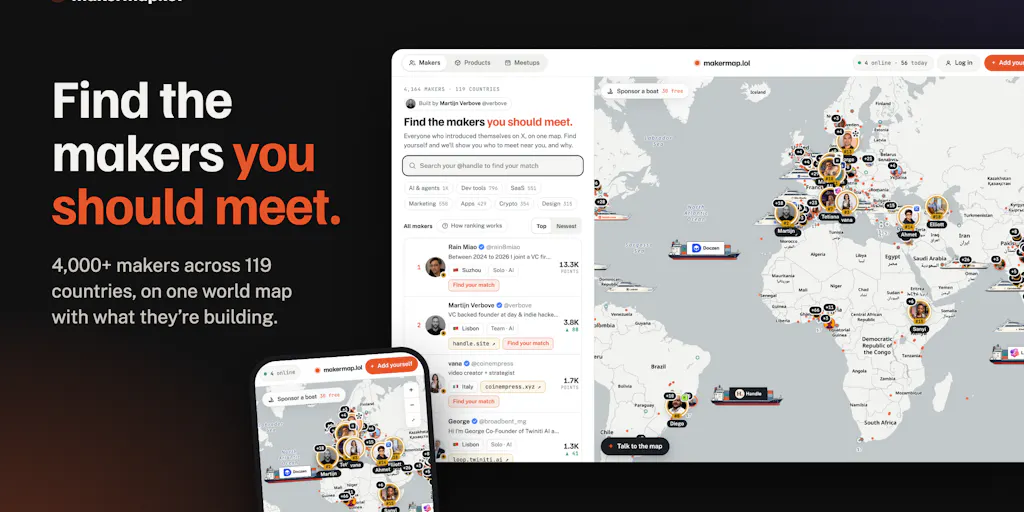
The directory is not the product. The graph is.
Every cross-border operator I know is sitting on the same quiet problem: the tools got better, the channels got noisier, and the people got harder to find. You can buy traffic from Meta and TikTok Shop, you can rank on Amazon, you can spin up a Shopify storefront in a weekend — but the thing that actually moves a brand from $40k a month to $400k a month is almost always a specific human: the right 3PL contact, the right TikTok affiliate manager, the right EU VAT advisor, the right supplier in Shenzhen who answers at 2am. Directories don’t solve that. Graphs do. That’s why I paid attention to MakerMap, a small, scrappy launch that quietly points at something much bigger than a map of founders.
What MakerMap actually is, and why it’s not just another directory
MakerMap is a Product Hunt launch from Martijn Verbove, built over roughly ten days and shipped as a global map of makers and products. The pitch is simple: 4,000+ makers and products that you can explore geographically, with search queries like “AI founders in Lisbon,” “Twitter tools,” “gym bros in Lisbon,” or “designers building iOS apps.” Every maker gets a “living profile” that shows what they’re building, where they are, their posts, activity, and growth. You add yourself via makermap.lol/introduce, or you can ask @MakerMapBot on X to do it for you. The tagline is “Dreams finally have a map.”
Read that again with a cross-border lens and it stops being cute. A geographic, activity-driven index of builders is exactly the primitive that every seller-side vertical has been missing. Not a LinkedIn graveyard. Not a Crunchbase of funded logos. A map of who is actually shipping, where they sit, and what they’re touching right now.
Why Amazon sellers should care more than Shopify ones
Here’s my contrarian take from the launch thread. The Shopify crowd already has an enormous ecosystem of founder networks — Twitter/X, Indie Hackers, MicroConf, Slack communities, mastermind groups. They’re drowning in peers. What they lack is operational proximity: a way to find someone in the same city who runs the same 3PL, the same returns flow, the same Klaviyo setup.
Amazon FBA brand owners, by contrast, live in a weird isolation. Amazon Seller Central is a black box that tells you nothing about the human sitting next to you in the same category. If MakerMap’s “living profile” idea gets ported into a seller-specific vertical — location, category, fulfillment footprint, ad spend band, tooling stack — you’d have something far more valuable than another Helium 10 dashboard. You’d have a way to find the operator who solved your exact problem, in your timezone, in your language.
That’s the borrow. Not the map. The “living” part.
The staleness problem is the whole game
The most important comment on the entire launch page came from Justin Rockmore, who asked the question every directory founder should be forced to answer before they write a line of code: “Every maker directory I’ve seen goes stale because people fill out a profile once and never touch it again. How does a profile stay current?”
This is the single best critique in the thread, and honestly, it’s the one the maker didn’t fully answer. And it matters enormously for us, because we’ve all watched this movie. Crunchbase profiles rot. LinkedIn “About” sections are time capsules from 2019. AngelList (now Wellfound) listings go dormant within weeks. Even G2 and Capterra — the two directories every B2B SaaS buyer leans on — have review-velocity decay that makes half their rankings feel like archaeological finds.
The reason is structural: a directory asks the human to do the maintenance. A graph infers it. MakerMap’s bet — that X activity, product updates, and posts feed the profile automatically — is the right instinct. It’s also the hardest part to get right, because the moment you depend on X’s API, you inherit X’s pricing, X’s rate limits, X’s deprecations, and X’s moods.
Where the math breaks
Let’s be specific about the failure mode. If 4,000 makers sign up in the first ten days and 5% churn their X accounts, change handles, or go quiet, that’s 200 dead nodes inside a quarter. At 10% that’s 400. Directories die by a thousand abandoned profiles, not by a competitor. The only defense is a signal that decays on its own — last commit, last product update, last invoice, last shipment — so that a stale node visibly fades rather than silently misleading the searcher.
For cross-border sellers, this is not academic. If you’re using any directory to source a 3PL, an affiliate partner, or a sourcing agent, a stale profile isn’t just annoying — it’s a real operational risk. A dead Amazon agency still listed as “active” can cost you a quarter of ad spend before you notice.
The X-only login is a feature and a cage
Justin Rowsell asked the second-most important question: any plans to open it up to makers not on X? The answer was clear: “You’ll need X to login, but don’t need to be active there.”
I understand the choice. X is where the maker crowd lives, the friction is low, and the API gives you a free activity signal. But for cross-border operators, X-only is a real limitation. Half the people you actually need to find — the Shenzhen factory owner, the Vietnam-based 3PL ops lead, the German VAT consultant, the Turkish TikTok affiliate manager — are on WeChat, WhatsApp, LinkedIn, or Line. They are not posting threads on X. If MakerMap stays X-native, it becomes a map of the English-speaking indie hacker diaspora, not a map of global commerce.
That’s not a fatal flaw for a fun side project. It is a fatal flaw for anything a seller would rely on to source supply chain or fulfillment partners. Whoever builds the seller-side version of this needs to be multi-protocol from day one: X, LinkedIn, WhatsApp Business, WeChat, and ideally a lightweight email/push re-engagement loop to keep dormant nodes honest.
What cross-border sellers should actually borrow from this
Strip away the maker-map framing and there are four patterns here worth stealing, whether you’re running a DTC brand, an Amazon FBA private label, or a TikTok Shop operation.
1. Geographic search is underrated in B2B sourcing. Every seller tool searches by keyword or category. Almost none search by “who in my city does this.” For 3PL selection, local pickup, same-day courier, or in-person supplier meetings, geography is the primary filter and everyone treats it as an afterthought. If you’re building any internal vendor database — even a Notion doc — add a location column and a “last verified” column. Today.
2. “Living profiles” beat static ones. The MakerMap insight is that a profile should show what someone is doing, not what they say. For your own vendor stack, that means tracking signals: last shipment volume, last response time, last invoice paid, last dispute. If you’re evaluating a new 3PL or a new affiliate agency, ask them for evidence of activity in the last 30 days. A static case study is worthless. A live dashboard is not.
3. Free with optional paid exposure is a durable model. When asked about pricing, the maker said it’s free, with optional support payments or paid “Ships/Yachts” placements for more company exposure. That’s the same model that made Product Hunt itself, Gumroad, and a dozen other creator platforms work. If you’re launching a DTC brand into a crowded category, consider the same shape: free value first, paid amplification for the people who want it. Don’t gate the core.
4. Ten-day builds are a real signal. The maker says the project came together in about ten days. That’s not a flex — it’s a reminder that the tools, APIs, and infra available in 2025 compress the build cycle in ways that change competitive dynamics. If your competitor can ship a landing page, a waitlist, and a working MVP in 10 days, your 6-month roadmap is a liability. Ship smaller, ship more often, and let the market tell you what to keep.
Where I think MakerMap falls short
Three honest critiques, in order of severity.
First, the staleness question is unresolved. “Living profile” is the pitch, but the mechanism isn’t disclosed in the thread, and the answer to Rockmore was essentially a deflection. Until I see decay handling, deduplication, and re-engagement logic, I treat any directory as a snapshot, not a source of truth.
Second, X-only login caps the addressable market at exactly the wrong edge. The people cross-border sellers most need to find are the least likely to be on X. That’s a structural ceiling, not a bug.
Third, 4,000 makers in 10 days is impressive, but the real test is 40,000 in 12 months with less than 20% dead nodes. The launch number is a vanity metric. The retention curve is the business.
None of this is a knock on the maker. It’s a knock on the category. Every directory founder faces the same three fights — freshness, reach, and depth — and most lose two of them.
What I’d watch / test next
This week, three concrete moves.
One. Go to MakerMap and search for your own city plus your own category. See who shows up. If the answer is “nobody useful,” that’s your signal that the seller-side version of this doesn’t exist yet — and it’s a gap somebody will fill. If the answer is “three people I should already know,” you’ve just found your next mastermind, 3PL intro, or affiliate partner for free.
Two. Audit your own vendor stack for staleness. Take your top 10 partners — 3PLs, agencies, freelancers, suppliers — and write down the last date you verified they’re still operating at the level you hired them for. If it’s more than 90 days ago, re-verify this week. Directories rot. So do vendor relationships.
Three. If you run a brand with any community surface — a Discord, a Facebook group, a newsletter — steal the “living profile” idea. Ask your best customers and partners to submit a location, a current project, and one thing they’re looking for. Publish it internally. You’ll be shocked how many intros happen in the first month, and how much of your “growth problem” was actually a “who do I know” problem.
The map is not the territory. But for cross-border sellers, the territory has always been the people. MakerMap is a small, imperfect, genuinely charming first attempt at drawing that map. The version that matters to us hasn’t been built yet. Somebody reading this should build it.