The Real-Time Assist Playbook Cross-Border Sellers Keep Ignoring
Most cross-border operators I know are quietly running the same experiment: they’ve wired an AI copilot into live customer conversations — Amazon Buyer-Seller Messaging, TikTok Shop live streams, Shopify chat widgets — and they’re watching response times collapse while conversion holds. So when a tool like ParakeetAI ships a full “prepare, rehearse, execute” loop for high-stakes spoken conversations, I pay attention — not because I’m hiring, but because the architecture maps almost one-to-one onto the operator problems we solve every quarter: prep from real data, practice in a sandbox, then assist in the live moment. That’s the thesis. The interview is just the demo case.
What ParakeetAI Actually Built (And Why the Shape Matters)
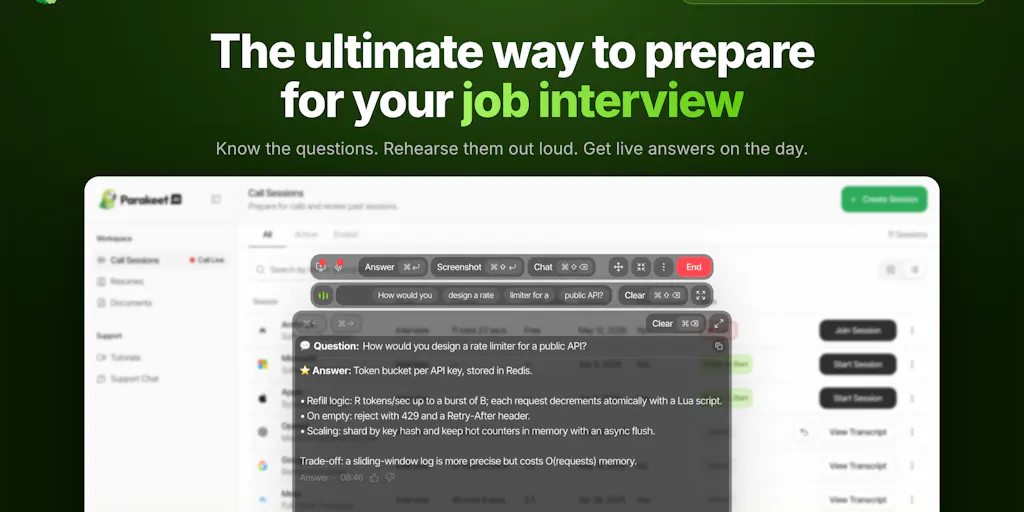
ParakeetAI is a real-time AI interview assistant from maker Domen Perko. The first version, launched September 11, 2024, did one thing: it listened to a live interview and drafted answers in real time. The current update, posted by the maker on the ParakeetAI product page, expands that into three stages — and the three-stage structure is the interesting part, not the interview use case itself.
Stage one: the Question Bank. According to the maker’s launch post, it “collects real interview questions per company, ranked by how often they come up,” built “only from real interviews, never from mocks.” Read that again as an operator: a corpus of actual observed inputs, weighted by frequency, scoped to a specific target. That is a VoC (voice-of-customer) engine wearing an interview costume.
Stage two: Mock Interview. An AI interviewer that “speaks in a real voice, waits for your answer and follows up on what you said.” You set role, company, and language. ParakeetAI drafts answers beside you during the mock — the same behavior it will exhibit live — and every session is saved with a full transcript. The maker says your first mock is free.
Stage three: Call Assistant. In the real interview, it listens and drafts answers live across browser, desktop app, or phone. The tagline is “Know it, practice it, nail it.”
The comment thread is unusually specific for a PH launch. Josip Begic asked whether you can compare two attempts at the same question; Oleksii Sekundant called the post-mock transcript “a nice touch”; Karl praised the “botless” interviews. Whether those are organic or seeded, the feature requests point at the real gap: longitudinal comparison of attempts, not just a transcript dump.
Why Amazon sellers should care more than Shopify ones
If you sell on Shopify, your customer conversations are mostly asynchronous — email, chat, helpdesk tickets. You have time to think. If you sell on Amazon, a growing share of your risk sits in synchronous or near-synchronous interactions: Buyer-Seller Messaging threads that get escalated, Account Health calls with Seller Performance, supplier negotiations on Alibaba or via sourcing agents, and increasingly live selling on TikTok Shop. Those are the moments where a wrong sentence costs you a listing, a margin point, or a supplier relationship. A tool that lets you rehearse the exact scenario against a simulated counterparty — and then drafts language in the live moment — is worth more to an Amazon operator than to a Shopify one. This is the asymmetry most “AI for e-commerce” tools get backwards.
How It Differs From the Incumbents You Already Pay For
Let’s be honest about the comparison set, because “AI assistant” is a crowded shelf.
Versus Helium 10 or Jungle Scout. Those are data platforms — keyword volume, sales estimates, review mining. They tell you what the market looks like. They do not rehearse you for a conversation. The Question Bank concept is the closest analogue to review mining, but applied to a different corpus (real interviews, not reviews) and a different output (prepared answers, not product specs).
Versus Klipfolio-style dashboards or Gorgias / Zendesk macros. Those are response libraries — canned replies triggered by intent. ParakeetAI is dynamic drafting conditioned on what the other party just said. That’s a meaningfully different technical bet: retrieval-plus-generation versus static templates.
Versus Otter.ai or Fireflies.ai. Those are meeting recorders and summarizers. They operate after the fact. ParakeetAI’s Call Assistant operates during. The latency budget is the whole product.
Versus generic ChatGPT with a prompt. The difference is the corpus. A generic LLM doesn’t know which questions a specific company actually asks. The Question Bank is the moat attempt — and also the most fragile part, because it depends on continuous ingestion of real interview data that ParakeetAI does not obviously control.
Where the math breaks
Here’s my skepticism, stated plainly. The maker’s pitch is “prep is only as good as the answer on the day” — a real insight. But the three-stage loop only compounds if the Question Bank is accurate. If a candidate prepares against a stale or thin question set, the mock reinforces the wrong answers, and the live assistant drafts fluent responses to the wrong questions. Garbage in, confident garbage out. For an operator, the analogue is brutal: if your “VoC corpus” is scraped from three-year-old reviews, your AI-drafted buyer messages will sound like a chatbot from 2022. I’ve watched sellers do exactly this with generic prompt libraries and wonder why their Amazon response rate dropped.
The other break point: language. The maker says you can set the language in Mock Interview, but the launch copy doesn’t specify which languages are supported, how accent handling works, or whether the live Call Assistant handles code-switching (a German buyer opening in English, switching to German). For cross-border sellers, that’s not a nice-to-have. It’s the entire value proposition. Not disclosed in the source.
What Cross-Border Sellers Should Steal From This Architecture
Strip away the interview framing and you have a reusable three-layer pattern that any DTC or marketplace operator can implement this quarter.
1. Build a real-input corpus, not a generic one. The Question Bank’s discipline — “only from real interviews, never from mocks” — is the lesson. Too many sellers build AI assistants on synthetic data or vendor-provided templates. Instead, ingest your actual tickets from Gorgias, your actual Amazon Buyer-Seller Messaging threads, your actual eBay resolution cases. Rank by frequency. That’s your question bank.
2. Sandbox before you ship. The Mock Interview is a rehearsal environment with a transcript. Sellers should be doing this with their support macros, their ad copy, their supplier negotiation scripts. Run the draft through a simulated counterparty (an LLM with a persona prompt) before it goes live. Save the transcript. Compare attempts. The feature Josip asked for — comparing two tries — is exactly what you want in your own ops.
3. Assist in the live moment, with a kill switch. The Call Assistant’s value is latency. But any operator deploying live AI drafting needs a human-in-the-loop gate, especially on Amazon where a bad message can trigger a policy flag. The maker’s “botless” framing (per Karl’s comment) suggests they’ve thought about detection — you should think about liability.
A sidebar for TikTok Shop live sellers
If you’re running TikTok Shop live streams, you already know the pain: a viewer asks a sizing question in Portuguese, your host freezes, the sale is gone. A ParakeetAI-style live assistant that drafts a response in the right language, in the right tone, within two seconds, is not a luxury — it’s the difference between a 2% and a 5% conversion rate on live. The mock-interview layer maps to host training: rehearse the ten most common objections per SKU before you go live. The transcript archive maps to post-stream review. I’d pay for that today. ParakeetAI isn’t selling it to me yet.
Where My Judgment Says It Falls Short
Three things I’d push back on.
First, the pricing opacity. The maker says “your first mock is free” but does not disclose what happens after. For a tool aimed at candidates — a price-sensitive, one-time-use audience — the LTV math is ugly. For an operator, that’s actually good news: it means the tooling is likely to stay cheap, or the company will pivot toward B2B use cases (sales call prep, support training) where the willingness to pay is higher. Watch for that pivot.
Second, the compliance surface. Live AI assistance in a job interview is, depending on jurisdiction and employer policy, somewhere between gray and disqualifying. The maker doesn’t address this. For cross-border sellers, the analogous risk is Amazon’s stance on automated messaging — you can use templates, but fully AI-generated buyer messages that misrepresent the seller can get you suspended. Any operator borrowing this architecture needs a compliance review before deployment, not after.
Third, the moat question. The Question Bank is only defensible if ParakeetAI keeps ingesting fresh real-interview data at scale. That’s a content-ops grind, not a technology moat. Competitors with distribution — LinkedIn, Indeed, or any of the big job platforms — could replicate it overnight if they chose to. The same is true in e-commerce: your VoC corpus is only a moat if you keep it fresh. Stale data is worse than no data, because it produces confident wrong answers.
What I’d Watch / Test Next
This week, I’d do three concrete things.
One: Open your Gorgias or Zendesk instance and pull the last 500 tickets. Cluster them by intent. That’s your question bank. If you don’t have 500 tickets, pull your last 200 Amazon Buyer-Seller Messaging threads. Rank by frequency. You now know what your customers actually ask — which is more than most sellers know.
Two: Build one mock scenario. Pick your highest-stakes recurring conversation — a supplier price negotiation, a negative-review escalation, a live-stream objection — and run it against an LLM with a counterparty persona. Save the transcript. Run it again tomorrow. Compare. If you can’t see improvement, your scenario is too vague.
Three: Watch ParakeetAI’s next launch. If they ship a B2B tier for sales or support teams, that’s your signal that the interview market was a wedge and the real product is coming for your ops stack. If they don’t, borrow the architecture anyway — the three-layer loop of real-data prep, sandboxed rehearsal, and live assist is the most transferable idea in this launch, and it costs you nothing to steal.