The Linter Nobody Asked For Is Quietly the Most Useful Ops Lesson of the Quarter
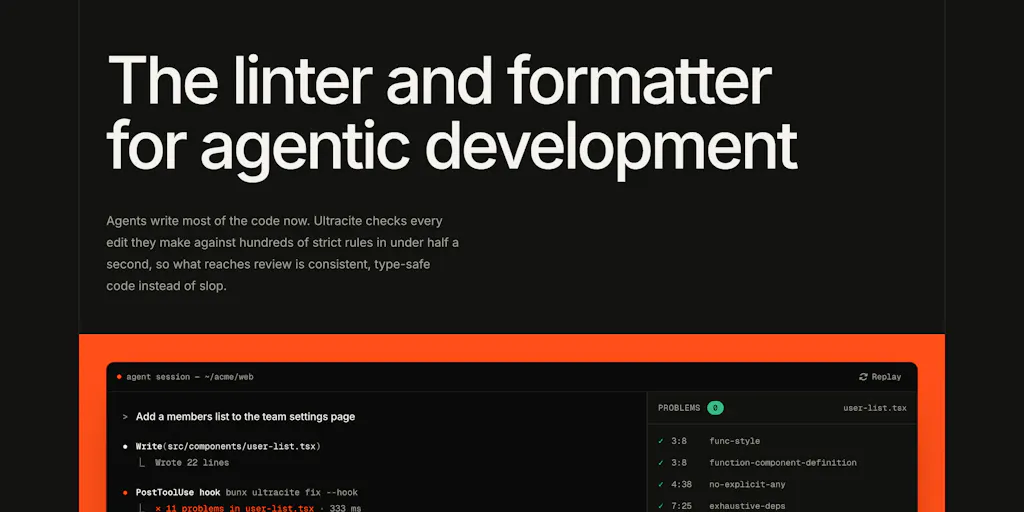
Cross-border sellers don’t ship JavaScript bundles. So why am I writing about a code linter? Because the most expensive failures in a Shopify or Amazon operation are not marketing failures — they are configuration drift failures. One theme file edited by three freelancers, one checkout extension patched at 2 a.m. before a Q4 promo, one tracking script that someone “just quickly” reformatted. Then the cart breaks in the EU, the tax line renders wrong, and the marketplace account manager spends a weekend in a Slack war room. Ultracite is an opinionated, zero-config linter and formatter for JavaScript apps, and its entire thesis — remove the debate, enforce one standard, let machines settle the arguments — is a thesis every DTC operator with a dev contractor should steal. The v7 launch on January 3rd, 2026 is the news hook; the operational philosophy is the actual story.
What Ultracite Actually Solves (And Why It’s a People Problem)
Read the product description plainly: “Opinionated, zero-config code linter and formatter.” That’s it. No AI copilot, no dashboard, no enterprise tier with a sales call. The value proposition is subtraction — you don’t configure it, you don’t argue about it, you just run it and the codebase becomes uniform.
For anyone who has managed a Shopify theme, this should trigger recognition. The standard failure mode of a mid-size store is not that the code is bad. It’s that the code is inconsistent. Your agency’s senior dev uses tabs, the freelance CRO specialist uses spaces, the app vendor’s snippet uses neither, and every merge is a negotiation. Multiply that across a headless storefront, a subscription app, a returns portal, and a TikTok Shop integration, and you have a codebase that no single human can hold in their head.
Ultracite’s answer is to remove the negotiation entirely. The config is the product. You accept it or you don’t use it. That’s a strong opinion, and strong opinions are exactly what small teams need, because small teams cannot afford architecture review boards.
The launch history is worth noting for a different reason. This is the third Product Hunt launch for the same product — the original in June 2025, v6 in November 2025, and v7 in January 2026 — with launch-day upvote counts of 195, 242, and 231 respectively. That’s a remarkably flat curve. It tells you something honest about developer tooling distribution: relaunching gets you a modest bump, not a hockey stick. The real growth channel was elsewhere.
The GitHub stars footnote is the real growth story
A forum thread on the Ultracite page asks how the project got its first 1,000 GitHub stars, with the poster explicitly crediting “the Product Hunt effect.” I’d push back on that framing. A thousand stars is a rounding error in developer mindshare. What actually compounds for a tool like this is the second-order effect: once a codebase is formatted by Ultracite, every new contributor has to adopt it, and the tool propagates through teams rather than through feeds. That’s a distribution mechanic sellers should study closely, because it’s the same mechanic behind why a good 3PL relationship outlives three ad accounts.
How It Stacks Up Against the Incumbents
The honest comparison set here is not other Product Hunt launches. It’s ESLint and Prettier, the two tools that have owned this category for years, plus the newer all-in-one challengers like Biome.
The traditional stack is ESLint for linting plus Prettier for formatting, wired together with a plugin bridge, plus a config file that someone on your team will spend a genuinely shocking number of hours maintaining. Every rule is a decision. Every decision is a debate. Every debate is a pull request comment thread at 11 p.m. Prettier solved formatting by being opinionated; ESLint never solved configuration by being opinionated, which is why eslint-config-* packages are their own sub-industry.
Ultracite’s bet is that the whole stack should behave like Prettier: one preset, no committee, done. That’s a defensible position in 2026 because the underlying tooling has consolidated. Biome has already proven that a single fast Rust-based binary can replace the lint-plus-format two-step, and the market has clearly decided that speed and simplicity beat configurability for the majority of projects. Ultracite sits one layer above that trend as the preset, not the engine.
Where it differs from Biome specifically: Biome is a toolkit you configure; Ultracite is a decision you accept. Where it differs from ESLint: ESLint gives you rope. Ultracite takes the rope away. For a five-person team shipping a storefront, that’s a feature. For a platform team with a decade of custom rules, it’s a non-starter — and the community is already asking about it.
What the community is actually worried about
Look at the comments on the launch page and you’ll find the two questions that matter. One user asks whether Ultracite works with existing custom ESLint rules “or does the preset take over” — the migration anxiety. Another, responding to a mention of ultracite fix --claude and an “anti-slop preset,” asks the sharper question: when the agent hands over what autofix can’t settle, what stops it from silencing a diagnostic with an ignore comment instead of fixing the code?
That second question is the one I’d frame and hang on the wall. It’s the same question I ask about every AI tool in the e-commerce stack: when the machine can’t solve the problem, does it solve the appearance of the problem? An ignore comment in code is a refund issued to close a ticket. It’s a listing suppressed instead of fixed. It’s a negative review flagged instead of addressed. The presence of an “anti-slop preset” in the product suggests the team is thinking about this, but the comment thread shows the community hasn’t been convinced yet — and the launch page lists no reviews at the time of writing.
What Cross-Border Sellers Should Borrow From This
Here’s where I stop pretending this is a developer-tooling essay and get to the part that pays for your 3PL invoices. Three transferable ideas, in descending order of how fast you can implement them.
1. Buy the opinion, not the configurability
Every tool in your stack is asking you to make decisions you are not qualified to make repeatedly. Your Klaviyo flows have forty possible branch conditions; you need six. Your Helium 10 dashboard has more columns than your P&L. Your Shopify theme settings expose typography controls nobody on your team should touch.
Ultracite’s discipline is refusing to expose the knobs. Sellers should apply the same rule when evaluating SaaS: prefer the tool with fewer settings and a stronger default, because the settings are where your team’s time dies. A returns platform with one workflow beats a returns platform with a workflow builder, unless you are genuinely a special case — and you are almost never a special case.
2. Standardize before you scale headcount
The reason a linter matters is that it makes a codebase legible to a stranger on day one. Your operations have the same requirement. Before you hire your third VA or your second agency, write down the one standard: how a listing is built, how a return is adjudicated, how a creative is briefed. Not a wiki with forty pages — one opinionated preset. The moment your ops standard requires a meeting to interpret, you’ve rebuilt ESLint’s config problem in your warehouse.
3. Treat AI agents as contributors who need guardrails, not oracles
The --claude flag in the community thread is the tell. Ultracite is being positioned as a tool that AI coding agents run against, which means the interesting question is no longer “can the agent write code” but “what stops the agent from cheating.” Apply that lens to every AI feature your Amazon Seller Central tooling vendor pitches you this quarter. Ask specifically: when the model is uncertain, does it escalate or does it paper over? If the vendor can’t answer, that’s your answer.
Why Amazon sellers should care more than Shopify ones
Shopify operators at least own their codebase and can enforce a standard. Amazon sellers live inside a platform that changes the rules without asking. Your listing content, A+ modules, Brand Registry assets, and advertising structure all sit in a system you don’t control, and the drift accumulates invisibly — a suppressed variation here, a mismatched browse node there. The Ultracite lesson for Amazon operators is that you need your own opinionated preset for listing hygiene: one checklist, one owner, run on a fixed cadence against Seller Central data, with no committee. The platform won’t give you consistency. You have to manufacture it.
Where My Judgment Says This Falls Short
I like the thesis. I’m less sold on the product’s durability, for three reasons.
The moat is thin. A zero-config preset is, definitionally, a configuration file plus maintenance. The hard engineering is in Biome and ESLint underneath. Ultracite’s defensibility rests entirely on taste and upkeep — on the maintainer staying ahead of the ecosystem’s breaking changes and keeping the preset genuinely current. That’s a real skill, but it’s a person-shaped moat, and person-shaped moats are fragile.
The launch cadence suggests a distribution ceiling. Three launches in roughly seven months, with upvotes flat at 195, 242, and 231, is not a growth curve — it’s a plateau. Compare that to how the team’s other project, Kilo Code, is being positioned, and you get the sense that the energy is moving toward agentic tooling. That’s rational, but it raises the question of how much long-term investment a preset gets.
The enterprise objection is unanswered. The custom-rules question in the comments is not a nitpick; it’s the entire objection that kills adoption at any company with an existing lint culture. If Ultracite can’t coexist with a team’s own rules, it’s a greenfield-only tool — and greenfield-only tools have a much smaller addressable market than their launch-day numbers imply. The “anti-slop preset” concept is genuinely interesting and, as far as I can tell from the page, underexplained.
Where the math breaks
Run the actual ROI. If Ultracite saves a two-dev team three hours a month of config wrangling and review nitpicking, that’s maybe thirty-six hours a year — real, but not transformative. The value only becomes large when it prevents a catastrophic inconsistency, the kind that takes down checkout during a promo. And that value is probabilistic and hard to attribute, which means it will always lose a budget fight against a tool with a dashboard that shows a number going up. This is the same problem every “quality infrastructure” purchase faces in e-commerce: Etsy sellers don’t buy insurance, they buy ads.
What I’d Watch / Test Next
Three concrete moves for this week, none of which require you to write a line of JavaScript.
First, run the audit. Pull your last ten production incidents — cart errors, checkout failures, feed rejections, listing suppressions — and classify each as “capability failure” or “consistency failure.” My bet is the majority are the second kind. If so, your next hire should be a process owner, not another specialist.
Second, write your preset. One page. How a product page gets built, how a return gets approved, how an ad gets launched. Circulate it, get one round of objections, then declare it final and stop debating it. The whole point of an opinionated preset is that it ends the conversation.
Third, interrogate your AI vendors with the ignore-comment question. Ask each one what their tool does when it’s uncertain — escalate or suppress. Watch how they answer. Then go read the Ultracite forum threads yourself; they’re a better education in tooling adoption politics than most paid courses. The linter is a small product with a large lesson, and the sellers who internalize the lesson will out-operate the ones who just bookmark the launch.