Why a Desktop-Automation Agent That Clicks Pixels Matters More to Your Cross-Border Operation Than Any New Marketplace Feature
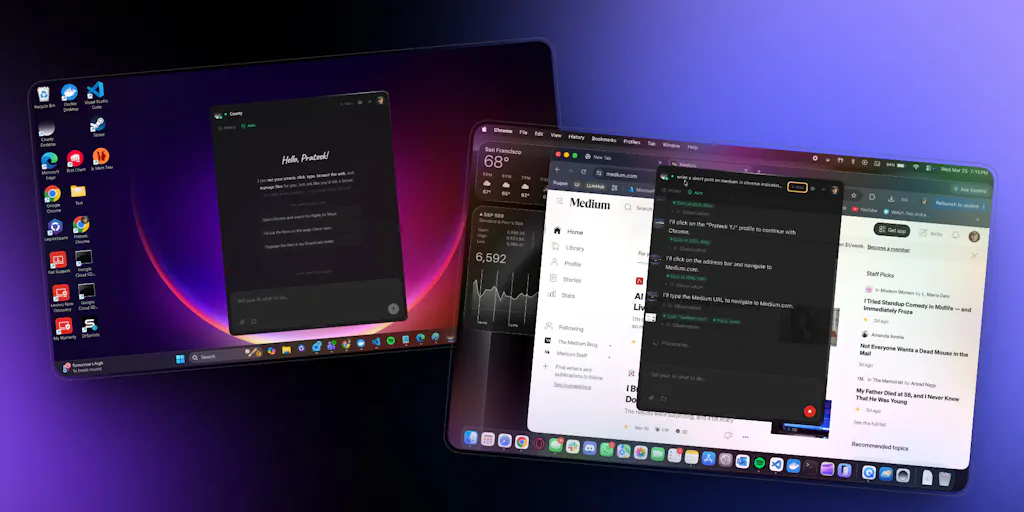
If your fulfilment workflow touches a carrier portal that has no API—and let’s be honest, that’s 90 % of the small-freight forwarders, customs brokers, and overseas warehouse management systems you are forced to use—then you are already paying a tax in repetitive keystrokes. Every manual upload, every order-status check in a legacy web app, every “please fill out this PDF for the supplier” eats margin. The standard answer has been offshore VA teams or fragile browser macros that break the moment the page layout shifts. But a new class of agent that actually uses the computer the way a human does is now crossing from research toy to potentially operational tool, and the launch of Coasty on Product Hunt last month crystallises why cross-border sellers should start paying attention to “computer-use agents” today. Coasty is not a general-purpose assistant; it is a purpose-built agent that lives inside a persistent cloud VM, clicks, types, reads screens, and hands off to a human when confused. It scored 82.81 % on the OSWorld Verified benchmark (359 tasks) and is already being deployed in healthcare prior-authorisation workflows. That same architecture could automate the ugliest parts of your cross-border operation—if you know where to look and what to watch for.
Section 1: The Problem Coasty Actually Solves (That Your Current Stack Ignores)
Every cross-border seller I know has a “legacy software graveyard” in their operations. The Vietnam factory’s ERP that requires a decade-old VB6 plugin. The customs broker’s portal that only accepts CSV uploads through a specific version of Internet Explorer. The freight forwarder’s tracking system that refuses to expose an API but has a perfectly fine search box. You cannot replace these systems; they are too embedded in the supply chain. So you hire a person—or a team of people—to manually copy data from one screen to another, re-type tracking numbers, and click “submit” fifty times a day.
Coasty’s co-founder Prateek J frames the problem clearly: the bottleneck is not the AI model; it is “operating legacy desktop software end to end [without] an API, just a screen.” The team originally built an LLM aggregation tool, but after analysing 14,000+ agent interaction logs they realised that the hardest operational problem is not generating text—it is reliably driving software that was never designed to be automated.
Existing solutions try to solve this with robotic process automation (RPA) tools like UiPath or Automation Anywhere. Those tools work well when the UI is static and the workflow is deterministic, but they choke on unexpected pop-ups, dynamic modals, and layout changes. They also require heavy configuration—recorded macros that must be maintained every time the target software updates. Browser-based automation frameworks like Puppeteer or Playwright are better for web apps but cannot touch desktop applications (the old-school freight TMS that runs as a Windows .exe) and have no built-in “when in doubt, ask a human” fallback.
Coasty approaches the problem differently. It does not rely on pre-recorded paths or DOM selectors. Instead, it verifies the screen after every step and recovers from unexpected state changes. It can handle long-horizon tasks (the maker confirmed 30-minute-plus workflows are routine). More important, the VM “runs forever”—the agent does not die when the session ends; it keeps state and even snapshots the VM on failure so you can restore and continue. For a cross-border seller who needs to run a batch of supplier invoice checks that span three hours, that persistence is non-negotiable.
Section 2: How Coasty Differs from What You’re Probably Already Using
Incumbent 1: Traditional RPA (UiPath, Automation Anywhere)
RPA giants make you train a “bot” to follow a script. Record the clicks, define the regions, handle exceptions programmatically. The learning curve is steep, and the maintenance cost is high. Every time the freight portal tweaks its UI—which happens without notice—your bot breaks. Coasty does not record a script; it interprets natural-language instructions and adapts its behaviour visually. The maker says setup takes 2 to 5 minutes per environment and the agent “runs unattended until the task is done or it decides a human should take over.” That is a fundamentally different trade-off: you trade deterministic, scripted reliability for adaptive, model-driven flexibility.
Incumbent 2: Browser Automation (Puppeteer, Selenium, Playwright)
These are great for web apps but useless for desktop software, and they require developers to write selectors and wait strategies. Coasty, by contrast, works at the pixel level—it sees what a human sees. The company claims it is “completely modular and transparent with the pricing at the end for every type of call” and provides a full action log with replay so you can audit every click. For a seller who wants to automate a workflow that crosses both a web-based carrier portal and a desktop-based supplier tool (yes, some still use Windows-only ERP clients), a single agent that can handle both environments is a step up.
Incumbent 3: Custom AI Agents (AutoGPT, BabyAGI, etc.)
The wave of 2023–2024 agent frameworks attempted similar ambitions but rarely worked well on real-world software because they had no concept of GUI state persistence. They would hallucinate a completed action or get stuck in loops. Coasty’s OSWorld benchmark score suggests it has made measurable progress: 82.81 % on 359 tasks is not human-level, but it is well above the 20–30 % that earlier vision-based agents achieved. For regulated workflows (healthcare prior auth, which the team is actively pursuing), the bar is even higher—and Coasty’s response to a comment about PHI handling indicates they are building enterprise-grade data retention controls.
Why Amazon sellers should care more than Shopify ones
Shopify runs on APIs. Most Shopify integrations—fulfilment, inventory, payments—are available via REST or GraphQL. If you are a Shopify-first DTC brand, the legacy-software problem is muted; you can almost always find an app instead of automating an old screen. Amazon sellers, especially those who sell internationally and deal with non-Amazon systems (customs brokers, overseas warehouses, supplier portals), face the opposite reality. Amazon’s own Seller Central has a decent API, but the logistics providers and customs portals that your Chinese supplier uses rarely do. Coasty’s strength—driving software that has “no API, just a screen”—maps directly onto the pain points of an FBA seller who is still manually entering ASINs into a third-party label-printing tool or copying tracking numbers from a freight forwarder’s web portal into Amazon’s backend. If the agent can automate even one of those manual steps reliably, it could save hours per week.
Section 3: What Cross-Border Sellers Can Borrow Right Now (Even Without Buying Coasty)
You do not need to run out and subscribe to Coasty today. But the product’s design reveals several concepts worth testing in your own operation.
1. The “human-in-the-loop” boundary as a feature, not a bug.
Coasty is designed to know when to hand off to a human. Instead of failing silently or producing a wrong result, it stops and asks for guidance. For any automation you build—whether with Coasty, another agent, or a traditional RPA tool—you should hard-code a threshold: if confidence drops below X, stop and notify. In my experience, the most expensive automation failures are the ones that look correct but aren’t. A deliberate hand-off preserves trust and prevents downstream shipping errors.
2. Treat every automation as a replatable audit trail.
Coasty records every click and keystroke so you can replay what the agent did. That is a powerful compliance tool. If you are managing supplier payments or customs documentation, being able to prove that a specific action was taken by an agent (and reviewed by a human) can protect you in a dispute. Even if you are not using Coasty, consider integrating session recording into any automation you deploy—it pays for itself the first time a customer claims an order was never placed.
3. Persistent VMs change the economics of batch processing.
Most automation tools spin up ephemeral environments that die after the task. Coasty’s VMs “last forever” and maintain state. For cross-border sellers, this is ideal for long-running tasks like nightly reconciliation of orders across multiple marketplaces. Instead of kicking off a script that might timeout after 30 minutes, you can run an agent that works through a queue over several hours, snapshotting progress periodically. You could theoretically automate the entire weekly inventory sync between your ERP and a supplier’s portal without a single manual intervention.
Where the math breaks
Coasty is not yet a plug-and-play solution for e-commerce. The pricing, while described as “fully transparent for every type of call”, is not disclosed in the Product Hunt thread. If it is based on API calls or VM runtime, costs for a seller who runs dozens of tasks per day could add up quickly. Additionally, the agent’s reliability—82.81 % on a controlled benchmark—is respectable but still leaves nearly one in five tasks failed. In a cross-border workflow where one failed data entry can cause a shipment to be misrouted or a customs form to be rejected, that error rate is too high for unsupervised operation. You would need to pair it with human review loops, which reduces the labour savings.
Another gap: Coasty’s current focus on healthcare prior auth and EHRs suggests it is optimised for form-heavy, data-entry workflows. E-commerce involves more dynamic environments—real-time price changes, live inventory levels, CAPTCHAs, and two-factor authentication. The maker has not demonstrated handling those scenarios publicly. Until I see a demo of a Coasty agent logging into a freight forwarder portal that uses SMS OTP and then processing a CSV upload, I’ll remain cautious.
Section 4: My Judgement Call—What to Watch, What to Skip
What to watch: The API-first approach Coasty offers. The team released an API that lets you “send a task in plain language, the agent gets a fresh environment, does the work, and returns structured results plus a full action log.” This is the most promising vector for cross-border sellers. You can imagine a pattern where a webhook from your Shopify store triggers a Coasty task that logs into your factory’s ERP and updates production status. The API, combined with the modular harness (you “can switch out any part of the harness and use/call whatever you need”), means developers can integrate it into existing tooling stacks—perhaps connecting to Helium 10 for product research or Klaviyo for triggered workflows. I would watch for community-built integrations and pre-built “connectors” for common cross-border portals (Flexport, DHL, customs brokerages).
What to skip for now: The standalone desktop agent for your own machine. Unless you have a dedicated ops person who can babysit the first dozen tasks, the risk of a mis-click costing more than the manual labour is real. Start with the API and low-risk batch tasks—data extraction, status checks, report generation—and only escalate to transactional workflows after you see 95 %+ reliability in your specific environment.
What to test this week: The Coasty/Docs quickstart says it takes “2 to 5 minutes per environment” to set up and gets a first running task in a few minutes. I’d grab a developer (or a technically inclined VA) and have them test the API against one of your least-critical legacy portals—say, a tracking-status lookup for a carrier that has no API but a tolerable web search form. Task: “Go to Carrier X, enter tracking number Y, return the current status and estimated delivery date.” See if the result matches what a human would get. That test alone will tell you whether the agent’s visual understanding is good enough for your data.
Section 5: What I’d Watch / Test Next
Run a two-week pilot on a single repeatable task. Choose the most manual, low-risk data entry process you have—for example, “look up supplier invoice number on portal A, paste amount into spreadsheet column B, mark as paid.” Do it in parallel: a human handles the control group, Coasty handles the experimental group. Track speed, error rate, and human-review time. The OSWorld benchmark result is interesting, but your portal’s specific UI quirks will determine its real performance.
Review the pricing model. Ask Coasty for a cost estimate based on your expected monthly task volume. Calculate the break-even point against the hourly cost of a remote VA (which might be $3–$8/hour depending on region). If Coasty’s per-task cost is higher than manual labour, it is only worth it for tasks that require 24⁄7 coverage or cannot be outsourced due to data sensitivity.
Pressure-test the recovery system. The maker claims the agent handles pop-ups and modal surprises by re-reading the screen after every step. Intentionally throw curveballs during your pilot—move a window, trigger a CAPTCHA, force a network timeout. If Coasty recovers gracefully without corrupting data, you can scale confidence.
Check the compliance infrastructure. If your workflow involves customer PII (names, addresses, phone numbers) or supplier commercial data, ask for a BAA or equivalent data-processing agreement. The PHI handling discussion shows the team is thoughtful, but their default “zero retention” posture may not meet every seller’s audit requirements.
Coasty is not the killer app for cross-border e-commerce automation yet. But it represents a shift in how we think about automating the part of our operation that lives inside legacy screens. Five years from now, the question will not be “should I hire a VA or automate this workflow?” It will be “which agent runs this reliably and at what cost?” Coasty gives us a first real glimpse of that future—one where a computer uses the computer the way we do, just faster and without coffee breaks.


