The AI That Talked a Founder Out of His Own Company
Every cross-border operator I know is running at least three AI subscriptions right now — one for listing copy, one for ad creative, one for customer service macros. And almost every one of them is quietly making worse decisions than they were two years ago, because the tools are optimized to answer, not to interrogate. That’s the lens I brought to siift, a new “human-first AI for serious business builders” that launched this week from founder Samim Safaei. The pitch isn’t better generation — it’s better judgment. For anyone juggling SKU rationalization, supplier switches, new-market entries, or a Temu-vs-Amazon channel bet, the failure mode siift is pointing at is uncomfortably familiar: AI that makes you feel decisive while quietly removing the friction that used to force you to think.
What siift Actually Is, Stripped of Launch-Day Framing
The founder’s origin story is the most useful part of the launch page, and it’s worth reading in full rather than paraphrased. Two years ago he ran a startup on a general-purpose AI. It accelerated research, plans, content, and decisions. As the business grew, “our thinking got buried across chats, and no one really understood the details anymore.” The AI did everything asked, “without any second thought or filtering.” The result, in his words: “It helped us make rushed decisions, not informed ones.” The company shut down. His framing of the post-mortem is the thesis of the product: “AI didn’t kill the business. It let us go further than we should have, which cost us a year and tens of thousands of dollars.”
That is a very specific failure mode, and it is not the one most AI tooling vendors sell against. Most sell against slowness. siift sells against a specific kind of speed — the kind that compounds into a wrong strategic direction before anyone notices.
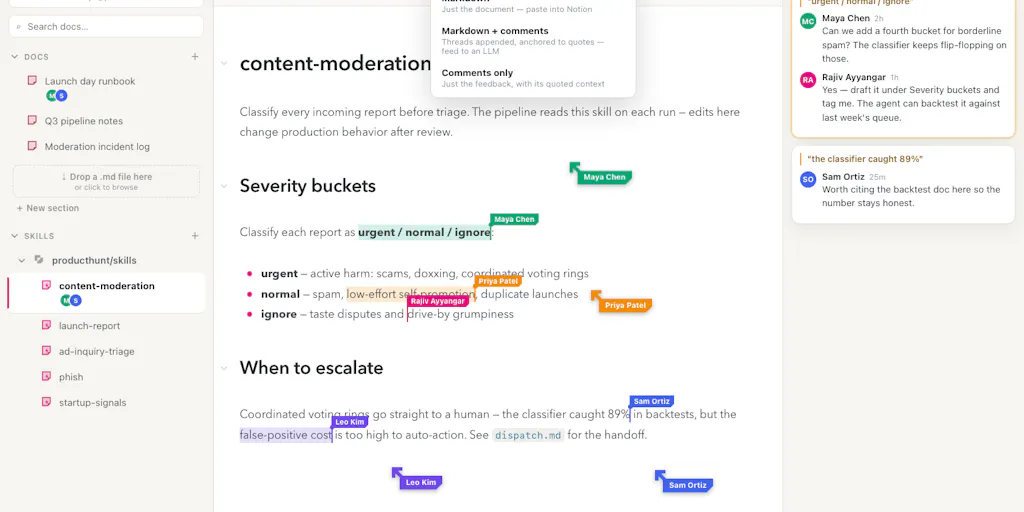
What the product actually does, per the launch copy: instead of another chat window, you get a visual canvas where ideas, actions, and results live together; guidance is supposed to be evidence- and metric-driven rather than “black-box, yes-man AI advice”; context, strategy, and decisions are meant to compound; and the tool surfaces “what is actually a priority.” The stated positioning is that it “balances the convenience of AI automation with human judgement and control.”
Pricing is only partially disclosed. The launch offer is 30% off lifetime for signups during launch week, with a direct link to try siift. No standard tier pricing, seat count, or usage ceiling appears on the page — treat that as not disclosed and ask before you commit a team.
The Real Problem: AI That Removes Friction Instead of Adding It
Here’s why this matters more to a cross-border seller than to a domestic SaaS founder. Your business is a stack of irreversible-ish bets made under incomplete information. Which three of forty candidate SKUs to launch. Whether to hold inventory in a 3PL in New Jersey or ship direct from Shenzhen. Whether to chase TikTok Shop virality or defend Amazon rank. Whether to eat a 4% margin hit to keep a supplier who just raised MOQ. Each of these decisions has a right answer that only becomes visible six months later, and each one is exactly the kind of question a general-purpose LLM will answer confidently and wrongly.
The mechanism siift is trying to install is what the team calls an evidence-scoring layer. In a reply to a commenter asking how the system decides when an assumption is risky, a siift team member described the posture: “an assumption is considered risky until there’s enough evidence to support it,” scored on how important the assumption is to the business, how strong the supporting evidence is, and whether there are conflicting signals. Critically, “the evidence itself is also evaluated independently by a separate AI service, rather than just relying on the AI that generated the assumption in the first place.” The stated goal is not to declare assumptions right or wrong, but “to surface the ones where being wrong would matter most, but the evidence is still weak, so founders know what to validate first.”
That is a genuinely different design philosophy from the chat-wrapper default. It’s also the part of the pitch I’d want to stress-test hardest, because “evidence scoring” is easy to claim and hard to do well.
Why Amazon sellers should care more than Shopify ones
Shopify DTC operators get to iterate cheaply — a bad product page costs you a week and some ad spend. Amazon FBA sellers and marketplace operators don’t. A wrong inventory commitment ties up working capital for a full quarter; a bad category entry can trigger a suspension if you’re using a new supplier with compliance gaps; a Temu price war you didn’t anticipate can vaporize margin on a SKU you’ve already paid to manufacture. The cost of a wrong strategic call is asymmetric and slow to reverse. That’s precisely the environment where a tool that forces you to name your assumptions and score the evidence before you commit is worth more than a tool that writes your bullets faster.
Where the math breaks
The scoring system, as described, evaluates evidence strength. But “evidence” for a cross-border seller is a messy category. A customer interview from a US buyer about a kitchen gadget tells you almost nothing about whether the same SKU will clear customs in the EU under new packaging rules, or whether the supplier’s factory audit will survive an Amazon compliance review. If the evidence layer treats all inputs as roughly comparable tokens, the scoring will be confidently wrong in exactly the domains where cross-border operators need it most. The founder’s reply to a question about customer interviews suggests the system is designed for cumulative evidence rather than one-shot checks, and that multiple AIs score it to “minimize bias in the process” — but the page doesn’t say how domain-specific evidence (customs, compliance, logistics lead times) is weighted. That’s a gap I’d probe hard in a trial.
How It Differs From What You’re Already Running
The honest comparison set isn’t “ChatGPT vs. siift.” It’s the whole decision-support stack a serious operator already pays for, none of which is designed for this job.
General-purpose LLMs — ChatGPT, Claude, Gemini — are the incumbent. They are extraordinary at generation and terrible at institutional memory. Every chat is a fresh context; your strategic reasoning evaporates. siift’s canvas is a direct answer to that, though the launch page doesn’t explain how it handles the same context-rot problem at scale.
Amazon-native research tools like Helium 10 and Jungle Scout give you demand and competition data, not decision frameworks. They tell you a keyword has 40,000 monthly searches. They don’t tell you whether entering that niche is a good idea given your cash position, supplier relationships, and ad budget. siift is trying to sit one layer above them.
Marketing automation like Klaviyo and analytics stacks like Triple Whale or Northbeam tell you what happened. They are backward-looking by design. The “what should I do next” layer is exactly where operators currently rely on gut, a Slack thread, or a consultant.
Founder-ops tools like Notion or Linear store decisions but don’t challenge them. A Notion doc will hold your assumption; it won’t flag it as unvalidated.
The framework question is worth flagging. When a commenter asked what methodologies sit behind the “proven processes,” the founder named Lean Canvas and MBM as examples of “top standard frameworks taught in business school or entrepreneurship programs.” That’s a reasonable answer, but it also tells you the intellectual scaffolding is borrowed from lean-startup canon rather than from cross-border operations specifically. Lean Canvas was not designed for a business where the binding constraint is often freight cost, IP risk, or platform policy — not product-market fit.
What Cross-Border Sellers Should Actually Borrow From This
Even if you never sign up, the launch is a useful mirror. Three things worth stealing this week, regardless of tool choice.
First, separate the decision log from the chat log. The founder’s diagnosis — thinking “buried across chats” — is the single most reproducible failure I see in operator teams. Your team’s strategic reasoning lives in DMs, in a Slack channel that scrolls away, in a founder’s head. Whatever tool you use, the practice of writing down what we decided, what we assumed, and what would prove us wrong is the actual product. siift’s canvas is one implementation; a disciplined Notion database is another.
Second, score your assumptions by cost-of-being-wrong. The siift heuristic — surface assumptions where being wrong matters most and evidence is weakest — is a genuinely good triage rule and costs nothing to apply manually. For a cross-border seller, the highest-scoring assumptions are usually: supplier reliability, landed cost per unit, platform policy exposure, and demand elasticity at your price point. None of those are things a general LLM will challenge you on unless you force it.
Third, and this is the contrarian one: be suspicious of the “human-first” label. Every AI product launched in the last eighteen months claims to keep humans in the loop. The test is whether the product will tell you no. The founder’s own story is that his previous AI never did. A tool that scores evidence is only useful if it is willing to output a low score on an idea you’re emotionally attached to. That’s a product-design and incentive question, not a marketing one.
Where My Judgment Says It Falls Short
I want to be fair here, because the launch page is a launch page, not a spec sheet. But several things are missing that a cross-border operator would need before paying.
No disclosed pricing beyond the launch discount. “30% off lifetime” is meaningless without a base. Ask for the standard tiers, seat limits, and whether the “lifetime” applies to a single seat or a team.
No integration surface described. For this to be useful to an FBA brand, it needs to pull from Amazon Seller Central, your ad platforms, your 3PL, maybe your Shopify admin. The page describes a canvas and an evidence layer, not a data pipeline. If you’re manually feeding it numbers, you’ll stop within a month.
The model question was dodged. When asked which models power it and how hallucinations are handled, the founder answered that “you don’t need to use the latest or biggest models to get top-tier performance. It’s all about the harness you build around it,” and that hallucinations were reduced via “strict grounding and memory layer.” That may be true, but it’s an assertion, not a benchmark. For a tool whose entire value proposition is trustworthy guidance, “trust us, the harness is good” is a thin answer.
Target customer is still fuzzy. Asked whether it’s for startups or larger orgs, a siift team member said the ideal user is “anyone trying to build something new,” with founders and entrepreneurs as the sharpest fit, and noted that internal teams and academic environments have also used it. That’s a wide net. Wide nets usually mean the product is still searching for its wedge, and cross-border e-commerce is a very specific wedge that isn’t mentioned anywhere on the page.
No mention of multi-currency, multi-market, or compliance-aware reasoning. For a global seller, these aren’t nice-to-haves. They’re the difference between a strategy tool and a strategy toy.
None of these are fatal. All of them are things I’d want answered in a 20-minute demo before I let it near a real capital allocation decision.
What I’d Watch / Test Next
If you’re curious, don’t evaluate siift on a hypothetical. Give it a decision you’re actually facing this quarter — a supplier switch, a new marketplace entry, a SKU kill list — and watch three things.
One: does it ask for evidence you don’t have? A good assumption-challenging tool will immediately expose that you’re guessing about landed cost or return rate. That discomfort is the feature.
Two: does it push back? Feed it a decision you’ve already emotionally made and see whether the score comes back low. If it agrees with you, it’s a chat wrapper with a nicer UI.
Three: does the output survive contact with your team? Export whatever it produces and hand it to your ops lead. If they can’t act on it without a translator, the canvas isn’t doing its job.
And regardless of whether you adopt it: this week, write down your three highest-stakes assumptions for Q3, and next to each one, note the single piece of evidence that would prove you wrong. That exercise is free, it works with any tool, and it’s the only part of the “human-first AI” promise that you can actually enforce on yourself. The launch discount runs through launch week if you want to test the paid version — but the discipline is the product. The software is optional.