Why This Matters More Than Another AI Chatbot
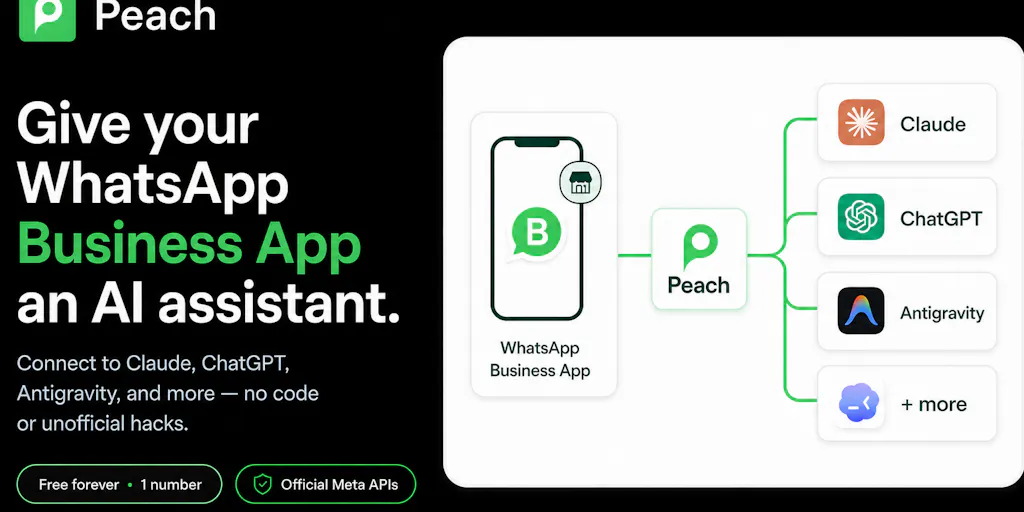
Every cross-border seller I know has the same dirty secret: their most important conversations aren’t happening in a tidy CRM or a helpdesk ticket. They’re happening in WhatsApp — with suppliers in Shenzhen, with freight forwarders in Yiwu, with Amazon account managers who only respond after 11 PM their time, with customers who’d rather send a voice note than open an email. And those conversations are a mess. They’re scattered across your phone, buried under family group chats, impossible to search, and completely invisible to the AI tools you’ve already started trusting with your product research and ad copy. That’s the gap Peach Co-Pilot is targeting, and for anyone running an operation that touches global supply chains, this is not a nice-to-have — it’s the missing bridge between the unstructured chaos of chat and the structured workflows you actually run your business on. The pitch is simple: keep using WhatsApp Business exactly as you do today, but let Claude, ChatGPT, or any MCP-compatible AI tool see and act on that account for you. No browser extensions, no unofficial libraries, no API keys, no coding. Connect your existing number, follow a few prompts, and your AI assistant can draft replies, chase quiet leads, triage your inbox, and run scheduled sweeps. It’s the kind of tool that makes you wonder why we’ve been treating WhatsApp as a black hole for business context for the last decade.
The Official API Bet: Why This Isn’t Another Fragile Hack
The first thing that separates Peach from the graveyard of WhatsApp automation tools is a deliberate architectural decision: it’s built exclusively on Meta’s official WhatsApp Business APIs. That might sound like technical detail, but for anyone who’s been burned by the ecosystem of unofficial workarounds — the browser extensions that break when WhatsApp updates, the Python libraries that get your number banned, the “automation” services that are one policy change away from killing your account — this is the entire ballgame.
Suresh, Peach’s co-founder, makes the point explicitly in the launch thread: they chose the official APIs from day one, even though it meant more complexity and a slower path to launch. When asked whether this was a deliberate product decision, his answer is unambiguous: “We’ve been building on the official WhatsApp Business APIs from day one, even though that meant more complexity and a slower path to launch. For something as business-critical and personal as WhatsApp, we didn’t want customers worrying about fragile browser hacks, unofficial workarounds, or the risk of losing their number.”
That’s the right bet, and here’s why it matters specifically for cross-border operators. Your WhatsApp number isn’t just a communication channel — it’s often your only verified line to suppliers who don’t use email reliably, to factories that need PO confirmations at 3 AM their time, and to customers in markets where WhatsApp is the default commerce channel. Losing that number to a ban from an unofficial automation tool isn’t an inconvenience; it’s a supply chain disruption. The fact that Peach connects through Meta’s official APIs means the compliance risk sits with Meta’s own infrastructure, not with a scrappy third-party hack.
Why Amazon sellers should care more than Shopify ones
Here’s where I’ll get contrarian for a second. The Product Hunt crowd will mostly see this as a productivity tool for busy professionals — and it is. But for cross-border e-commerce operators, the use case hierarchy is inverted. Shopify sellers have Zendesk, Gorgias, and a dozen helpdesk tools that already ingest email and chat. Amazon sellers, especially those doing private label in categories where supplier relationships are everything, have nothing comparable for WhatsApp. Your Amazon Seller Central messages are structured and trackable; your supplier negotiations are not. If you’re managing a 40-foot container order with a factory in Guangdong, the critical path runs through WhatsApp voice notes and forwarded images of inspection reports. That’s the context Peach can capture and make actionable — and it’s why I’d argue the Amazon FBA operator gets more leverage from this tool than the DTC brand owner with a polished Shopify stack.
What the Product Actually Does (and What It Doesn’t)
Let’s get specific about the mechanics, because the devil is in the data flow. Peach Co-Pilot connects to your existing WhatsApp Business App number through Meta’s official APIs. You continue using the WhatsApp Business app on your phone normally — that’s a critical distinction from tools that force you into a web dashboard or a separate client. The AI layer — Claude, ChatGPT, or any MCP-compatible tool — can then:
- Find conversations and recall past decisions
- Draft and send contextual replies
- Follow up with quiet leads
- Triage a busy inbox
- Send files and documents
- Run scheduled inbox sweeps
You can also exclude private contacts and disconnect access whenever you want. The Lite version launching today is free forever for one WhatsApp Business number, subject to fair use. That’s a smart wedge: free for one number, which means you’ll actually try it with your real supplier conversations, not a throwaway test account.
The MCP (Model Context Protocol) angle is worth pausing on. MCP is the emerging standard that lets AI models access external tools and data sources in a structured way. By building on MCP, Peach isn’t locking you into their own AI — you bring whatever model you already trust. That’s the right architecture for a tool like this, because the last thing a cross-border operator needs is another proprietary AI with its own quirks and data policies.
Where the math breaks
Now let’s talk about the hard part — and the question that Richard Mohammed asked in the launch thread is exactly the right one: “When Claude or Cursor reads a thread through this, what actually leaves my machine and what do you keep?” Suresh’s answer is honest: the requested WhatsApp content passes through Peach and is returned to your AI client. It leaves your machine, and it’s subject to the data-handling policies of the AI provider you choose. Peach stores message data encrypted in transit and at rest, and they’re SOC 2 audited and certified. You can disconnect your number and request deletion at any time.
That’s a straight answer, but it’s also the point where I’d flag a real concern for cross-border operators. If you’re using this to manage supplier negotiations, you’re sending your pricing discussions, your MOQ details, your shipping terms — the proprietary commercial context of your entire operation — through a third-party relay to an AI provider. The SOC 2 certification covers Peach’s handling of the data, but it doesn’t cover what Anthropic or OpenAI does with your conversation history. For most sellers, that’s an acceptable trade for the productivity gain. But if you’re operating in categories where supplier relationships are genuinely proprietary — private label with exclusive designs, for instance — you need to think carefully about which threads you let the AI see. The “exclude private contacts” feature is a start, but it’s a blunt instrument. You can’t exclude “all conversations with my factory about the new SKU” — you can only exclude entire contacts.
What Cross-Border Sellers Can Borrow From This
Even if you never install Peach, the product is a signal about where the industry is heading — and there are three concrete lessons for how you run your operation.
First, the official-API-first approach is the only sustainable way to automate messaging. If you’re already using WhatsApp automation tools — or if you’ve been tempted by the cheap unofficial options — this launch is a reminder that the risk calculus has changed. Meta has been cracking down on unofficial automation for years, and the cost of a ban is now catastrophic for anyone who runs a real operation through the platform. When you evaluate any messaging automation tool, the first question shouldn’t be “what can it do?” — it should be “what’s the compliance architecture?” If the answer isn’t “official Meta APIs,” walk away.
Second, the MCP-compatibility trend is going to reshape your tooling stack. The fact that Peach lets you plug in Claude, ChatGPT, or any MCP-compatible tool is a sign that the AI layer is becoming interchangeable. That’s good news for operators: you’re no longer locked into a single vendor’s AI quirks. When you’re evaluating AI tools for your business — whether it’s for product research, ad copy, or customer service — prioritize tools that are MCP-compatible or at least have open APIs. The ones that try to lock you into their own model are going to lose.
Third, the “quiet lead follow-up” use case is more valuable than it sounds. One of Peach’s core features is following up with quiet leads — the people who went dark after a quote, the suppliers who stopped responding, the customers who asked a question and never got an answer. In cross-border e-commerce, quiet leads are the silent killer of revenue. A supplier who goes quiet on a price quote is often a supplier who’s giving your competitor a better rate. A customer who goes quiet after a question is a customer who’s one click away from buying from someone else. The ability to have an AI systematically sweep your WhatsApp for these dead-end conversations and nudge them back to life is genuinely valuable — and it’s a feature I’d expect to see replicated across every CRM and helpdesk tool in the next 12 months.
Where My Judgment Says It Falls Short
I want to be clear: I like this product, and I think the team is asking the right questions. But there are three gaps that would stop me from making it the backbone of my WhatsApp workflow today.
The data governance question is unresolved. The launch thread shows the team is aware of this — Suresh explicitly says they’re documenting the precise data flow and retention periods more clearly — but “we’re documenting it” isn’t the same as “here’s the documentation.” For a cross-border operator, the data flow matters not just for privacy but for compliance. If you’re handling EU customer data, GDPR requires you to know exactly where data goes and how it’s processed. If you’re handling supplier commercial data, you need contractual clarity on who owns the AI’s outputs. Until Peach publishes clear, specific documentation on data retention, processing locations, and AI provider handoffs, this is a tool for low-stakes conversations, not for your core supplier negotiations.
The “follow a few prompts” setup hides real complexity. The team says setup takes minutes and requires no code, and I believe them — for the basic use case. But the moment you want the AI to do something genuinely useful — like “triage my inbox and draft replies to suppliers about the delayed shipment, but don’t send anything without my approval” — you’re going to need to write instructions that are effectively prompts. And prompt engineering for a tool that can send messages on your behalf is a different beast than prompt engineering for a chatbot. The stakes are higher: a bad prompt doesn’t produce a bad answer, it produces a bad message sent to a supplier. I’d want to see more guardrails and templates for high-stakes use cases before I’d trust this with anything mission-critical.
The “free forever” Lite tier has a ceiling. Free forever for one WhatsApp Business number is a generous wedge, and it’s the right go-to-market move. But “subject to fair use” is doing a lot of work in that sentence. For a cross-border operator managing multiple supplier conversations, one number isn’t enough — you’ll want to connect your customer-facing number, your supplier number, and possibly your internal team number. That’s going to cost money, and the pricing for the paid tiers isn’t disclosed yet. I’d want to see the pricing model before I invested time in building workflows around it.
What I’d Watch / Test Next
If you’re a cross-border operator reading this, here’s what I’d do this week — not next quarter, this week.
First, claim the free Lite tier and connect your lowest-stakes WhatsApp Business number. Don’t connect your main supplier line yet. Use a number you use for customer inquiries or secondary supplier communication. Spend 30 minutes setting it up and ask the AI to do one thing: draft replies to unanswered messages from the last 48 hours. Don’t let it send anything yet — just see how well it understands context and tone. That’s the fastest way to gauge whether the tool is ready for your real workflows.
Second, pressure-test the data governance. Before you connect anything, email the Peach team and ask for their data flow documentation. Ask specifically: where are messages processed, which AI providers are supported, what happens to message data when you disconnect, and what the retention period is. The team is clearly responsive — they answered detailed questions in the launch thread — so use that. If they can’t give you clear answers, that’s your answer.
Third, start thinking about which WhatsApp conversations are actually your business-critical context. Most cross-border sellers treat WhatsApp as ephemeral — messages that are read, answered, and forgotten. But your supplier negotiations, your pricing discussions, your shipping terms — that’s the commercial DNA of your operation. Even if you never use Peach, the exercise of identifying which conversations hold your most valuable context is worth doing. Once you know where the value lives, you can decide what to protect, what to automate, and what to leave alone.
Peach Co-Pilot isn’t the finished product — the team is explicit that they’re launching early to get real user feedback. But the direction is right, and for cross-border operators, the timing couldn’t be better. The tools that win the next phase of e-commerce won’t be the ones with the best dashboards — they’ll be the ones that can finally see and act on the conversations we’ve been having all along.


