Why a Developer Tunnel Tool Deserves Your Attention as a Cross-Border Seller
Let’s be honest: when I scroll Product Hunt and see a tool called “Localdock” that promises to replace localhost with a persistent project link, my first instinct as someone who spends 14-hour days in Amazon Seller Central and Shopify admin is to keep scrolling. Developers are not my target audience; my audience is a warehouse manager in Shenzhen and a customer in Ohio. But here is the uncomfortable truth that separates operators who scale from those who plateau: the most expensive bottleneck in cross-border e-commerce is not ad spend or freight rates — it is the feedback loop between your internal tools and your external partners. Every time you have to screen-record a dashboard, email a CSV, or explain a bug report over a blurry Zoom call, you are burning margin. Localdock, despite its humble developer-facing pitch, is a case study in solving that exact class of problem: making local, temporary, and fragile resources accessible to anyone with a link. And if you can borrow that architecture for your own vendor portals, QC workflows, or TikTok Shop content previews, you will shave days off your iteration cycles. Let me explain what this tool actually does, why the free alternatives like ngrok and Tailscale aren’t quite the same, and what a $9 one-time purchase can teach you about building trust with overseas partners.
The Problem: Your “Local” Work Is Invisible to Everyone Who Matters
The core friction Localdock addresses is one every cross-border operator knows intimately: the gap between “it works on my machine” and “it works for the person I need to convince.” For a developer, that gap means a colleague in another timezone cannot see the new checkout flow. For you, that gap means your factory partner in Dongguan cannot see the revised product label without you sending a WeChat screenshot, and your Amazon listing manager in Vietnam cannot preview the A+ content you just edited without a shared Google Drive folder that is already three versions out of date.
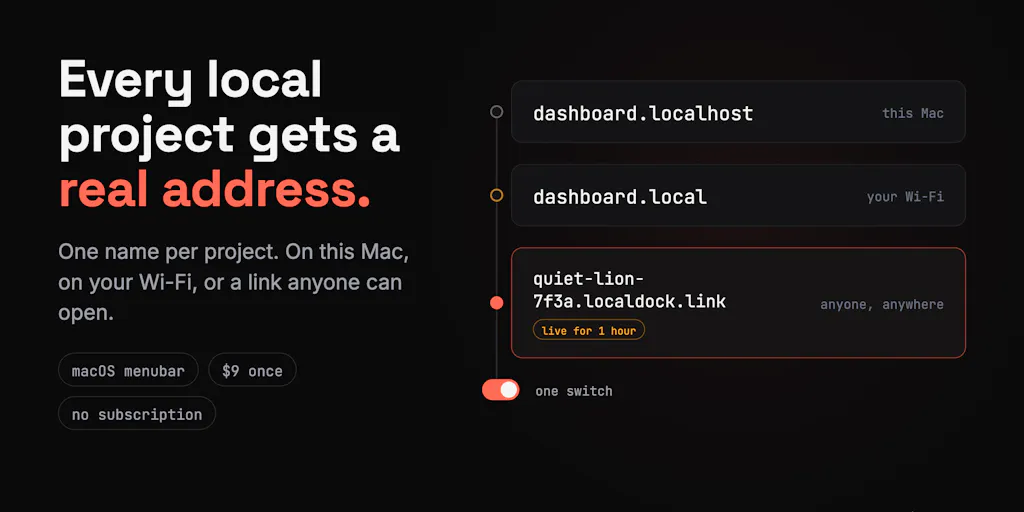
The maker, Dmytro V, describes Localdock as solving this with three core features: a persistent project link instead of localhost plus port, Wi-Fi sharing with that persistent link, and a tunnel. The key word here is persistent. Most free tunneling solutions give you a random URL that expires or changes every time your machine reboots. For a developer demo, that is annoying. For a cross-border workflow, that is fatal. If I send a link to my 3PL partner on Monday and it is dead by Wednesday, I have lost credibility and created a support ticket.
This is why the Product Hunt discussion is so revealing. The top comment from Gal Dayan asks the exact question your procurement manager would ask: “what does the $9 one-time buy you that a free ngrok/Tailscale Funnel tunnel doesn’t?” The maker’s honest answer — that it is “not only about tunnels” but about the persistent link and Wi-Fi sharing — is the whole ballgame. In our world, the difference between a tool that is 80% effective and one that is 95% effective is not a luxury; it is the difference between a product launch that hits the runway and one that gets stuck in customs.
Why Amazon sellers should care more than Shopify ones
Here is a contrarian take: if you are a pure Shopify DTC operator, you might already have decent preview and collaboration tools built into your theme editor and your email marketing platform like Klaviyo. But if you are an Amazon FBA seller, you are living in a black box. Seller Central does not give you a staging environment. You cannot spin up a “preview” of your listing that your virtual assistant in the Philippines can comment on before you hit submit. You are editing live, praying that the category manager does not flag your bullet points for a policy violation. Any tool that gives you a persistent, shareable link to a work-in-progress state — whether that is a listing mockup, a Helium 10 keyword research export, or a Jungle Scout opportunity scorecard — is worth more than its weight in gold because it closes the loop between your strategy and your execution team.
How Localdock Differs from the Incumbents (and Why It Matters)
Let’s get specific about the competitive landscape. The default choice for most developers is ngrok, which has a generous free tier but is fundamentally a reverse proxy that exposes a local server to the public internet. The tunnel URL is the product. Tailscale Funnel is another option, leveraging a WireGuard-based mesh network to expose services, but it requires a client install on every device that needs access. Localdock’s positioning, as described in the launch page, is different: it lives in your menu bar, gives you a persistent project link, and allows Wi-Fi sharing without requiring the recipient to install anything.
For a cross-border operator, this “no client install” framing is the killer feature. Think about your last interaction with a freight forwarder or a supplier who is not technically sophisticated. Asking them to install Tailscale, create an account, and accept an invitation is a non-starter. Asking them to click a link that opens in a browser is trivial. The maker’s response to the ngrok comparison confirms this: he pivots the conversation to the persistent link and Wi-Fi sharing, not the tunnel speed. That is a product management decision that understands the buyer is not the developer who loves CLI tools, but the person who needs to show something to a non-technical stakeholder.
The second differentiator is the pricing model. A $9 one-time payment is psychologically brilliant for a niche tool. It is low enough to be an impulse buy — less than the cost of a late-night Uber to the airport — but high enough to signal that the developer has put real thought into the UX. In contrast, ngrok’s paid tiers are subscription-based, and Tailscale’s business features are monthly. For a solo seller or a small team that does not want another recurring line item on their QuickBooks, a one-time fee is a welcome change. It also aligns incentives: the maker is not trying to extract recurring revenue from you; he is trying to build a user base that will give feedback on his roadmap.
Where the math breaks (and where it doesn’t)
Let’s do the math that any CFO would do. The tool costs $9 once. If it saves you one hour of back-and-forth with a remote contractor — and that hour is billed at even $15 — it has paid for itself. The break-even point is absurdly low. However, the math breaks down if you need more than a one-hour session. The maker explicitly states in the comments that “the link is temporary and lives for no more than 1 hour.” This is a critical limitation. If you are running a 24-hour flash sale or a multi-day QA cycle, a one-hour link is useless. You would be back to screen recordings or, worse, leaving your computer on overnight with a tunnel open — a security nightmare.
This is where the tool falls short for our industry. We do not live in one-hour increments. A product launch cycle is days. A supplier audit is weeks. A TikTok Shop content calendar is months. The maker’s roadmap may address this, but as of the launch, the one-hour TTL is a hard constraint. That said, the privacy stance — “Localdock is not collecting any info” — is a strong counterweight. In an era where every SaaS tool is mining your data for AI training, a tool that explicitly says it keeps no logs is a trust signal that larger vendors cannot match.
What Cross-Border Sellers Can Borrow from This Tool (Beyond the Tool Itself)
The most valuable takeaway here is not that you should buy Localdock and start tunneling your localhost. The takeaway is the pattern of solving a collaboration problem with a persistent, shareable link. Let me give you three concrete ways to apply this thinking in your own operations this week.
First, consider how you share inventory reports with your 3PL. Instead of emailing a weekly CSV that gets overwritten and causes version confusion, build a small script that generates an HTML dashboard and serves it on a persistent URL. Even if you use a free tool like GitHub Pages or a simple Cloudflare Tunnel, the principle is the same: your partner gets a link that always shows the latest data, not an attachment that is stale the moment you send it.
Second, use the “no client install” principle when onboarding overseas VAs or agencies. The moment you ask a contractor to install software, you have added friction that will delay your project by at least a day. Localdock’s Wi-Fi sharing feature is a reminder that the best tool is the one that requires zero setup from the recipient. If you are evaluating a new project management tool or a design collaboration platform, ask this question: can the client-side user simply open a browser, or do they need an account? The answer will predict your onboarding success rate.
Third, and this is the meta-lesson, pay attention to the Product Hunt comments as a market research goldmine. The commenter Doon says, “Ive built so many local LLM based solutions that no one can use. I have to make videos of everything.” That frustration is universal. Every cross-border seller has built a spreadsheet or a workflow that is brilliant but inaccessible to their overseas team. The solution is not to make more videos; it is to make the work itself accessible via a link. Whether you use this tool, a self-hosted solution, or a platform like Loom (which is just a video link), the goal is the same: reduce the distance between the creator and the consumer of information.
A note on security and trust
The thread also touches on a question that should be on every operator’s mind: can someone abuse a tunnel to serve pirated content? The maker’s response that the link is temporary and limited to one hour is a reasonable mitigation, but it is not a security strategy. If you are sharing sensitive financial data with your accountant in another country, do not use a public tunnel. Use a VPN or a dedicated tool like Tailscale with proper access controls. The lesson here is to match the tool to the sensitivity of the data. A product mockup is fine on a temporary link. A P&L statement is not.
Where I’d Watch / Test Next
If you are a solo seller or a small team that regularly collaborates with remote contractors, I would not buy Localdock today — the one-hour link limit is too restrictive for most real-world workflows. But I would watch it. The maker has a clear roadmap, and if he extends the link lifetime or adds a scheduling feature, the value proposition becomes significantly more compelling. Here is what I would do this week:
Test the free tier of ngrok to understand the basics of tunneling. Set up a simple HTML page that shows your current inventory levels and share the link with your 3PL for a one-hour window. Measure how much faster they respond when they can see live data instead of waiting for an email.
Audit your current collaboration stack — whether that is Slack, WhatsApp, or WeChat — and identify the top three instances where you shared a screenshot or a video to explain something that could have been a live link. For each instance, find a tool that generates that link natively.
Set a budget for “one-time utility tools.” The $9 price point is a reminder that not every software purchase needs to be a subscription. Allocate $50–$100 per quarter for niche tools that solve a specific pain point. The ROI on a tool that saves you one hour of frustration is immediate.
Re-read the Product Hunt comments as a customer discovery exercise. The questions people ask — about bandwidth limits, data logs, and comparison to free tools — are the same questions your buyers ask about your products. Pay attention to how the maker handles objections. It is a masterclass in honest positioning.
The bottom line is that Localdock is not a tool for cross-border sellers. But the problem it solves — making the local accessible, the temporary persistent, and the complex simple — is the exact problem you face every day. Steal the pattern, ignore the product, and watch your feedback loops tighten.