Why a QA Agent for Developers Is Quietly Relevant to How You Ship Storefronts
If you run a cross-border operation, your storefront is your sales floor, your customer service desk, and your brand reputation all at once. A broken checkout button on a Friday afternoon doesn’t just cost you a sale — it costs you the customer’s trust, a negative review on Trustpilot, and a support ticket that eats into your margin. For years, the standard answer has been to hire more QA people or to buy more testing tools, both of which are slow, expensive, and still leave gaps. The emergence of agentic testing tools like Checksum signals a shift in how we think about verifying the software we ship, and that shift matters far beyond the engineering team. If you’re building on Shopify, managing a custom Amazon seller tool, or running a DTC site with a headless front-end, the ability to have an AI agent not only write but also maintain your test suite is a competitive advantage you should be watching closely. This isn’t about replacing your developers; it’s about freeing them from the drudgery of test maintenance so they can focus on the features that actually move your conversion rate.
The Real Problem: It’s Not Writing Tests, It’s Keeping Them Alive
Most sellers I talk to who have dabbled in test automation hit the same wall. They spend weeks or months getting a suite of end-to-end tests running, only to see it slowly rot. A developer changes a button’s CSS class, a third-party payment widget updates its DOM structure, or a new marketing banner shifts the layout, and suddenly half your tests are red. The team spends days triaging failures, trying to figure out which ones are real bugs and which are just the test being out of sync with the new reality. Eventually, the suite becomes noise, and people start ignoring it. That’s the exact pain point Gal, founder and CEO of Checksum, describes from his own experience at a previous startup, where he watched teams “lose entire sprints to test maintenance.”
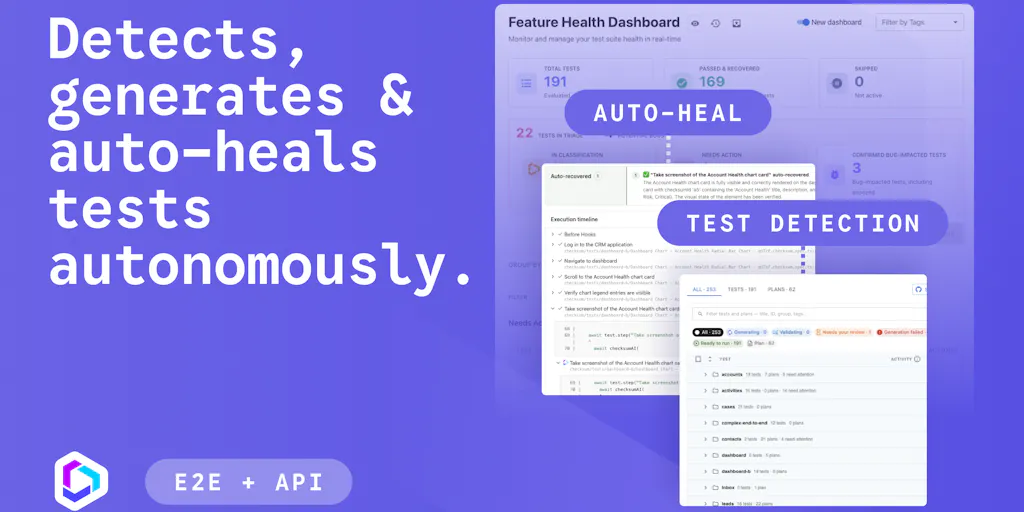
The core insight here is that AI coding tools solved the generation problem, but not the verification problem. As Gal points out, teams can now “ship far more code than ever,” but every pull request still needs to be tested and trusted before it ships. This is the bottleneck that Checksum is attacking. Their agentic loop runs in two parts: first, an agent spins up on every PR, detects what changed, and generates or updates end-to-end and API tests automatically. Second, when a test fails, a second agent steps in to triage it — determining whether it’s a real bug or a broken test caused by a product change. Real bugs get routed to Jira, Linear, or Slack; broken tests get fixed autonomously.
This is a fundamentally different approach from the traditional test automation tools like Selenium or even modern frameworks like Playwright. Those tools give you the ability to write and run tests, but they don’t maintain themselves. You still need a human to update selectors, re-triage failures, and decide what’s a bug and what’s just noise. Checksum’s bet is that this triage and maintenance work is the actual cost center, and it’s the part that can be automated. The fact that everything ships as standard Playwright code committed to your own repo is a smart move — it means no proprietary format and no lock-in, which addresses a major concern for teams that have been burned by black-box QA tools in the past.
Why Amazon Sellers Should Care More Than Shopify Ones
If you’re purely a Shopify seller using a standard theme, you might think this is irrelevant. But consider the complexity of an Amazon FBA operation. You’re likely managing inventory across multiple marketplaces, dealing with repricing tools, and using a variety of third-party apps for everything from review generation to supply chain forecasting. Any custom integration you build to glue these systems together is a piece of software that can break. The more complex your operation, the more you rely on software that needs to be verified. For Amazon sellers, a broken repricing tool that isn’t caught quickly can mean losing the Buy Box for hours or days, which directly impacts revenue. The ability to have an agent that not only catches that break but also fixes the test that would have caught it is a significant operational upgrade. Shopify sellers with a standard theme might get away with less testing, but the moment you go headless or add custom theme code, you’re in the same boat.
How It Differs from the Incumbent Tooling Landscape
To understand where Checksum fits, you have to look at the existing options. On one end, you have manual QA — the offshore developer or a dedicated QA team member who clicks through the site before a release. This is slow, expensive, and error-prone. On the other end, you have test automation frameworks like Playwright or Cypress, which require a significant upfront investment in writing and maintaining test code. In between, you have tools that promise “codeless” testing, but those often end up being another black-box layer that’s hard to integrate into your existing workflow.
Checksum’s differentiator is the “healing” workflow. The maker’s response in the comments highlights that “70% of failures resolve that way without anyone touching them.” This is a bold claim, but it speaks to the core problem of test flakiness. The comment from Ashir Murtaza nails it: “AI generated code is only useful if the tests don’t become another maintenance job.” This is the exact fear that Checksum is trying to address. The value isn’t in the initial generation of tests — that’s becoming commoditized — it’s in what happens after the app changes and your suite starts to bleed red.
The comparison to a tool like Testim or Mabl is inevitable. These are also AI-powered testing platforms that promise self-healing tests. However, Checksum’s approach of committing Playwright code directly to your repo is a philosophical choice that stands out. It treats the test suite as a first-class citizen in your codebase, subject to the same review process as any other code change. As the maker Michelle Dailey explains, “a generated test shows up as a normal PR, gets reviewed like any other code change, not approved through some separate tool.” This is a huge win for teams that care about code quality and auditability. You’re not trusting a black box; you’re reviewing the exact diffs the agent proposes.
Where the Math Breaks
Let’s talk about the economics. The pitch from Counterpart is that they run a “10x QA team on Checksum at less than half the cost of one offshore developer.” The engineering manager, Ron Alexssen, is quoted as saying, “For less than half the salary cost of an offshore developer, I have the impact of a full QA team.” That’s a compelling ROI story. But where does the math break down? For a small team with a simple app and a handful of critical user flows, the cost of setting up and maintaining a tool like this might not be justified. You could probably get away with a few manual test scripts and a solid monitoring tool. The value of Checksum scales with the complexity and frequency of your changes. If you’re deploying multiple times a day and have a complex application with multiple services, the time saved on triage and maintenance is immense. If you’re shipping once a week to a static site, the overhead might not be worth it.
Another potential break point is the trust factor. The question from Hamza Afzal Butt is the right one: “How do teams build confidence in auto healed tests without manually reviewing every change?” The answer from the makers is that every healed change lands as a diff you can review, and over time, you build trust by seeing the model make correct decisions on the same failure modes. This is a reasonable approach, but it requires a discipline that not every team has. If you let the agent run wild without review, you could end up with a test suite that is green but not actually testing anything meaningful — the worst kind of false security.
What Cross-Border Sellers Can Borrow from This Playbook
You might not be running a SaaS product, but the principles here translate directly to your e-commerce operation. The first lesson is about automation of the boring stuff. Whether it’s checking your inventory feed for errors or validating that your shipping rates are calculated correctly, there are repetitive tasks that are perfect for automation. The idea of an agent that not only runs the check but also fixes the test when it breaks is a model for how to think about your operational tooling. You want systems that are self-healing, not systems that require constant manual babysitting.
The second lesson is about the importance of the “triage” step. In your business, not every negative review is a real problem with your product; sometimes it’s a customer who had a bad experience with the courier. Not every drop in conversion is a real issue; sometimes it’s a seasonal trend. The skill of distinguishing signal from noise is what separates good operators from great ones. Checksum’s approach of routing real bugs to the team and fixing broken tests autonomously is a framework you can apply to your own data analysis. Build systems that can automatically categorize issues and only escalate the ones that truly need human intervention.
The third lesson is about avoiding lock-in. The decision to ship standard Playwright code is a refreshing move in an industry that loves proprietary ecosystems. For sellers, this is a reminder to be wary of tools that hold your data hostage. Whether it’s your customer database in a closed CRM or your product listings in a proprietary format, you should always have a clear exit path. The ability to walk away from a tool and take your data and your work with you is a form of leverage that you should never give up.
Where My Judgment Says It Falls Short
Despite the strong value proposition, there are a few areas where I’m skeptical. First, the claim of “zero flaky tests” from Postilize is a red flag. In my experience, flakiness in end-to-end tests is often a symptom of deeper issues — poor test isolation, reliance on timing, or flaky third-party services. An AI agent can heal a test that’s broken by a UI change, but it can’t fix a test that’s inherently unreliable due to a race condition in your application. If the agent “heals” a flaky test by making it more resilient, it might be masking a real performance issue that will eventually bite you in production.
Second, the focus on end-to-end and API tests is a narrow slice of the testing pyramid. What about unit tests and integration tests? Those are often where the most critical logic bugs are caught. If Checksum is only generating and maintaining the top of the pyramid, you’re still leaving a lot of risk on the table. The makers mention it specializes in “complex cases across surfaces and users,” which sounds great, but the mention of “auth boundaries” and “edge flows” in the launch post suggests they’re targeting the hard E2E scenarios, not the foundational unit tests that your developers should be writing anyway.
Finally, there’s the pricing question. The source mentions a “free 30-day trial with code PHLAUNCH,” but doesn’t disclose the actual pricing. This is a common pattern for enterprise-focused tools, but it makes it hard to assess the ROI without a sales conversation. For a small team or a solo seller, the cost might be prohibitive, even if the value is clear. The Counterpart case study is impressive, but it’s a large company with a complex platform. The math might not work the same way for a two-person operation managing a single Shopify store.
What I’d Watch / Test Next
For the cross-border operator who wants to apply this thinking without a full commitment, here are three concrete steps you can take this week.
First, audit your current “test suite” — and I use that term loosely. What are the critical user flows on your site or in your internal tools that, if broken, would cost you money? Write them down. This doesn’t need to be automated yet; just having a clear checklist of your top ten critical paths is a valuable exercise. For most sellers, this will be checkout, add-to-cart, search, and maybe the account login flow.
Second, if you have a development team, have them look at Playwright and start writing a few tests for those critical paths. Even if you don’t adopt Checksum, the discipline of having a few reliable tests is better than none. If you’re a non-technical seller, this is a good time to start a conversation with your agency or freelance developer about their testing practices. Ask them how they verify their work before pushing it live. If they don’t have a good answer, that’s a red flag.
Third, sign up for the free trial of Checksum using the code PHLAUNCH. Even if you’re not sure it’s the right fit, seeing how an agentic loop works in practice will give you a better understanding of what’s possible. Run it against a staging environment of your store or your internal tools. Watch how it handles a change you make to a page layout. The goal is to see if the “healing” workflow lives up to the hype. The real test isn’t whether it can generate tests — it’s whether it can keep them alive and trustworthy over time. That’s the metric that matters.