The $30/month Question Every Cross-Border Seller Using AI Should Be Asking
Most cross-border operators I know are now paying for three or four AI subscriptions at once — a ChatGPT plan for listing copy, a Claude subscription because the reasoning is better on supplier contracts, a Cursor seat for whoever touches the storefront code, plus a couple of API keys wired into n8n or Zapier for the automation nobody wants to rebuild. Each one lives in its own silo with its own quota, and the moment you hit a limit mid-task you’re either paying overage or switching tabs and losing context. So when OpenLLM launched on Product Hunt promising “take your tokens anywhere” — one key across your subscriptions, API keys, and local models, with a fallback chain when you hit a cap — my first instinct as a seller wasn’t “cool developer toy.” It was: this is the missing layer between the half-dozen AI tools my ops team already pays for and the actual work of running a store across Amazon, Shopify, and TikTok Shop. Here’s my read.
What OpenLLM Actually Solves — and Why It’s a Seller Problem, Not Just a Dev Problem
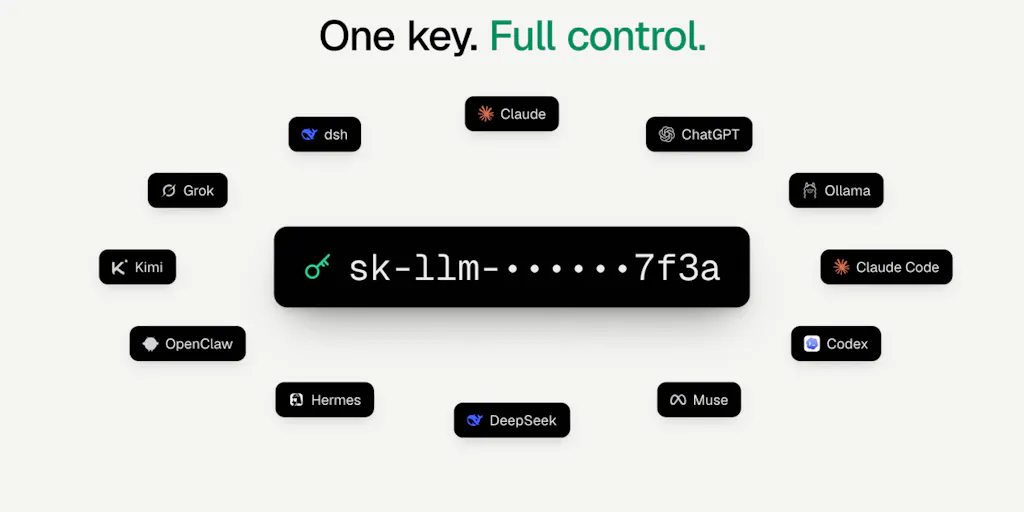
Strip away the coding-agent framing and the core mechanic is simple. OpenLLM, built by the team at openllm.sh, gives you a single unified key that routes requests across every AI subscription and API key you already own. You connect Claude, Codex, Kimi, Grok, Muse, and Cursor subscriptions once, stack them in a priority order, and when the top model hits its usage ceiling the next one picks up automatically. The founder, Jonathan Archer, frames the origin story plainly: he was “paying for a lot of intelligence and could only use it in the box it came in.” That’s the exact complaint I hear from sellers who bought a Claude Pro seat for the listing team and a separate API budget for their automation stack, then watched both sit half-idle because the workflows couldn’t cross the wall between them.
The feature list matters more than it looks at first glance. There’s a shared memory layer — save a decision or preference once and every connected app can recall it — and it’s included on every plan, including free. There’s remote session support, so you can start a coding session on your home machine from a laptop or the web app. There’s a ChatGPT app integration on Mac that lets you run the ChatGPT client against your OpenLLM-routed models. And there’s free inference on DeepSeek and Qwen so your first request works before you connect anything. Pricing is free to start, Pro at $30/month for up to five devices with a three-day trial, and a Product Hunt promo code (PHUNT) for 50% off Pro for six months for the first 100 people.
Why Amazon sellers should care more than Shopify ones
Here’s the asymmetry most coverage will miss. A Shopify DTC brand’s AI usage is concentrated: listing copy, ad creative briefs, maybe a support macro generator. One or two seats covers it. An Amazon FBA operation is fragmented by necessity — Helium 10 or Jungle Scout for research, a separate stack for PPC bid rules, Seller Central’s own reporting, a review-analysis workflow, a supplier-email workflow, and increasingly an agentic layer stitching them together. Every one of those tools wants its own model endpoint and its own key. The fallback chain is genuinely valuable in that environment, because a PPC optimization agent that dies mid-run when you hit a Claude limit is worse than no agent at all — you get a half-applied bid change and no audit trail. Routing through one key with automatic failover is the difference between automation you trust overnight and automation you babysit.
How It Stacks Up Against What Sellers Are Already Using
The honest comparison set isn’t other Product Hunt launches — it’s the tools already in your stack. OpenRouter is the closest functional analogue for the API-key side: one endpoint, many models, pay-per-token. But OpenRouter is fundamentally a marketplace for inference you buy through them. OpenLLM’s pitch is different — it’s about your existing subscriptions, the flat-fee plans you already pay for, not a new metered bill. That distinction matters enormously for a seller running lean margins. If you’ve already sunk $20–$100/month into Claude and ChatGPT seats, squeezing more utility out of those sunk costs before adding another line item is the right order of operations.
Against Cursor and Claude Code, OpenLLM isn’t a competitor — it’s a wrapper that sits underneath them. The founder’s own framing is that you “keep working when you hit a limit” inside “the coding agents you already use.” That’s a complement play, and it’s the right one. The comparison that’s less flattering is against doing nothing: if you’re a single-operator store doing $30k/month, the complexity tax of a routing layer may not pay for itself. The math flips somewhere around the point where you have two or more people touching AI tools daily and at least one automated workflow that runs unattended.
Where the math breaks
The founder is unusually candid about the limits, and sellers should take him at his word: “It doesn’t make any subscription unlimited, and it isn’t account sharing. Your vendor’s limits and terms still apply.” That’s the correct disclosure, but it also means the value proposition is smoothing, not expanding. If your problem is genuinely that you need more tokens than you’re paying for, OpenLLM won’t fix that — you still need to buy more capacity. What it fixes is the waste from capacity sitting stranded in the wrong app when you need it elsewhere. For a seller, that’s a real but bounded saving. Don’t let the “one key” framing convince you you’re getting more intelligence for free.
What Cross-Border Operators Should Borrow From This Launch
Three things, and none of them require you to sign up.
First, the fallback-chain mental model applies to your whole ops stack, not just AI. The reason this product resonates is that it treats vendor limits as a routing problem rather than a crisis. Sellers should apply the same logic to fulfillment: a primary 3PL, a backup 3PL with an integration already tested, a documented trigger for when you switch. Most operators have a primary and a prayer. The launch is a reminder that resilience is a design choice you make before you need it.
Second, the shared-memory feature is the sleeper. A single memory layer that every connected app can recall — brand voice rules, supplier lead times, your returns policy, the exact tone your TikTok Shop captions use — is precisely what’s missing when you have five different AI tools each starting from zero on your brand. Whether OpenLLM’s implementation holds up across a fallback switch is an open question (more on that below), but the architectural idea is one every seller should be demanding from their tooling vendors. If your listing tool and your support tool don’t share context, you’re paying twice for the same onboarding.
Third, the observability angle. Commenters on the launch pushed on exactly the right thing: seeing which model answered and where a fallback occurred mid-session. For a seller running automated pricing or ad-spend decisions, that audit trail isn’t a nice-to-have — it’s the difference between being able to explain a bad automated decision to your account manager and not. When you evaluate any AI tool that touches money, ask whether it logs which model made which call. Most don’t.
Where My Judgment Says It Falls Short
I’ll be direct: this is a developer-first product wearing a generalist jacket, and sellers should calibrate accordingly. The launch is built around coding agents — Codex, Cursor, Claude Code, Kimi Code. The integrations that matter to a seller’s actual daily workflow — Shopify admin, Amazon Seller Central reporting, Klaviyo flows, Helium 10 — aren’t mentioned, and an MCP marketplace is only “coming soon.” The same-key-works-anywhere claim (“anywhere an OpenAI or Anthropic key does”) is the bridge, but you’ll be doing the wiring yourself.
The unanswered questions that matter for operators
The comment thread surfaced the exact technical questions I’d want answered before trusting this with unattended workflows, and the founder’s answers were partial. When a session falls back from a hosted model to a local one mid-task, does the local model inherit the full conversation or restart from a summary? A commenter asked precisely this and it wasn’t fully resolved. Does shared memory propagate mid-task or only on new sessions? The founder’s answer — Codex only picks up mid-task “if you ran out of usage with Claude, and it was placed below it on your fallback chain” — is narrower than the marketing implies. And the account-safety question, which the founder says is the one he gets most, is answered in a comment rather than the main copy; for sellers whose entire business rides on not getting a marketplace or vendor account flagged, “it’s for your own accounts on your own machines” needs to be airtight, not reassuring.
Platform support is macOS and Linux only — no Windows, which rules out a chunk of warehouse and ops desks. Teams features (per-person token limits, shared memory across a team) are “coming soon,” so the multi-seat value proposition for a growing seller isn’t there yet. And the $30/month Pro tier caps at five devices, which is fine for a solo operator and tight for a team of five sharing a workflow.
What I’d Watch / Test Next
This week, before spending a dollar, I’d do three concrete things. First, audit your actual AI spend: list every subscription and API key, note the monthly cost, and estimate what percentage of each quota goes unused. If more than a third of any seat is idle, a routing layer has a business case — if not, it doesn’t yet. Second, pick your single most limit-sensitive unattended workflow — PPC bid rules, repricing, or review-response automation — and test OpenLLM’s fallback chain against it in a sandbox with a deliberately exhausted top model. Watch whether the fallback preserves enough context to finish the task cleanly, and whether the log tells you where the switch happened. Third, read the account-safety comment in full and pressure-test it against your specific vendor terms before you route anything tied to a marketplace account through it. The product is promising and the pricing is honest; the question is whether it’s ready for the workflows where a mid-task failure actually costs you money. Test that before you trust it.