Why a Legal-Tech Agent Builder Should Make Every E-commerce Operator Reconsider Their Automation Stack
There’s a dirty secret in cross-border e-commerce that nobody puts on their LinkedIn profile: most of our “scaled operations” run on a fragile patchwork of Zapier zaps, half-configured back-office tools, and a VA or two who quietly carry the entire business in a Google Sheet. We obsess over the front-end — the ad creative, the PDP, the TikTok Shop affiliate list — while the back office bleeds hours into work that is, as the Caddi team puts it, “not hard, it’s just endless.” A signed contract comes back, someone downloads it, renames it to the firm convention, files it to the matter, logs it in the CRM. Swap “contract” for “purchase order” or “return label” and you’ve just described the life of an Amazon FBA operator. So when I see a Product Hunt launch for a tool called Caddi — an agent that builds agents, aimed at law firms, RIAs, and accounting firms — I don’t see a vertical SaaS product. I see a mirror held up to every e-commerce operator who has ever paid a human to copy-paste data between Seller Central and an inventory app. The question isn’t whether this specific tool is for us. The question is what it teaches us about the next generation of operational automation, and whether we’re going to be the ones building it or the ones being automated around.
The Problem Caddi Actually Solves: The “Endless Work” Gap That Zapier Can’t Close
Let’s be brutally honest about the current state of e-commerce automation. We have Zapier and Make for the simple stuff — “when a new order comes in, send a Slack message.” We have Helium 10 and Jungle Scout for the research layer. But the moment a workflow involves judgment — “is this a valid return or a scam?” or “should this customer get a refund or a replacement?” — the automation stops and a human has to pick it up. The gap isn’t in the tools; it’s in the translation of operational knowledge into executable rules. Caddi’s core insight, as articulated by maker Jason Alafgani on the launch page, is that “automating that has always meant a project. Scope it, spec it, configure it, get a developer. So it never happens, and people keep doing it by hand.” That’s the exact same reason your operations team is still manually reconciling Shopify payouts against Stripe fees every Monday morning.
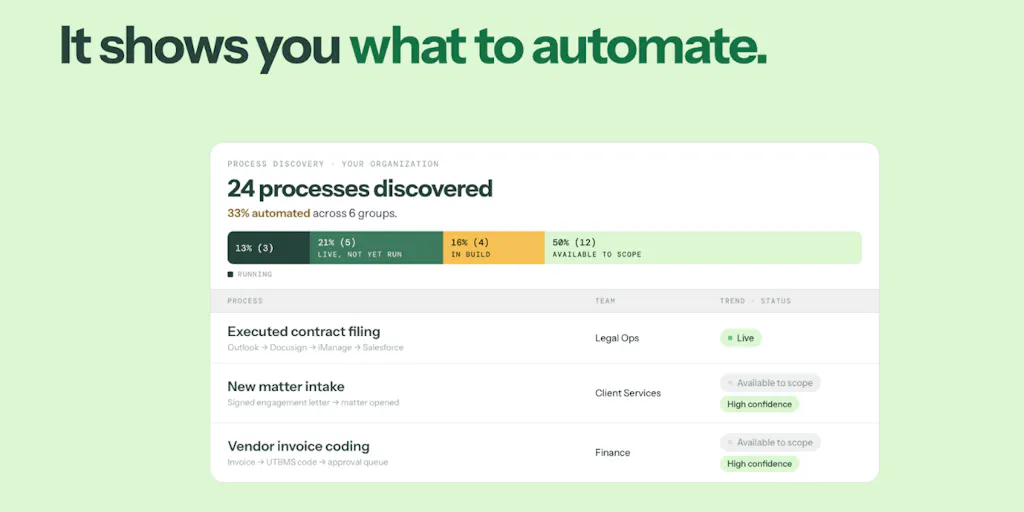
What Caddi does differently is start before you build anything. The product claims to “read your stack and tells you which work you repeat most, ranked by impact.” That’s the discovery layer that’s been missing. Most of us don’t even know what our most repetitive work is — we just feel it as a vague sense of drowning. Caddi’s “discover” function, which Alafgani describes in the comments as proactively checking your tools to find repetitive work, is the operational equivalent of an audit. Then, instead of forcing you to learn a visual builder or write YAML, you teach it like a new hire. You talk to it, it asks questions back, and it probes for edge cases — the product description gives the example of asking “how you tell an executed copy from a draft.” For us, that’s the difference between a return label and a return label where the customer has already opened a dispute.
The key architectural bet — and this is where it gets interesting for cross-border sellers — is the hybrid reasoning model. Caddi “reasons with AI where judgment is needed and runs deterministic code where it isn’t.” That’s not a marketing phrase; it’s the only viable architecture for production-grade automation. If you let an LLM handle the arithmetic, you get hallucinations. If you let deterministic code handle the ambiguity, you get brittle systems that break on the first edge case. The “messy cases get handled without the exact parts going off-script” — that’s the promise that actually matters for anyone who’s watched a Klaviyo flow send a “Your order is on the way!” email for a package that’s been stuck in customs for three weeks.
Why Amazon Sellers Should Care More Than Shopify Ones
Here’s a controversial take: if you’re a Shopify DTC operator, you might be able to skip this. Your platform is modern, your APIs are clean, and you can hire a developer to build custom flows. The pain is real but the infrastructure is forgiving. Amazon FBA sellers are in a different universe. Amazon Seller Central is a legacy fortress of clunky UI, opaque rules, and data that lives in a dozen disconnected tabs. The operational work — reconciling disbursements, managing FBA inbound shipments, responding to Buy Box suppression notices, handling A-to-Z claims — is exactly the kind of “endless work” that Caddi’s pitch describes. The stakes are higher too. On Shopify, a missed notification costs you a customer. On Amazon, a missed deadline can get your listing suppressed or your account flagged. The tolerance for “automation that mostly works” is much lower, which is why the Caddi model — where it stops and asks when it hits ambiguity, with “the options laid out and a confirm button” — is so compelling. You don’t want an agent that guesses on a compliance question. You want one that knows the difference between a draft and an executed copy, and asks when it doesn’t.
How Caddi Differs From the Incumbents: The “Teach It Like a New Hire” Paradigm
Every automation tool claims to be AI-powered now. The incumbents — UiPath in the RPA space, Workato in the integration space, and the aforementioned Zapier/Make in the SMB space — all have some flavor of AI assistance. But they all share a fundamental assumption: the human is the architect, and the machine is the executor. You design the workflow, you map the steps, you handle the exceptions. Caddi flips this. The human is the teacher, and the machine is the agent that learns. The distinction matters because it changes the skill required. I don’t need to be a workflow architect to tell Caddi “when a contract comes back signed, file it to the matter and log it in the CRM.” I just need to know my own job.
The other differentiator is the self-improvement loop. In the comments, when asked about handling small changes in the process, Alafgani responds that Caddi is “self-improving, so it’s constantly looking for things that break and suggests fixes on its own.” That’s a radical departure from the traditional automation model where you are the maintenance burden. Every Zapier user knows the pain of a zap that silently fails for three weeks before you notice. Caddi’s approach — “you can update the process with a simple message, then it’ll test it, and if you like the results, it ships the new version” — is the difference between a tool you maintain and a colleague you manage. For a cross-border operator running a lean team, that’s the difference between a system that scales and a system that becomes a second job.
The third differentiator is the transparency layer. The launch page emphasizes that “every run is a log of what it decided, step by step, with the permission it used to do it: read, create, send.” This is the trust architecture that enterprise buyers demand and that SMB tools often skip. When an agent is going to send an email to a customer or create a record in your ERP, you need to know it did it right. The permission model — read, create, send — is a clean taxonomy that maps to how we actually think about risk. Reading is low-risk, creating is medium, sending is high. The fact that Caddi surfaces this per-action is exactly the kind of audit trail that will eventually become table stakes for any AI agent that touches customer data.
What Cross-Border Sellers Can Borrow From Caddi (Without Buying It)
Here’s where I shift from product review to operational strategy. You don’t need to be a law firm to benefit from the Caddi playbook. The principles it embodies are transferable to any e-commerce operation, and you can start implementing them this week with the tools you already have.
Principle One: Discover before you automate. Most of us automate reactively. A problem shows up, we build a fix, we move on. Caddi’s approach is to proactively scan your stack for repetitive work and rank it by impact. You can do a poor man’s version of this by spending 30 minutes in your Shopify Admin or Amazon Seller Central looking at your recent activity. What actions are you taking over and over? What data are you copying between systems? What reports are you generating manually? Write them down. Rank them by time spent and error cost. That list is your automation backlog.
Principle Two: Teach, don’t spec. The reason most automation projects die is the specification phase. Writing a detailed requirements doc is boring, and it’s easy to miss edge cases. The Caddi model — talk through the process, let the system ask clarifying questions, and have it probe for ambiguity — is a much more natural way to capture operational knowledge. You can replicate this by recording yourself (or your best operator) doing a task while talking through your decision-making. That recording is the spec. Whether you feed it to an AI tool or hand it to a developer, it’s infinitely more useful than a dry document.
Principle Three: Hybrid reasoning is the only safe bet. The moment you trust an LLM with your entire workflow is the moment it fails spectacularly. The Caddi architecture — AI for judgment, deterministic code for exactness — is the correct pattern. When you’re building your own automations, split the workflow into “judgment steps” and “exact steps.” Use an LLM (via OpenAI API or similar) for the judgment steps, and hardcode the exact steps. Never let the LLM do arithmetic, and never let the deterministic code handle ambiguity.
Principle Four: Build in the stop-and-ask. The most valuable feature in Caddi, from my perspective, is the ability to pause when it hits something ambiguous. Most automation tools fail because they either guess (and guess wrong) or they error out (and stop the whole flow). The “stop and ask with options laid out and a confirm button” pattern is the right middle ground. You can implement this in your own systems by adding a human-in-the-loop step for any workflow that has a low-probability, high-cost edge case. It’s slower, but it’s safer.
Where the Math Breaks: The Trust Line for E-commerce
There’s a comment on the launch page from a user asking where law firm customers “draw the trust line in practice — read and create but never send?” The maker’s response is telling: lawyers trust their Caddies to do the operational work that associates and partners do, including client intake and pre-billing. That’s a high bar. But for e-commerce, the trust line is different. We’re not dealing with privileged client communications; we’re dealing with customer data, payment information, and marketplace compliance. The risk profile is different. I’d trust an agent to read and create records all day. I’d be much more cautious about letting it send — an email, a refund, a response to an A-to-Z claim — without a human review. The cost of a wrong send is not just the immediate error; it’s the damage to seller metrics that can take months to recover. So when you’re evaluating any agent tool, ask specifically about the permission model. If the tool can’t granularly control what an agent can do — and log it — it’s not ready for marketplace operations.
Where Caddi Falls Short (And Why I’m Not Ditching My Stack Yet)
Let me be clear: Caddi is not a tool I would deploy in my e-commerce operations today, and it’s not because the product is bad. It’s because the product is built for a different vertical. The workflows Caddi excels at — contract management, client intake, billing — are document-centric and process-heavy. E-commerce workflows are system-centric and data-heavy. Our operational work involves more integrations with marketplaces, payment gateways, and logistics APIs. The question of whether Caddi can “handle workflows that hop across 3 or 4 different apps in one go” was asked in the comments, and the maker answered that it’s “actually best at long-running, multi-step, multi-tool tasks” with particular pride at accuracy for 6+ steps. That’s promising, but it’s also a claim I’d want to see tested against a real Amazon MWS or Shopify Admin API integration before I trusted it with my order data.
The bigger gap is the compliance question. When asked about healthcare use cases, the maker was honest: no HIPAA certification, so no patient data. For e-commerce, the equivalent concern is PCI DSS compliance for payment data, and the various data privacy regulations like GDPR and CCPA that govern customer data. Caddi is not certified for any of these, and the maker’s response — “operational work, yes absolutely” — suggests they haven’t prioritized this. For a cross-border seller handling EU customer data, that’s a non-starter. You can’t have an agent reading and creating records in your CRM if it’s not compliant with the data residency and privacy requirements of your market.
The pricing is also not disclosed, which is a red flag for SMBs. Enterprise tools for law firms and RIAs typically command enterprise prices. If Caddi is priced at $500+ per seat per month, it’s not going to be viable for a 10-person e-commerce operation. The value proposition has to be measured against the cost of a part-time VA, which is still the default solution for most operators. I’d want to see a clear ROI calculator before I even consider a pilot.
What I’d Watch / Test Next
If you’re a cross-border operator, here’s what I’d do this week, based on the Caddi launch:
Run your own “discover” audit. Spend 30 minutes in your operational tools — Shopify Admin, Amazon Seller Central, your ERP, your inventory management system — and list the top 10 repetitive tasks you do weekly. Rank them by time spent and cost of error. This is the Caddi “discover” function, done manually. You’ll likely find that 80% of your operational pain comes from 3-4 tasks.
Pick one workflow and teach it to an LLM. Choose the highest-impact task from your audit. Write a detailed prompt for ChatGPT or Claude that describes the task, including all the edge cases you can think of. Ask the model to ask you clarifying questions, just like Caddi does. This exercise will reveal how much operational knowledge is locked in your head and how poorly you’ve documented it.
Map the permission model. For that same workflow, write down every action it requires: what needs to be read, what needs to be created, and what needs to be sent. This is the Caddi permission taxonomy. It will help you decide where you can trust automation and where you need a human checkpoint.
Test a hybrid automation. Take that workflow and build a simple version using Zapier or Make for the deterministic parts, and an LLM API call for the judgment parts. Add a manual approval step for any “send” action. This is the poor man’s Caddi, and it will tell you more about your operational readiness than any tool evaluation.
The Caddi launch is a signal, not a solution. It’s a signal that the automation paradigm is shifting from “build workflows” to “teach agents.” The tools that win in e-commerce will be the ones that let us teach them like a new hire — with questions, edge-case probing, and a stop-and-ask button — while running on a permission model we actually trust. The question is whether we’re ready to be teachers, or whether we’re going to keep being the ones doing the endless work. The line between the two is the whole product.