The Controller Launch That Should Bother Every Hardware Seller on Amazon
Every few weeks a Product Hunt launch lands that looks like a curiosity to the SaaS crowd but reads like a warning label to anyone who sells physical goods across borders. This week it’s the 8BitDo Arcade Controller Pro, a $119.99 fight-stick-adjacent device from 8BitDo, shipping next month for Windows, Switch, and Switch 2. On the surface it’s a niche gaming peripheral. Underneath, it’s a masterclass in how a Chinese-founded hardware brand has spent a decade turning enthusiast credibility into a repeatable cross-border retail machine — and why the rest of us should be taking notes on the pricing, the spec sheet, and the launch cadence rather than the fighting-game ergonomics.
What the product actually solves (and why the problem is bigger than fighting games)
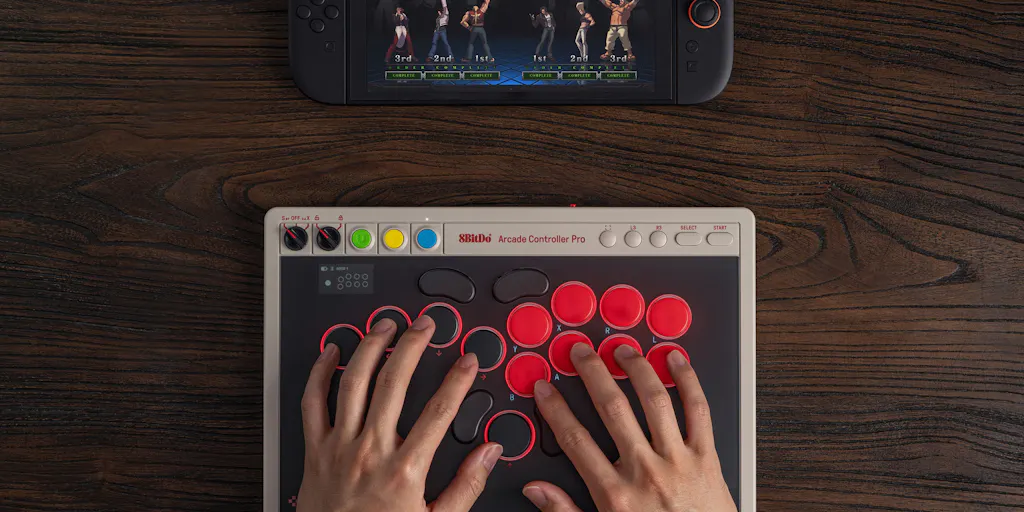
The Arcade Controller Pro is built for fighting games, and the design brief reads like it was written by someone who has lost a ranked match to a dropped input. There’s no joystick — it’s all buttons, in a compact layout, with five programmable buttons and a 1.47-inch screen that lets you check inputs, remap buttons, and change SOCD modes directly on the device. For the uninitiated, SOCD (simultaneous opposite cardinal direction) resolution is the arcane ruleset that determines what happens when you press left and right at the same time; different tournaments and platforms handle it differently, and getting it wrong is the difference between a clean input and a disqualification. Putting that control on the controller itself, rather than buried in desktop software, is a genuine workflow improvement for the tournament crowd.
The hardware details are where it gets interesting for operators. There’s a metal lock to keep the USB-C cable in place — a small thing that solves a very real failure mode in competitive play, where a bumped cable ends a match. A rear release lifts off the glass faceplate so you can swap mechanical switches, which is the keyboard-enthusiast playbook applied to a game controller: sell the platform, let the community customize the feel. Five flat lock caps are tucked inside the magnetic wrist rest for buttons you keep hitting by accident, and a side dial turns on Tournament Lock so you don’t fat-finger your way out of a legal configuration mid-match.
That’s a lot of spec for a $119.99 device, and the price point is the tell. This is not a commodity accessory racing to the bottom on Temu. It’s a premium, opinionated product with a clear point of view, sold to a community that will pay for the details. That positioning is the entire ballgame in cross-border hardware right now.
Why Amazon sellers should care more than Shopify ones
If you run a Shopify DTC brand, this launch is interesting but not urgent — you already control your storefront, your margins, and your customer relationship. If you run an Amazon FBA business, this should sting a little. 8BitDo’s entire model is built on the assumption that a hardware brand can own its category across marketplaces and its own channel simultaneously, using enthusiast press and community goodwill as the top of the funnel instead of paid acquisition. The Product Hunt launch itself is free distribution to exactly the kind of early adopter who writes the reviews that later sell the product to the mainstream. When you’re fighting for Amazon Seller Central rank against a brand that already has a decade of community equity, your PPC budget is competing with something money can’t easily buy.
How it differs from the incumbents — and what that says about category ownership
The obvious comparison set is the fighting-game controller market: Hori with its Real Arcade Pro line, Razer with its Kitsune and Panthera sticks, Victrix at the premium end, and a long tail of boutique leverless builders. What 8BitDo is doing differently is not a single feature — it’s the cadence. Look at the launch history on that Product Hunt page: the original Bluetooth SNES Controller in November 2015, the NES30 Pro in February 2016, the 8BitDo wireless omni-platform controller in May 2016, and the M30 Retro Controller in January 2019. That’s a brand that has been iterating in public, on the same product line, for the better part of a decade.
That cadence matters more than any single SKU. The incumbents tend to launch a flagship and then coast on it for years, defending share with sponsorships and tournament presence. 8BitDo ships a new variant, a new form factor, or a new compatibility target every few quarters, each one small enough to be a manageable inventory bet and distinctive enough to earn its own press cycle. For a cross-border seller, that’s the playbook: treat your catalog as a series of bounded experiments rather than a single hero product you’re terrified to touch.
Where the math breaks
Here’s where I’d push back on the “just copy 8BitDo” instinct. The $119.99 price and “ships next month” timeline are doing a lot of quiet work. Premium pricing only holds if the community believes the brand will support the product — firmware updates, switch compatibility, tournament legality rulings. That support cost is real and ongoing, and it’s the part of the model that doesn’t show up in a Product Hunt post. A seller who copies the price point without the community infrastructure is just an expensive unknown. The other break point is the platform mix: Windows, Switch, and Switch 2 is a deliberately narrow compatibility matrix. Every additional platform you claim support for is another QA surface, another set of returns, and another reason a review can go sideways. 8BitDo’s discipline in not claiming everything is a feature, not a limitation.
What cross-border sellers can borrow from this launch
Three things, and they’re all operational rather than creative.
First, the spec-as-marketing approach. Every feature in that Product Hunt post is a sentence a reviewer can quote. “Metal lock to keep the USB-C cable in place” is not a spec — it’s a story about a failure mode the buyer has personally experienced. When you write your Amazon bullet points or your Shopify product page, you’re usually listing features. The 8BitDo post lists scars. That’s the difference between a listing that converts and one that gets skimmed.
Second, the on-device screen as a retention play. A 1.47-inch screen that lets users check inputs and remap buttons without a companion app is a support-cost reduction disguised as a feature. Every function you move on-device is a customer-service ticket you don’t have to staff, a firmware update you don’t have to ship, and a reason the product still feels current two years after launch. If you sell any hardware with a companion app, ask yourself which three settings could live on the device instead. Your Zendesk queue will thank you.
Third, the launch-as-community-event framing. The Product Hunt post is written by a “Hunter” — Zac Zuo — not by a brand account, and the tone is enthusiast-to-enthusiast. That’s a deliberate choice about who introduces the product to the community. For cross-border sellers, the equivalent is finding the subreddit moderator, the Discord admin, or the niche reviewer who already has the audience’s trust and letting them be the one who says “look at this.” It’s slower than a TikTok Shop affiliate blast and it doesn’t scale the same way, but it’s how you get the first hundred reviews that make the next thousand sales possible.
A note on fulfillment and returns
The “ships next month” line is doing something subtle: it’s a pre-order signal. For a hardware product with mechanical switches and a glass faceplate, pre-orders are how you fund the production run and validate demand before you commit to inventory. Cross-border sellers who use SHEIN-style fast-turnaround suppliers often skip this step and eat the inventory risk. The 8BitDo model — announce, take orders, ship in weeks — only works if your supply chain is close enough to the factory to turn a pre-order into a shipment without a six-week ocean-freight gap. That’s a logistics decision as much as a marketing one, and it’s the part of the playbook most sellers can’t replicate without moving their production closer to their customer.
Where my judgment says it falls short
I’m not fully sold on the Arcade Controller Pro as a category-defining product, and here’s why. The leverless fighting-game controller market is small, intensely opinionated, and already served by boutique builders who have deep tournament credibility. 8BitDo’s brand equity is in retro and omni-platform controllers — the SNES and Genesis nostalgia lane — not in the competitive fighting-game scene. The Razer Kitsune and the Victrix Pro FS already own the “serious tournament player” mindshare, and they’ve been at it longer. A $119.99 entry from a retro-brand is a credible value play, but it’s not obviously a must-buy for the person already invested in a $300 leverless stick.
The second concern is the screen. A 1.47-inch display on a controller is a wonderful demo feature and a potential long-term liability — screens fail, firmware gets abandoned, and a dead screen on a $119.99 device is a one-star review waiting to happen. I’d want to see the update cadence and the warranty terms before I called it a smart trade. The third concern is the Switch 2 compatibility claim. Launching for a platform that’s still new is a bet on the platform’s install base growing faster than your support costs — and if the Switch 2’s controller ecosystem tightens up, that bet gets expensive.
Why this matters beyond gaming
Step back and the pattern is clear: a hardware brand with Chinese manufacturing roots has built a decade-long cross-border business on community trust, premium pricing, and a steady drumbeat of bounded product experiments. That’s the model every DTC hardware operator is trying to copy, and most of them are failing at the boring parts — the support, the firmware, the returns, the platform discipline. The Arcade Controller Pro isn’t the story. The fact that 8BitDo can launch it at all, on a decade of goodwill, is the story.
What I’d watch / test next
Three concrete things an operator can do this week. One: audit your top three listings and rewrite one bullet per SKU in “scar” language — name the failure mode the customer has experienced, then explain how your product solves it. Measure conversion against the control for two weeks. Two: if you sell any connected hardware, list every setting currently locked in a companion app and pick one to move on-device. Ship it in your next firmware update and watch your support ticket volume for that feature. Three: look at your launch cadence over the last 24 months. If you’ve shipped one hero product and coasted, plan a bounded variant — a new colorway, a bundle, a compatibility expansion — and give it its own press cycle instead of burying it in your existing listing. The 8BitDo pattern isn’t about being clever. It’s about being consistent for longer than your competitors are willing to be.