Why the Most Private AI Agent on Product Hunt Matters to Your Cross-Border Operation
If you run a cross-border e-commerce business—whether you’re juggling Amazon FBA inventory across three countries, bidding on TikTok Shop ads at 2 AM, or parsing supplier contracts in Mandarin—the thing that keeps you up at night isn’t which marketplace has the best buy box algorithm. It’s data leakage. Every time you paste a supplier price list into ChatGPT, every time you feed a competitor’s ad copy into Claude for analysis, every time you let a cloud-based AI tool touch your PPC data, you’re handing the keys to someone else’s inference stack. The OpenCode Superapp launched on Product Hunt by maker Andrew Flores is not yet another AI coding tool. It’s a blueprint for how operators can bring AI into their private workflow without surrendering control over the hardest-won asset any cross-border seller owns: the proprietary data that makes your business faster, cheaper, and smarter than the next guy. And that’s exactly why you need to understand it before your competitors do.
What Problem Does This Actually Solve—And Why Should a Seller Care?
Let’s be honest: most AI tooling in e-commerce today is a thin wrapper around OpenAI’s API. You log into ChatGPT, ask it to write a product description for a fidget spinner that complies with EU RoHS directives, and hope it doesn’t hallucinate a certification number. But the real pain isn’t accuracy—it’s trust. Every prompt you write, every image you upload, every P&L summary you paste into a cloud LLM becomes part of the model’s training data unless you’ve explicitly opted out. And even then, the provider sees your traffic.
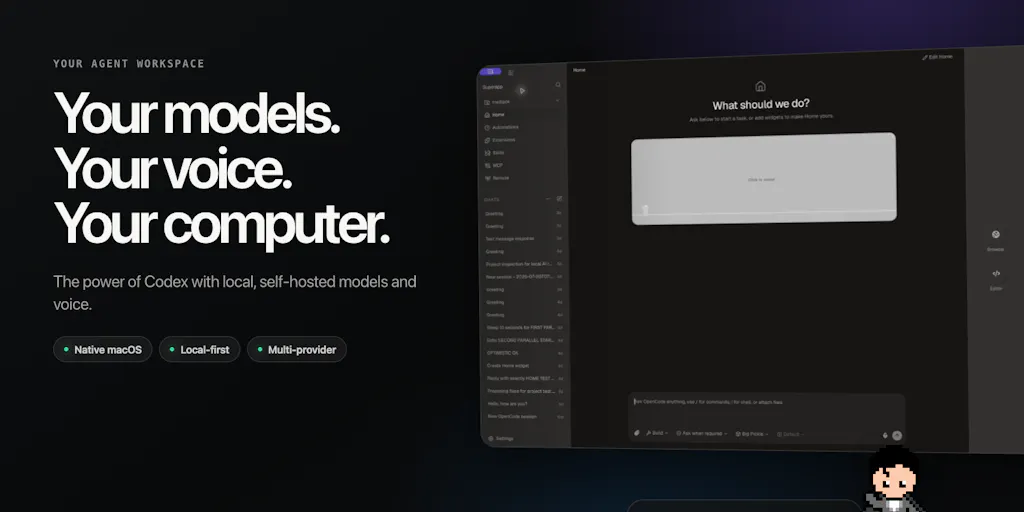
What Flores built with OpenCode Superapp solves a completely different vector of that problem. It’s not a product-listing generator or a customer-service chatbot. It’s an operating system for private AI agents—a workspace that lets you run local or self-hosted models, control what those models can read and do on your machine, and even interact with them via voice. For a cross-border seller, that translates to three concrete use cases:
- Supplier negotiation scripts that never leave your laptop. You can upload a spreadsheet of landed cost comparisons from five factories in Shenzhen, ask an offline model to summarize the riskiest terms, and never expose that data to a third party.
- Brand protection logic that runs on your own hardware. If you’re enrolling in Amazon Brand Registry, you might want an agent that screens for unauthorized resellers by scraping listings—but you don’t want your scraping IP or detection patterns logged by a cloud API.
- Voice-driven operations during fulfillment audits. Imagine walking through your 3PL’s warehouse with a headset, dictating inventory discrepancies into an agent that logs them directly into a local spreadsheet without any cloud round-trip.
The maker himself describes his motivation bluntly: “Codex is my favorite app. However I do have 3 blockers to use it in certain circumstances: Offline, with local models. Self-hosted models. Voice control.” He’s talking about OpenAI Codex, the coding agent that many developers now rely on. But the same blockers apply to sellers: you can’t run a critical analysis on an airplane, you can’t handle healthcare-adjacent data (like customer health supplement orders), and you can’t operate hands-free while packing samples.
OpenCode Superapp isn’t a direct e-commerce tool—it’s an infrastructure layer that lets you build your own e-commerce tools privately. That’s a distinction that matters more than any feature list.
How It Differs From Every Other AI Tool You’ve Tried
After testing a dozen “AI for e-commerce” products over the past two years—from Helium 10’s chatbot to Jasper’s marketing copy engine—I’ve noticed a pattern: they all assume you’re happy with a black-box cloud API that costs per token. The differentiation is mostly in the prompt templates.
OpenCode Superapp takes the opposite approach. It’s built on a “mature and robust OpenCode harness,” but the real differentiator is model sovereignty. You can bring your own local model (like Gemma, Qwen, or GPT-OSS), run it on your hardware, and decide exactly when data leaves your machine. In the Product Hunt comments, a user asks about the “capability cliff with smaller local models,” and Flores honestly admits that quality varies depending on your hardware. That’s a far cry from the slick, always-on promises of SaaS tools.
The second differentiator is supervised computer use. Most agentic tools today—including Codex and Devin—either run fully autonomously or require you to approve every action. OpenCode Superapp lets you set granular permissions per app: you can allow automatic clicks in your text editor but require manual approval in a banking app. For a seller managing multiple marketplace accounts, this is huge. You could have an agent that re-orders inventory on Amazon Seller Central but only after you approve each PO—no more accidental double-ordering of slow-moving SKUs.
The voice control layer is not just speech-to-text slapped on top. Flores explains that the system “needs to understand pauses, utterance, tone and interruptions” and integrates with the agent loop to “launch/edit/read real task threads.” That’s a far more sophisticated interaction than the typical “Alexa, order more units” experience. In practice, it means you could say: “Check the last 30 inbound shipments, flag any that had more than 5% damaged units, and draft an email to the supplier asking for a credit note.” The agent would run the analysis locally, draft the email, and present it for your review—all without ever sending raw shipping data to a cloud.
Why Amazon Sellers Should Care More Than Shopify Ones
I’ll say it plainly: if you’re a Shopify store owner who only sells private-label apparel, you probably don’t need local AI agents. Your data risk is lower—your product images and descriptions are already public. But if you’re an Amazon FBA seller, your entire business depends on a fragile equilibrium of PPC bid strategies, keyword cannibalization analysis, and IP enforcement. Every time you use a cloud AI to help with keyword research, you’re feeding Amazon’s competitors your thought process. Worse, if you’re enrolled in Amazon Brand Registry and using third-party tools, you’re already leaking brand performance data.
A private, self-hosted agent changes that calculus. You can have a local model that analyzes your Amazon Seller Central reports (which you download manually) and generates bid adjustment recommendations without ever pinging a cloud server. The output is yours alone. For sellers dealing with high-margin, competitive categories like electronics or supplements, that competitive edge is worth the friction of running a local model on a MacBook Pro.
What Cross-Border Sellers Can Borrow From This Launch
Even if you never install OpenCode Superapp, the product’s architecture offers three mental models worth stealing:
1. The “private by default” data pipeline. Flores emphasizes that the system supports “self-hosted models/infra” specifically for scenarios “handling private information like in healthcare scenarios where sharing PHI is not acceptable.” Replace “PHI” with “proprietary product cost data” and you’ve got the same logic. Start an internal rule: any AI tool that processes supplier cost-of-goods, landed-cost calculations, or PPC margin data must run locally or on your own server. Period.
2. The permission matrix for agentic tasks. In the comments, Flores explains the supervision model: “it works exactly as Codex, you make the call if you allow things at the OS level, or at the app level, if you want to allow every single time, or if you want to go full Auto mode.” Sellers can replicate this by clearly categorizing their operational tasks into three tiers: fully autonomous (e.g., scraping public demographic data for market research), supervised (e.g., adjusting inventory reorder points), and human-only (e.g., signing contracts).
3. Voice as an input modality for logistics. The real-time voice control with “computer use” could be a killer app for fulfillment audits. Most 3PL walkthroughs are still done with a clipboard and a phone camera. Imagine an agent that records voice notes, screenshots the pallet labels, and builds a discrepancy report without you ever touching a keyboard. The OpenCode Superapp shows that such a workflow is already technically feasible—it just needs a seller who cares enough to build the prompts.
Where the Math Breaks
Let’s not sugarcoat it: local models are still not as capable as GPT-4 or Claude 3.5 for complex reasoning tasks. The maker admits that “the quality of local models varies a lot between models since you can run something really basic as a small language model or some of the newer more capable models but it depends on your hardware.” If you’re running a Qwen 7B on a laptop, you’re not going to get the same nuance as a cloud model with 200 billion parameters. For tasks like rewriting product bullet points to match Amazon’s coercive discount policies, GPT-4 is simply better.
The cost side is also non-trivial. Running a decent local model requires a powerful GPU—think NVIDIA RTX 4090 or Apple Silicon with 64GB+ unified memory. That’s a capital expenditure of $3,000–$6,000, plus the ongoing electricity cost. Compare that to a ChatGPT Pro subscription at $200/month, and the ROI only makes sense if you’re dealing with truly sensitive data or need offline operation frequently.
Finally, the product is clearly aimed at developers. Setting it up involves “architecture, native integrations, UI, testing, debugging, and release hardening.” Most sellers aren’t going to compile a local model pipeline. The value isn’t in the product itself—it’s in the concept. That’s why I’m recommending you borrow the idea, not necessarily adopt the tool.
What I’d Watch / Test Next
If you’re an operator who likes to stay ahead, here are three concrete steps you can take this week:
Run a controlled experiment with a local AI agent. Download Ollama, pull a 7B model like Qwen, and give it a single task: analyze your last 100 supplier emails for recurring price increase patterns. Keep a log of how many insights you get vs. what ChatGPT would give. The goal isn’t perfection—it’s to understand the data privacy trade-off in practice.
Map your data security tiers. Go through every AI tool you currently use (Klaviyo, Helium 10, Jungle Scout, etc.). List what data they see. Any tool that sees your landed costs, supplier contracts, or Amazon account details should be flagged. Start planning a migration path where at least the highest-sensitivity data is processed locally.
Monitor OpenCode Superapp’s evolution. The maker is clearly iterating based on community feedback. If he adds a “seller mode” with pre-built agent configurations for inventory reconciliation or PPC optimization, that could be a game-changer. Until then, use the product as inspiration for your own internal tooling stack.
The most dangerous thing a cross-border seller can do right now is assume that cloud AI is safe enough. It’s not. And the tools that let you take control back—even if they’re rough around the edges—are the ones worth watching. OpenCode Superapp is that kind of tool. Whether you use it or not, the lesson is clear: the next competitive moat in e-commerce isn’t a cheaper supplier or a better ad. It’s data sovereignty. And the sellers who start building that moat today will be the ones laughing when the next AI API price hike hits.


