Why an Agent That Babysits Other Agents Is the First AI Tool Worth Paying For
Every cross-border operator I know has been through the same cycle: you buy the hype, you wire up an AI assistant to help with listing optimization or repricing, you spend three weekends coaxing it to do something useful, and then you quietly abandon it when the token bill exceeds the time saved. The problem was never the model. It was the babysitting. Someone has to watch the logs, debug the failed runs, and re-prompt the thing when it drifts. For a solo seller or a lean DTC team, that someone is you — and your time is already spread across Amazon Seller Central, Shopify backends, and a logistics queue that never ends. So when I see a product built specifically to make AI agents self-managing, my first thought isn’t “cool demo.” It’s “finally, someone is attacking the real cost center.”
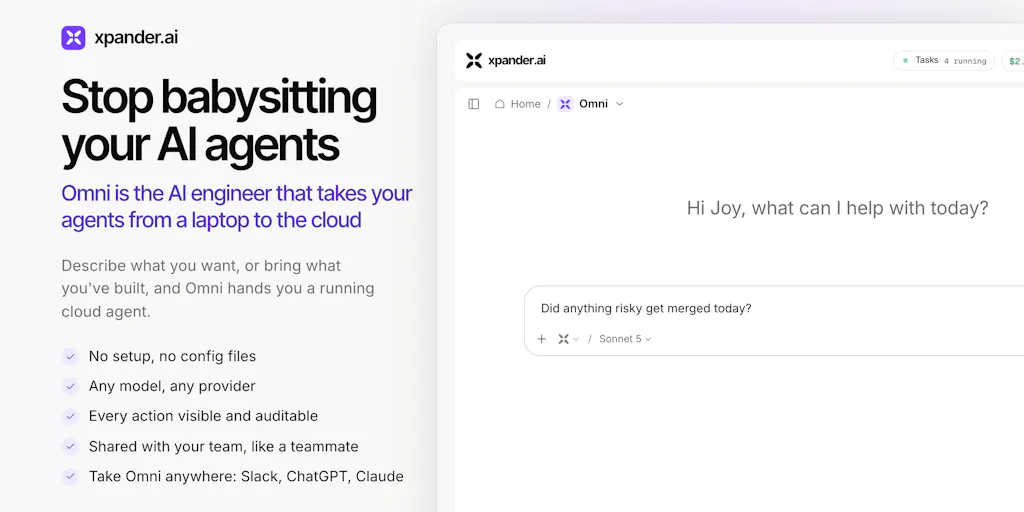
The product is Omni by xpander.ai, and the pitch is refreshingly blunt: stop tinkering with AI and start using it. The company, xpander.ai, has been quietly powering agent infrastructure for Fortune 500 companies, and Omni is their attempt to put that same horsepower in front of a solo operator or a small team without requiring a PhD in prompt engineering. The core promise is that you ask, and Omni executes — then it builds, tests, ships, and maintains the custom agents you need for specific business processes. It reads the logs, troubleshoots failures, optimizes performance, and benchmarks models for cost and quality. In other words, the part that made you give up on AI before is now Omni’s problem, not yours.
For cross-border sellers, this matters more than it might for a SaaS founder building a dev tool. Your operations are a tangle of moving parts: marketplace APIs, repricing rules, inventory syncs, review monitoring, ad spend optimization, and customer service triage. Each one is a candidate for automation, but each one also has failure modes that require human judgment. The reason most sellers haven’t adopted agentic AI isn’t that they don’t see the value. It’s that they don’t have the engineering bandwidth to keep the agents alive. If Omni delivers even half of what it promises, it changes the calculus.
The Problem It Actually Solves: The “100-Prompt Loop” Is a Tax on Your Team
Let me be specific about what’s broken today. The maker’s comment nails it: “got stuck in a 100-prompt loop trying to achieve something with your ‘AI Assistant’.” Every operator who has tried to build a custom GPT or a Claude-powered workflow knows this pain. You start with a clear goal — say, “monitor competitor prices on Amazon and suggest repricing moves” — and you end up in an endless back-and-forth where the assistant asks clarifying questions, produces output that’s almost right, and then needs another round of correction. Multiply that by every workflow you want to automate, and the overhead becomes untenable.
The deeper issue is that generic AI assistants are generalists. They don’t understand the specifics of your business. They don’t know that your profit margin on a given SKU is thinner than average, or that your supplier in Shenzhen is unreliable in Q4, or that your return rate spikes after a particular ad campaign. A generalist agent can’t be trusted with decisions that require that context. So you either build a custom agent (which requires engineering skill) or you give up and keep doing the work manually.
Omni’s approach is to sit on top of the xpander platform and act as a layer that both builds and maintains those custom agents. It’s not just another chatbot. It’s a meta-agent — an agent that manages other agents. The early user requests cited in the launch are telling: “Benchmark this agent across latest Sonnet, GPT, and Qwen models. Tell me which is cheapest at the same quality.” “Watch our cloud bill. When something spikes, find the cause and post it in Slack.” These aren’t toy examples. They’re the kind of operational chores that eat a seller’s day.
For a cross-border operation, the equivalent asks would be: “Every morning, pull yesterday’s sales by marketplace, flag any SKU where the buy box was lost, and draft a response for the supplier.” Or: “Monitor our return rate by warehouse. If it spikes for a specific ASIN, investigate the listing images and suggest changes.” These are the workflows that would save real hours — if they could run without constant supervision.
Why Amazon sellers should care more than Shopify ones
Shopify operators have it comparatively easy. The platform’s API is clean, the app ecosystem is mature, and most of the tooling is designed for a single storefront. Amazon sellers, on the other hand, are dealing with a marketplace that is simultaneously more powerful and more hostile to automation. Seller Central’s API is a labyrinth, the reporting is delayed, and the stakes of a mistake are higher — a bad repricing decision can tank your buy box, and a compliance misstep can get your listing suppressed.
This is where an agent that can monitor its own performance becomes valuable. Amazon sellers are already used to using tools like Helium 10 or Jungle Scout for product research and keyword tracking. Those tools are great at generating data, but they don’t act on it. An agent like Omni could theoretically sit on top of that data and take action — adjusting bids, flagging inventory risks, or drafting supplier communications — without needing a human to babysit every step. The caveat is that Amazon’s terms of service are strict about automation, so any agent that touches Seller Central needs to be careful. But the potential is real.
How It Differs From the Incumbents: Not Another ChatGPT Wrapper
The AI tooling space is crowded with products that are essentially wrappers around a single model. You’ve got ChatGPT for general chat, Claude for long-form reasoning, and a dozen “AI copilots” that promise to automate your workflow but actually just paste a prompt into a model and hope for the best. Omni is different in a few key ways, and the differences matter for operators who are tired of being burned.
First, it’s model-agnostic. The platform lets you choose any model from any provider instead of getting married to the major AI labs. That’s a big deal for cost control. The launch mentions benchmarking across “latest Sonnet, GPT, and Qwen models” — the ability to compare cost and quality and pick the right one for the task is something that generic assistants don’t offer. If you’re running a high-volume operation, the difference between a cheap model and an expensive one on a routine task can add up to significant monthly savings.
Second, it has a real runtime environment. The maker’s response to a commenter clarifies that they built their own proprietary runtime rather than using an off-the-shelf harness, because the off-the-shelf options couldn’t meet their security and performance requirements. They do use the Agno framework for some parts, but it’s wrapped in a custom layer that handles sandboxes, vault-based secret injection, and tool calling with act-as-human authentication. For a seller who is paranoid about giving an AI access to their payment processor or supplier portal, this matters. The model never sees a secret — secrets are injected from a vault into downstream tools. That’s a security architecture that respects the reality of production systems.
Third, it’s designed for multiplayer use. The launch emphasizes that agents can be shared across a team, so the work one person puts into building an agent benefits everyone. For a small DTC team, this is the difference between a tool that one power user adopts and a tool that becomes part of the company’s operating system.
Where the math breaks: the cost of autonomy
Here’s where I get skeptical. The launch promises a lot of autonomous behavior — Omni can “really optimize agents and fix issues” — but the economics of autonomy are tricky. Every time an agent makes a decision on its own, there’s a risk that it makes the wrong one. And when it does, the cost isn’t just the failed run. It’s the time you spend auditing what went wrong, plus the opportunity cost of the task not being done correctly.
The maker’s response to a question about approval boundaries is instructive. When asked whether Omni can change prompts, models, schedules, and tool permissions autonomously, or whether higher-risk changes are proposed with a diff and rollback point first, the response was a bit vague. The platform has audit trails — every action is permissioned per user and audited — but the default approval boundary isn’t clearly defined. For a cross-border seller, that ambiguity is a red flag. You don’t want an agent silently changing your repricing model mid-week without telling you. You want a diff, a rollback point, and a notification.
The good news is that the maker’s responses suggest they’re thinking about this. One commenter asked whether the model comparison happens on every run or whether it caches the winner. The answer was that you can schedule a weekly bake-off and configure the winner as the default. That’s a sensible cadence — it amortizes the cost of comparison while still catching model drift. But the follow-up question — “if the winner flips mid-week, is that visible anywhere?” — was left somewhat open. For operators who care about reproducibility, this needs to be explicit.
What Cross-Border Sellers Can Borrow From This Playbook
Even if you never touch Omni, the philosophy behind it is worth stealing. Here’s what I’m taking away.
The babysitting layer is the product. The reason most AI tools fail in operations is not the model quality. It’s the maintenance burden. When you evaluate any AI tool for your business, ask: who watches the logs? Who fixes it when it breaks? If the answer is “you do,” the total cost of ownership is much higher than the subscription price. Look for tools that self-monitor and self-heal, or budget for the engineering time to build that layer yourself.
Model selection is a cost lever. Most sellers are using one AI tool for everything — usually whatever is cheapest or most hyped. The xpander approach of benchmarking models for cost and quality on a per-task basis is smart. A routine task like summarizing a supplier email doesn’t need a frontier model. A complex task like drafting a negotiation strategy might. Building a simple routing layer that sends tasks to the cheapest adequate model can cut your AI spend by a significant margin.
Mock data testing before production is non-negotiable. The launch highlights that Omni lets you test agents on mock data before hooking them up to critical systems. This is a best practice that every operator should adopt, regardless of tool. Before you let any automation touch your real inventory, your real ads, or your real customer data, run it against a sandbox. The cost of a mistake in production is always higher than the cost of a few extra hours of testing.
Security architecture matters more than features. The fact that xpander built a custom runtime with vault-based secret injection is a signal. If you’re going to give an AI access to your business systems, the security model needs to be designed for production, not for a demo. Secrets should never be exposed to the model. Actions should be permissioned and audited. If a tool can’t articulate its security model, walk away.
Where My Judgment Says It Falls Short
I’m not going to pretend this is a perfect product. There are gaps that would make me hesitate before recommending it to a cross-border seller.
The enterprise DNA shows. The platform is built for Fortune 500 companies, and that heritage cuts both ways. On the one hand, it means serious security and scalability. On the other hand, it means the product might be overkill for a solo seller or a five-person team. The setup complexity — deploying to your own VPC, configuring connectors, managing permissions — is more than most operators want to deal with. The free tier at chat.xpander.ai is a good way to test the waters, but the full platform is likely priced and positioned for mid-market and enterprise buyers.
The “fixes itself” claim needs proof. The maker insists that Omni can really optimize agents and fix issues, and I believe the infrastructure is there. But the history of AI tooling is littered with products that promised self-healing and delivered self-deception. An agent that thinks it fixed a problem when it actually just changed the prompt to produce a different wrong answer is worse than no agent at all. I’d want to see detailed case studies of failed runs that were genuinely diagnosed and fixed, not just anecdotal claims.
The marketplace integrations are unknown. The launch doesn’t mention specific integrations with Amazon Seller Central, Shopify, TikTok Shop, or any of the platforms cross-border sellers actually use. The platform has 2,000+ tools and MCP connectors, and you can create a connector to any API, but that’s a far cry from a plug-and-play integration with Amazon’s notoriously finicky API. For a non-technical operator, the “create a connector to any API” line is a promise of engineering work, not a solution.
The cost model is unclear. Pricing is not disclosed in the launch. For a tool that benchmarks models for cost, the irony is that the platform’s own cost structure is opaque. If you’re a small operation, you need to know whether you’re paying per seat, per agent, per action, or some combination. The lack of transparency is a yellow flag.
What I’d Watch / Test Next
Here’s my practical advice for operators who want to act on this this week, without committing to a full platform migration.
First, try the free version and give it a real operational task — not a toy. Ask it to monitor something in your business, like a daily sales report or a supplier price change, and see how much hand-holding it requires. The test isn’t whether it can do the task. It’s whether it can recover when the task goes wrong.
Second, audit your current AI tooling stack. For every tool you’re paying for, ask: who watches the logs? If the answer is “nobody,” you’re paying for a liability, not an asset. Consider whether a tool that self-monitors — even a simple one — would reduce your maintenance burden.
Third, build a mock-data sandbox for any automation you’re considering. Before you let an agent touch your real Amazon inventory or your real Shopify store, run it against a test environment. The xpander approach of testing before production is a discipline every operator should adopt, regardless of which tool you use.
Fourth, if you’re a mid-market seller with engineering resources, watch the xpander platform closely. The enterprise-grade infrastructure — sandboxed compute, vault-based secrets, per-user permissions, audit trails — is exactly what you need if you’re going to give AI real access to your business systems. The question is whether the platform’s pricing and positioning will ever align with a seller’s budget.
Finally, keep an eye on the comments section of the Product Hunt launch. The questions being asked there — about approval boundaries, model re-comparison cadence, and visibility of changes — are the right questions. The quality of the maker’s answers will tell you a lot about whether this is a product built for real operations or just a demo looking for a buyer.
The bottom line: the agentic AI era is coming to cross-border e-commerce, whether we’re ready or not. The tools that win won’t be the ones with the smartest models. They’ll be the ones that require the least babysitting. Omni is an early attempt at building that layer, and even if it’s not the final answer, it’s pointing in the right direction. The question for sellers is whether you want to be an early adopter or a fast follower. Given how much time you’re already spending on manual operations, the fast-follower position might be the smarter bet.