The Care Economy Is a Data Problem, and Cross-Border Sellers Should Be Paying Attention
Every cross-border seller I know is chasing the same two numbers: acquisition cost and lifetime value. We obsess over funnels, creative testing, and retention loops. But there’s a quieter, more structural shift happening in consumer behavior that most operators are missing — the collapse of the “individual user” as the atomic unit of purchase. The household is becoming the decision-making entity, and it’s not just about shared Prime accounts or family plans. It’s about who manages the invisible infrastructure of daily life. When I look at Lifelong, a family health management app that just launched on Product Hunt, I don’t see a health app. I see a blueprint for how DTC brands should be thinking about their own customers: not as isolated buyers, but as nodes in a complex system of shared responsibilities, fragmented data, and emotional labor. If you sell anything to anyone who has a family — which is most of your market — the way this product frames its problem is directly relevant to how you should frame your value proposition.
The Problem: Health Data Lives in the Same Chaos as Your Order History
Here’s the uncomfortable truth about modern life: your customer’s health records are scattered across more platforms than their purchase history. Portals, group chats, folders, and one person’s head — that’s how the maker of Lifelong describes the current state of family care administration. Sound familiar? It should. That’s the exact same fragmentation your customers experience with their shopping data. They bought from you on Amazon, then on your Shopify store, then maybe through a TikTok Shop impulse buy. Their address, payment info, and preferences are scattered across your stack. You’ve solved this on your side with CDPs and order management systems. But your customer hasn’t solved it on theirs.
The founder’s origin story is worth sitting with. His grandfather couldn’t walk, so his father tore down two walls in their home to fit a hospital bed and wheelchair access. The care system stopped at the front door. Everything after that — the records, medications, appointments, the remembering of which specialist said what — fell to the family. That’s a powerful metaphor for what happens after a customer clicks “buy.” Your logistics provider handles the delivery. But what happens after the product lands on their doorstep? Who handles the setup, the troubleshooting, the returns, the repurchase timing? Most brands treat that post-purchase experience as someone else’s problem, just like the healthcare system treats in-home care as the family’s problem.
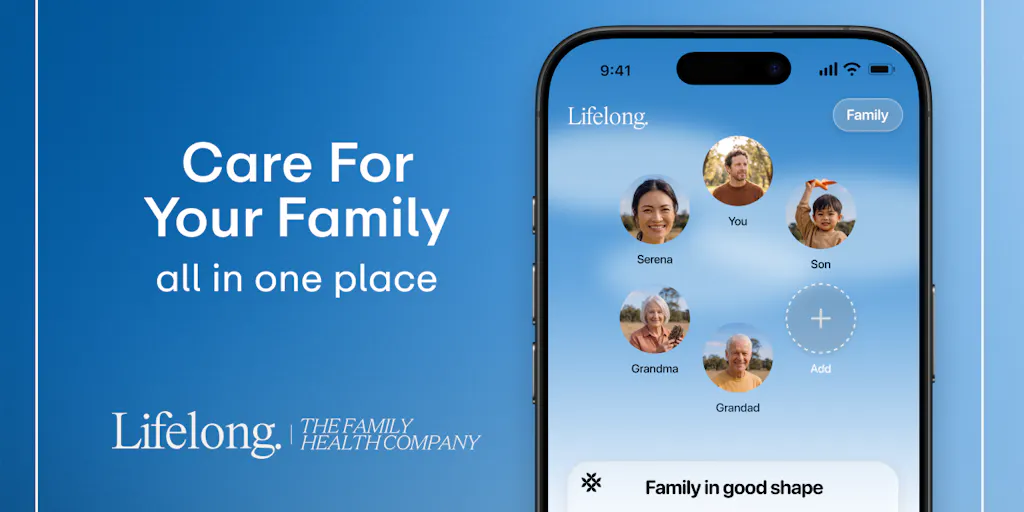
Lifelong’s answer is to build one place for a whole family’s health. Records, medications, symptoms, appointments, activity, sleep — all organized by person, connected to wearables, with an AI assistant called Alo to log updates and take simple actions. The key design decision is that it’s built around the household, not the individual. Most health apps are designed for one user tracking their own metrics. Lifelong is explicitly for families to use together, with user-controlled sharing and a clear disclaimer that it doesn’t diagnose or prescribe.
Why This Matters More Than the Product Itself
Let me be clear: I’m not here to review a health app. I’m here to tell you why this product’s framing should change how you think about your own customer data and product strategy. The comments on the Product Hunt page are revealing. One user, Mateusz Konik, points out that with a one-year-old, the health admin lives in his wife’s head — vaccination history, appointments, everything. Another commenter, Alex Gidirim, nails the deeper insight: “The real product here is the mental load, whoever remembers which specialist said what is doing a job that usually has no name and no backup.”
That’s the phrase I want you to sit with: the mental load. In every household, there’s one person who remembers which specialist said what. In every customer relationship, there’s one person who remembers which brand they trust, which product they need to repurchase, and which subscription they need to cancel. That person is your real customer. Not the account holder, not the credit card on file — the person who carries the cognitive burden of the purchase decision.
Cross-border sellers have been trained to think in terms of individual user journeys. Amazon Seller Central gives you a dashboard of orders, not households. Shopify gives you customer profiles, not family trees. But the purchasing reality is that most big-ticket or recurring purchases — household goods, supplements, kids’ products, even electronics — are managed by one person on behalf of several. If you’re not building for that dynamic, you’re leaving money on the table.
Why Amazon Sellers Should Care More Than Shopify Ones
Here’s a contrarian take: this household-centric framing matters more for Amazon sellers than for Shopify DTC brands. On Shopify, you own the customer relationship. You have email addresses, purchase history, and the ability to segment by household if you build the right data model. On Amazon, you’re renting the relationship. You get a shipping address and a vague sense of who’s buying. But Amazon has been pushing toward household-based commerce for years — Subscribe & Save, family accounts, shared delivery benefits. The seller who figures out how to position products as household solutions, not individual purchases, is the one who wins the Buy Box on repeat orders.
Lifelong’s design philosophy — user-controlled sharing, no diagnosis, no prescribing — is a lesson in restraint that Amazon sellers should copy. The platform doesn’t try to be a doctor. It just organizes information. That’s the same discipline you need on Amazon: don’t try to be the brand that does everything. Be the brand that makes the household’s life easier in one specific way. The data you collect from that focus is worth more than any broad-spectrum marketing campaign.
What Cross-Border Sellers Can Actually Borrow From This
Let me get practical. There are three concrete takeaways from Lifelong’s approach that you can implement this week, regardless of what you sell or where you sell it.
First, rethink your customer unit from individual to household. This starts with data collection. If you’re on Shopify, start tagging orders with household identifiers — not just email addresses, but shipping addresses, shared payment methods, and family-oriented product bundles. If you’re on Amazon, use the Amazon Marketing Cloud to build household-level segments based on purchase patterns. You’ll be surprised how many of your “individual” customers are actually buying for two or three people.
Second, build for the mental load bearer. Every household has one person who remembers the repurchase date, the size, the flavor, the subscription status. That person is your most valuable customer, and they’re probably exhausted. Your marketing should acknowledge that exhaustion. Don’t sell them on features. Sell them on relief. “Never run out of diapers again” beats “extra absorbent core” every time. “One place for your family’s health” is a better pitch than “track your vitals.” Look at your current ad copy and ask yourself: are you speaking to the person who carries the mental load, or are you speaking to a faceless demographic?
Third, respect the boundary between organizing and prescribing. Lifelong explicitly states it doesn’t diagnose or prescribe. That’s a trust-building move. In e-commerce, the equivalent is knowing the difference between helping a customer choose and telling them what to buy. Recommendation engines are fine, but there’s a line where personalization becomes manipulation. The brands that earn long-term loyalty are the ones that feel like they’re on the customer’s side, not just trying to upsell.
Where the Math Breaks
I want to be honest about where this falls short, because blind enthusiasm helps no one. Lifelong’s model has a fundamental tension: the person who needs the data most — the caregiver — is also the person with the least time to input it. The app tries to solve this with Alo, the AI assistant that logs updates and takes simple actions. But AI logging is only as good as the underlying data quality. If the wearable data is messy, or the user doesn’t speak to Alo in a way it understands, the whole system degrades.
There’s also the privacy question that Alkinoos Sarioglou raises on the launch page: what privacy measures are implemented? The founder doesn’t disclose specifics in the launch post. For a product handling family health data, that’s a gap. In e-commerce, we’ve seen how quickly trust evaporates when data handling is opaque. Klaviyo built a billion-dollar business on transparent, permission-based email marketing. The same principle applies here — if you’re asking customers to centralize sensitive data, you need to show your security architecture, not just mention it in a privacy policy.
And there’s the question that Mateusz Konik raises, which is the sharpest one on the page: whose record is it when the child grows up? A family record is permanent. If a parent logs a child’s entire medical history from birth, that child never agreed to any of it. When they come of age, can they take it with them, or delete it? That’s a design question, not just a privacy policy one. For cross-border sellers, the parallel is data ownership. When a customer leaves your brand, can they take their purchase history, their preferences, their data? If not, you’re building a walled garden that will eventually push them away.
The Bigger Picture: Infrastructure Becomes the Product
Here’s the thesis that ties all of this together. The comment from Alex Gidirim about the walls being torn down is the most important one on the page. “That is what happens when care work has no infrastructure of its own, it reshapes the physical space around it because nothing else was built to hold it.” That’s a profound observation about product design. When you don’t build the right tool, people hack together workarounds that distort everything else.
Look at your own customer’s journey. When they can’t easily find their order status, they email support. When they can’t track a shipment, they download a third-party tracking app. When they can’t manage a subscription, they set a calendar reminder to cancel it. Every one of these workarounds is a wall being torn down in your customer’s life. The brands that win in cross-border e-commerce over the next five years will be the ones that build the infrastructure their customers actually need, not the ones that optimize the funnel they already have.
Lifelong is trying to be that infrastructure for family health. Whether it succeeds is almost beside the point. The lesson for sellers is that the opportunity isn’t in selling more products — it’s in becoming the system that organizes the products, the data, and the decisions around a household’s needs. That’s a much harder product to build, but it’s also a much harder product to copy.
What I’d Watch / Test Next
If you’re an operator reading this, here are concrete actions to take this week.
First, audit your customer data for household signals. Pull your last 90 days of orders and look for patterns: same shipping address, multiple product categories, recurring purchase intervals. Build a simple segment in your Shopify admin or Amazon Seller Central and see how much of your revenue comes from household-level buyers. I’d bet it’s higher than you think.
Second, rewrite one ad set to speak to the mental load bearer. Pick your best-selling product and write copy that acknowledges the exhaustion of managing a household. Test it against your current control. The winner will surprise you.
Third, watch how Lifelong handles the privacy and data ownership questions. The team is active in the comments, responding to feedback. If they address the concerns about child records and data portability well, that’s a signal about how they think long-term. If they dodge it, that’s also a signal. Either way, you learn something about how to handle sensitive customer data in your own business.
Finally, keep an eye on where this category goes. Family health management is a space that’s about to get crowded. The incumbents — Apple Health, Google Fit, and the various electronic health record portals — all have the data but lack the household framing. If Lifelong or a competitor cracks the unit-of-analysis problem, it will change how health data is structured and shared. And that will ripple into consumer expectations about how all their data should work — including their shopping data. Be ready for that shift.