Why a Shared Workspace for AI Agents Is the Most Important Tool for Cross-Border Teams You Haven’t Tested Yet
Every cross-border operator I know is running the same silent experiment. You’ve got a product researcher in Shenzhen using one AI tool to scrape review sentiment, a media buyer in London prompting another for ad copy variations, and a customer service lead in Manila running a third to draft return responses. Each of them is building a private, fractured relationship with their AI tools. The insights don’t compound, the context doesn’t transfer, and when someone leaves, the institutional knowledge leaves with them. The problem isn’t that AI agents aren’t powerful enough—it’s that they’re operating as isolated contractors instead of integrated teammates. This is the exact fragmentation that the team behind Oasis is trying to solve, and why their Product Hunt launch reads less like a new SaaS product and more like a manifesto for how cross-border operations will run in the next eighteen months.
The Real Problem: Your AI Stack Is a Tower of Babel, Not a Brain Trust
Let’s be brutally honest about how most of us are running AI in our e-commerce operations. It’s a mess. The product team has a browser tab open with Claude Code running a script to analyze keyword gaps. The operations lead has Devin running locally to automate a spreadsheet reconciliation for supplier invoices. The creative director is using HeyGen to produce localized video ads for the TikTok Shop launch. And your brand manager is prompting Higgsfield for UGC-style content variations.
Every one of those agents is starting from zero. They don’t know that the supplier in Yiwu has a two-week lead time on that specific packaging. They don’t know that the phrase “free shipping” converts 12% better with your German audience but falls flat with your Japanese one. They don’t know that the customer service team has already answered the same question about sizing three hundred times this month. So they make the same mistakes, ask the same clarifying questions, and generate the same mediocre outputs that require significant human editing.
The maker behind Oasis, Stefano Delmanto, frames this perfectly in the launch post: “Every agent lives somewhere different. One is in a browser tab. Another is running locally. Another is inside your IDE.” For a solo developer, that’s annoying. For a cross-border operation with teams in different time zones and cultural contexts, it’s a logistical nightmare. You end up copying context between tabs, terminals, and chats—and then you have to forward that context to a teammate in a different city, who then has to rebuild it in their own isolated workflow. The more agents you adopt, the more fragmented your AI stack becomes. The cost isn’t just the tool subscriptions; it’s the lost productivity of every team member acting as a human API connector between systems that refuse to talk to each other.
Oasis: The Neutral Ground Where Agents Become Colleagues
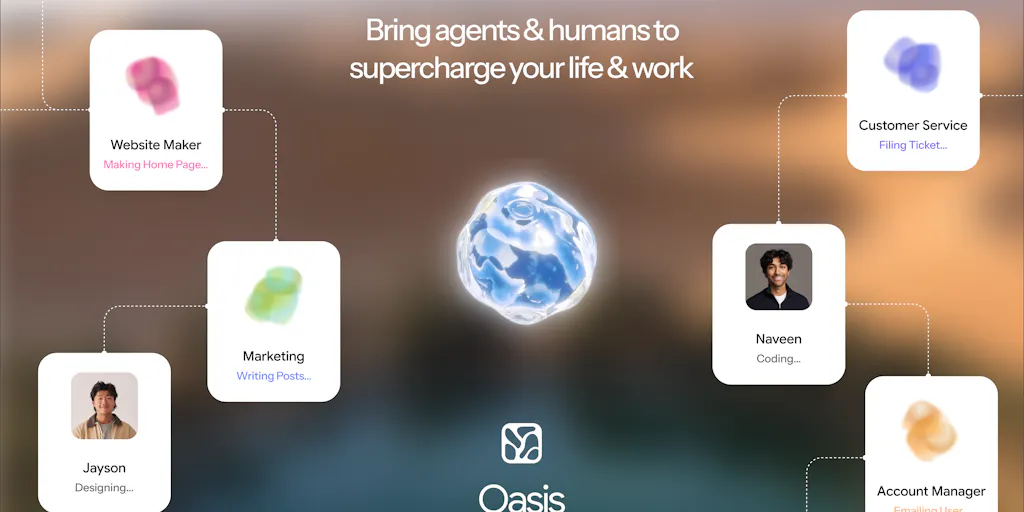
The core pitch for Oasis is straightforward: it’s a shared workspace for humans and agents. Instead of each agent living in its own silo, you bring them all into one place. The product partners with leading agent builders so you can deploy tools like Claude Code, Devin, OpenClaw, HeyGen, and Higgsfield—or any MCP-compatible agent—in a single click. This aggregation layer is the first part of the value proposition, and it’s genuinely useful. I’ve spent too many hours toggling between different agent interfaces, managing different API keys, and trying to remember which tool I used for which project. Having a single pane of glass for deployment is a win.
But the deeper value is in what they call “Rooms.” This isn’t just a chat interface; it’s a group chat for humans and agents. Think of it as a Slack channel where some of the participants happen to be AI. When a message is sent in a room, it becomes a shared memory available to every agent in that room. As Delmanto explains in the comments, “Think of it like saying something in a meeting: everyone present hears it and can remember it.” This is a fundamentally different model from what we have now. Currently, if I tell my ad copy agent that our brand voice is “premium but approachable,” I have to repeat that instruction every time I start a new session. With Oasis, that context is persistent and shared. The agents become the holders of that memory, and they query it during runtime.
This addresses the single biggest inefficiency I see in cross-border teams: the onboarding tax. When a new VA or junior brand manager joins, they don’t have access to the accumulated knowledge of how the business runs. They ask questions that have been answered dozens of times. They make mistakes that violate unwritten rules. With a shared memory base, new agents—and by extension, new human team members who collaborate with those agents—can plug into the knowledge your team has already built. The permissions aren’t an afterthought either; the system is designed to detect when an agent uses a memory that the person on the receiving end doesn’t have access to, and it blocks the output until a human who was present at the original memory’s creation approves it. That’s a level of governance that most enterprise AI deployments still lack.
### Why Amazon Sellers Should Care More Than Shopify Ones
Here’s a hot take: this tool is potentially more valuable for Amazon FBA operators than for DTC Shopify brands. Why? Because Amazon sellers are drowning in fragmented, high-stakes data. Your listing optimization, PPC management, and review analysis are all separate workflows, often handled by separate tools. If you’re using Helium 10 for keyword research, a third-party tool for review mining, and a manual process for tracking competitor pricing, you’re losing context at every step. The memory of “this keyword converts well but has high return rates” or “this competitor keeps undercutting us on Thursdays” is exactly the kind of institutional knowledge that gets lost when you switch tools or team members.
A shared workspace where your product research agent, your listing copywriter agent, and your PPC analyst agent can all see the same context—and where a human can oversee the entire flow—could eliminate the constant back-and-forth that eats up hours every week. The alternative, which is what most of us do now, is to create elaborate SOPs in Notion or Google Docs that try to codify this knowledge, and then hope everyone follows them. The SOP approach is static; it requires constant updating and policing. A shared memory base is dynamic; it learns and adapts as the business changes.
The Moat Question: Can Neutral Aggregation Survive the Giants?
The most interesting question in the Product Hunt comments comes from Michael Vavilov, who asks directly: “What is your moat? Oai and Anthropic are working on team features. Is it the neutrality of aggregation?” This is the right question to ask, because any tool that sits on top of the AI layer is vulnerable to the platform providers deciding to build the same features natively. If OpenAI decides to add shared memory and team rooms to ChatGPT Team, why would anyone pay for Oasis?
Delmanto’s answer is the crux of their strategy: “neutral aggregation paired with an incredibly powerful and sticky memory base.” The neutrality piece is about cost optimization. Oasis lets you deploy open-source or cheaper models based on how you work, and it proactively suggests cheaper models for a given task. This is a massive value proposition for cross-border operators who are watching their AI spend balloon. If you’re a DTC brand running a global ad campaign, you don’t need the most expensive frontier model for every task. Sometimes you need a cheap, fast model to categorize customer service tickets. Sometimes you need a premium model to write nuanced, culturally-aware ad copy. The ability to switch between them without losing context is a real differentiator.
The sticky part is the memory base. As Delmanto puts it, “Oasis retains the context around how you work, what you care about, and how you prefer things done. So even when you switch models, you don’t have to start from scratch or repeatedly explain yourself.” This is the classic data moat play. The more you use the tool, the more valuable it becomes, because it holds your accumulated context. The switching cost isn’t just learning a new interface; it’s losing the institutional memory that you’ve built up over months of use.
### Where the Math Breaks: The Hidden Costs of Shared Context
I’m bullish on the concept, but let me play devil’s advocate for a moment. The “shared memory” model has a dark side that cross-border operators need to think about carefully: context poisoning. If you have a room where multiple agents are contributing, how do you ensure the quality and relevance of the shared memories? If one agent reads a poorly-written product description and incorporates that into its understanding of your brand voice, it could degrade the output quality of every other agent in the room. The system’s permissioning is clever, but it only governs who can see a memory, not whether that memory is true or useful.
There’s also the question of cost. Storing, indexing, and querying a shared memory base isn’t free. The launch post mentions credits and a Pro tier, but the pricing details are not fully disclosed. For a small team running a few agents, the cost might be negligible. For a mid-sized operation running dozens of agents across multiple rooms, the memory storage and retrieval costs could add up quickly. The tool needs to demonstrate that the efficiency gains from shared context outweigh the additional infrastructure costs.
Finally, there’s the human adoption problem. I’ve seen too many promising AI tools fail because they required a fundamental change in how people work. If your team is used to working in separate tools, getting them to consolidate into a shared workspace is a behavioral change, not just a technical one. The tool needs to be so compelling that the value of shared context is immediately obvious, not something you have to explain in a training session. The “Rooms” concept is intuitive, but it still requires buy-in from team members who might feel like they’re losing control over their individual workflows.
What Cross-Border Sellers Can Borrow from This Right Now
Even if you don’t sign up for Oasis today, the product launch is a useful lens for auditing your own AI operations. Here are three principles worth stealing:
1. Centralize your context, not just your tools. The problem Oasis is solving isn’t that you use multiple AI tools; it’s that those tools don’t share a common understanding of your business. You can start solving this today by creating a “brand memory” document—a living file that captures your brand voice, your target audiences, your common customer objections, your shipping and return policies, and your competitive landscape. Then, require every AI tool you use to be prompted with the relevant sections of this document before starting a task. It’s a crude version of what Oasis does, but it will immediately improve output quality and consistency.
2. Audit your agent permissions. The concept of “memory governance” is something you can apply manually. Before you give an AI tool access to your customer data or your pricing strategy, think about who needs to see that information and who doesn’t. For a cross-border operation, this is especially important for data privacy compliance (like GDPR for your EU customers). Knowing exactly what your agents are allowed to remember and reuse is a discipline that will serve you well as these tools become more sophisticated.
3. Test the model-switching workflow. One of the most compelling features of Oasis is the ability to use cheaper models for simpler tasks without losing context. You can replicate this by building a simple routing system: for high-stakes tasks (like writing a launch email to your VIP list), use the premium model; for low-stakes tasks (like generating alt text for product images), use a cheaper or faster model. The key is to make sure the cheaper model has access to the same style guidelines and factual context as the premium one.
What I’d Watch / Test Next
The AI agent space is moving at lightspeed, and Oasis is positioning itself as the connective tissue. Here’s what I’d do this week:
Sign up for the Oasis waitlist or free tier and test it with two agents you already use—one for content generation and one for data analysis. Create a Room and see if the shared context actually improves the quality of the second agent’s output after the first agent has done some work. The launch post mentions you can sign up and claim credits, so the barrier to testing is low.
Map your current “context handoffs.” For the next three days, track every time you manually copy and paste context into an AI tool—a customer persona, a brand guideline, a list of product specifications. Count the minutes you spend on this. That number is your baseline for how much time a shared memory base could save you. If it’s under an hour a week, this tool isn’t for you yet. If it’s more than two hours, you’re a prime candidate.
Watch how the platform providers respond. The moat question is real. If OpenAI or Anthropic ship a shared-memory feature within the next two quarters, Oasis will need to lean hard into its neutrality and its partnerships with open-source models to survive. For now, the aggregation value is compelling, but it’s a feature, not a company—unless the memory base proves to be as sticky as they claim.
The bottom line is that we’re moving from a world of “AI tools” to a world of “AI teammates.” The tools that win won’t be the ones with the most powerful models; they’ll be the ones that let your team—human and AI—work together with shared context, shared memory, and shared goals. Oasis is an early bet on that future, and even if it doesn’t become the definitive platform, it’s showing us what the next generation of AI operations will look like. For cross-border sellers, that future can’t come soon enough.