The Quiet Threat to Your Funnel Isn’t a Competitor — It’s How Your Team Learns
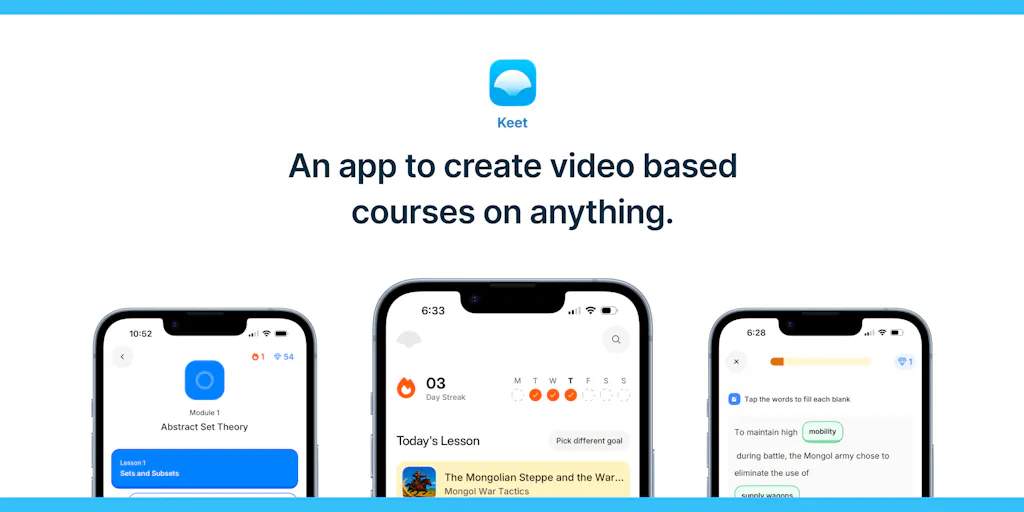
Every cross-border operator I know is running the same playbook in 2025: squeeze CAC on Meta, defend margin on Amazon, pray TikTok Shop’s algorithm doesn’t shift overnight. Almost nobody is auditing the learning layer underneath all of it — how a new hire in Shenzhen learns your ad policy, how a VA in Manila learns Helium 10, how you personally learn the new EU GPSR compliance rules before Q4. That’s why a small mobile app called Keet caught my attention this week. It isn’t e-commerce software. It’s a video-based learning app built by Tommy Tsai that borrows Duolingo’s structure and applies it to “learn anything.” And that framing — structured, measurable, video-first learning — is exactly the gap most seller orgs have quietly papered over with YouTube tabs and ChatGPT prompts.
What Keet Actually Is, and What Problem It’s Solving
Per the maker’s own launch note, Keet is a mobile app that “teaches you anything using videos,” with courses that “mirror a real curriculum to help you learn over an extended period of time.” The stated origin story is refreshingly honest: Tsai and team built it because they enjoyed teaching themselves via YouTube and AI chat, but found those platforms “lacked instructional design” — progress was “slower and more difficult to measure.” Keet’s pitch is autonomy within structure. It’s live now on the App Store.
Strip away the consumer framing and you have a productized version of a problem every cross-border team hits at scale: the difference between having access to information and having a curriculum. A new Amazon PPC hire can watch 40 hours of YouTube and still not know what a “placement modifier” does to their ACOS. A DTC ops lead can ask Claude to explain Incoterms and walk away with a confident-sounding hallucination. Keet’s bet is that the missing layer isn’t content — it’s sequencing, retention, and measurement.
Why this matters more to Amazon sellers than Shopify ones
Shopify operators tend to learn in public. They follow Klaviyo changelogs, sit in DTC Slack groups, and iterate on their own storefront where mistakes cost them a bad week. Amazon sellers learn in a black box. A misread on Amazon Seller Central policy — say, a botched handling of a restricted category or a misclassified variation — can trigger an account health hit that takes months to unwind. The asymmetry of consequences is why structured, auditable training matters more on the marketplace side than the DTC side. If Keet or something like it can produce a record of who learned what, when, that’s a compliance artifact, not just a nice-to-have.
How It Stacks Up Against the Incumbents You’re Already Paying For
Here’s where I want to be blunt, because the cross-border SaaS stack is already crowded and most “learning” tools are mislabeled.
Against YouTube and free video: Free wins on breadth, loses on everything else. No completion tracking, no spaced repetition, no way to know if your new hire actually finished the module on FBA prep requirements or just left the tab open. Keet’s explicit critique — “lacked instructional design” — is the right diagnosis.
Against Coursera and Udemy: These are course marketplaces, not learning systems. You buy a course, you watch it, you’re done. There’s no adaptive curriculum, and the content is generic — almost nothing on cross-border specifics like Temu semi-managed vs. fully-managed models or SHEIN supplier onboarding.
Against Duolingo: The comparison is inevitable and one commenter on the launch page, Nika, made it directly — “I like how the Duolingo model is applied to a wider scope of knowledge.” Fair. But Duolingo’s magic is in one domain (language) with tight feedback loops. Keet is trying to do “anything,” which is a much harder instructional design problem. The Duolingo model works because vocabulary is discrete and testable. “Understanding TikTok Shop’s affiliate commission structure” is not discrete, and it changes quarterly.
Against ChatGPT and Claude: This is the real competitor, and Keet’s own founder admits it. AI chat is on-demand, infinitely patient, and free-ish. What it doesn’t give you is a spine — a sequence you can trust, with checkpoints that prove you retained something. For a solo operator, ChatGPT is probably enough. For a team of 15 across three time zones, it isn’t.
Where the math breaks
Let’s do the operator math. If you’re paying a Philippines-based VA $6/hour and they spend 10 hours a week “learning” from unstructured sources, that’s $60/week per head of unverified learning. Multiply by 8 VAs and you’re burning ~$2,000/month on training that produces no measurable output. A structured curriculum that cuts that learning time by 30% pays for itself fast — if the curriculum actually maps to your workflows. Generic “learn marketing” content does not. This is the trap: buying a learning tool and then populating it with the same undifferentiated YouTube content you were already using.
What Cross-Border Operators Should Borrow From This
You don’t need to install Keet to steal its playbook. Three things are worth lifting regardless of the tool.
1. Treat onboarding as a curriculum, not a doc dump
Most seller orgs hand new hires a Notion page with 40 links and call it onboarding. That’s information, not instruction. The Keet thesis — courses that “mirror a real curriculum” over an extended period — maps cleanly onto a 30/60/90 plan for a new Amazon account manager: week 1 is Helium 10 fundamentals and listing anatomy, week 2 is ad structure and bid mechanics, week 3 is case studies from your own account, week 4 is a supervised live campaign. Video-first, sequenced, with a checkpoint at the end of each week.
2. Measure retention, not attendance
The reason YouTube fails as a training tool is that completion ≠ comprehension. Any curriculum you build internally should have a quiz, a role-play, or a “teach it back” moment. If your VA can’t explain the difference between Amazon Sponsored Products and Sponsored Brands after watching the module, the module failed.
3. Video is the right format for cross-border teams
This is the underrated insight. Distributed teams across time zones can’t do live training reliably. Video + structured curriculum + async checkpoints is the only format that scales without a full-time L&D hire. If you’re running a team in Shenzhen, Manila, and Warsaw, you already know this.
Where My Judgment Says Keet Falls Short (For Our Use Case)
I want to be fair to the product while being honest about fit.
It’s a consumer app, not a team tool. Nothing in the launch materials suggests admin dashboards, seat management, SCORM export, or compliance reporting. For a 3-person DTC brand, fine. For a 40-person cross-border operation with turnover, that’s a dealbreaker. Not disclosed whether team features are on the roadmap.
“Learn anything” is a positioning liability in B2B. Cross-border operators don’t want to learn anything. They want to learn the 12 things that move GMV and margin. A generalist learning app has to fight the gravity of generic content, and the launch page gives no signal on how Keet curates or vets course quality. If the library is user-generated, expect the same signal-to-noise problem as Udemy.
The Duolingo comparison cuts both ways. Duolingo’s retention mechanics — streaks, XP, leaderboards — are addictive for consumers but can feel infantilizing for a 35-year-old ops manager learning customs classification. Gamification is not a universal good; it’s a fit question.
Mobile-only is a constraint. The launch note is explicit: it’s a mobile app, live on the App Store. A meaningful chunk of cross-border learning happens on a laptop with Seller Central open in the next tab. If Keet stays mobile-first, it’s a commute-learning tool, not a workflow-adjacent one.
Why Amazon sellers should care more than Shopify ones
I said this earlier and I’ll say it again because it’s the sharpest angle. Shopify operators have a thousand free resources — Shopify’s own docs, Klaviyo Academy, the entire DTC Twitter ecosystem. Amazon operators have Amazon Seller University (dry, slow, but authoritative) and a swamp of guru content with wildly variable quality. The gap between “official but unwatchable” and “watchable but unreliable” is exactly where a structured learning product could win — if it takes the Amazon vertical seriously. Right now, there’s no evidence Keet does. That’s an opportunity, not a knock.
What I’d Watch / Test Next
Concretely, here’s what I’d do this week if I ran a cross-border team of any size:
- Audit your current training spend. Add up hours your team spends on unstructured learning (YouTube, ChatGPT, random Slack threads) and multiply by loaded hourly cost. Most operators will be shocked by the number.
- Build one 5-module curriculum for your highest-turnover role — probably VAs or junior PPC — using existing video assets. Don’t buy a tool yet. Prove the format works internally first.
- Download Keet yourself and run through one course end-to-end. Judge it as a learner, not as a buyer. If the retention mechanics work on you, they’ll work on your team.
- Watch for team/admin features. If Keet ships seat management and completion reporting in the next two quarters, it becomes a legitimate SMB training layer. Until then, it’s a personal tool.
- Steal the curriculum metaphor regardless. The real lesson from this launch isn’t “buy Keet.” It’s that the gap between information access and structured learning is where your team’s productivity is quietly leaking. Fix that before you fix your ad creative.
The cross-border operators who win the next 24 months won’t be the ones with the best tool stack. They’ll be the ones whose teams actually know how to use the stack they already have.