Why a Task Manager That Thinks About Context—Not Just Deadlines—Matters More for Cross-Border Sellers Than It Does for Anyone Else
Every cross-border seller I know lives inside a sea of to-do lists that are never truly done. There’s the Amazon alert that a buy box dipped, the TikTok Shop performance review due by Friday, the Shopify discount code that must go live before a flash sale, the supplier follow-up from 2 AM in a different time zone, and the FedEx claim that just landed in email. The typical response is to throw it all into Todoist or Asana, sort by due date, and then freeze when 47 tasks stare back. The paralysis isn’t laziness—it’s the sheer noise of deciding which of those 47 things is actually the right one right now. That’s why the recent launch of nxt, a voice-driven task manager that claims to prioritize not by urgency but by context, caught my attention. It’s built for a problem that e-commerce operators know intimately: the cost of decision friction in a high-stakes, multi-channel operation.
What Problem Does nxt Actually Solve for a Seller?
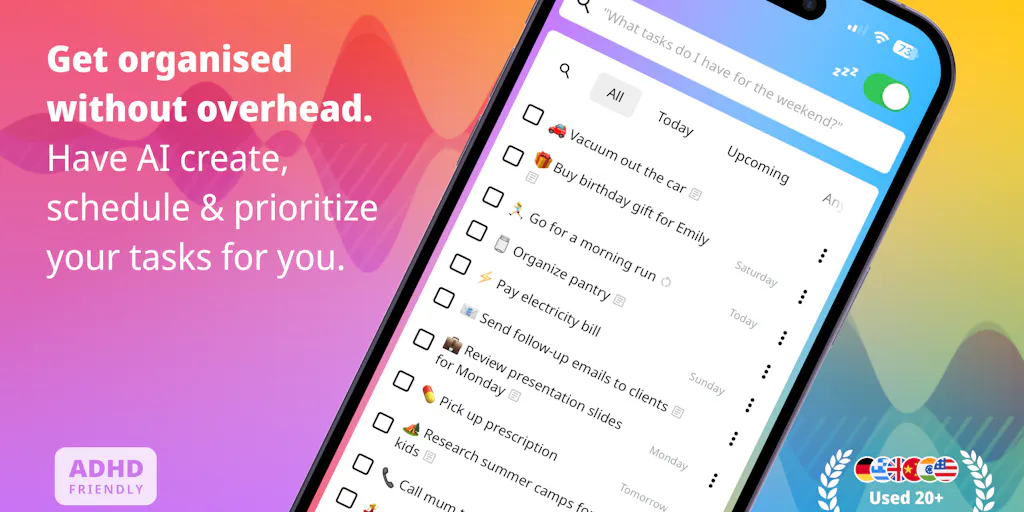
At its core, nxt solves the “what do I do next?” crisis. The product’s maker, Heather Perkins, frames it succinctly: “you speak your thoughts, and it handles the structure.” Behind that promise is a context engine that builds a picture of your habits, schedule, energy patterns, and even your physical location. It then recommends one task at a time—not because it’s overdue, but because it fits your current situation.
For a seller, that contextual reasoning is gold. Imagine you’re in the warehouse checking inventory. nxt could surface “review the return rate report for SKU-403” because it knows you’re on your feet and have 15 free minutes before the next shipment arrives. Or it might suggest “draft the TikTok Shop product description” when it senses you’re sitting in a quiet cafe with good Wi-Fi. The tool doesn’t just list tasks; it tries to match them to the moment. This is fundamentally different from the linear, date-driven lists that most task managers offer. As Perkins noted in response to a comment, “tasks without deadlines get surfaced based on context rather than urgency: a free 20 minutes, the right location, the right headspace.”
For cross-border operators who juggle tasks across time zones, platforms, and physical locations, that kind of intelligent surfacing could reduce the mental overhead of constantly re-evaluating priorities. The voice-capture piece is another overlooked win. Sellers often have ideas in the car, on the warehouse floor, or while unpacking a shipment. A brain-dump voice note that nxt splits into discrete tasks (as Perkins demonstrated in the comments) is far faster than typing into a list.
How It Differs from the Incumbents—and Why That Matters
The productivity space is crowded with tools like Todoist, TickTick, and Things. All of them let you capture tasks, set deadlines, and organize by project. But none of them, out of the box, learn your schedule and energy patterns to recommend what to do now. nxt’s approach is closer to a personal AI assistant than a traditional to-do list.
A key differentiator is how nxt handles the “rotting tasks” problem—those low-urgency but important tasks (like “optimize product images for Amazon” or “review customer W-9 forms”) that sink to the bottom of every list. The tool uses a stored context memory, similar to ChatGPT’s memory feature, to recall that you’ve put off a task for three weeks and then surfaces it when you have slack time. Perkins described an example: “mid-morning, working from home, nxt suggested a small house chore with reasoning ‘take a 10 min break, move around, knock this off your list.’” That level of human-like nudging could be exactly what a seller needs to stop ignoring the tedious but necessary work of cross-border compliance or listing optimization.
Why Amazon Sellers Should Care More Than Shopify Ones
Amazon’s ecosystem is notorious for tight deadlines: FBA shipment windows, lightning deal submissions, and reimbursement claim cutoffs. A missed deadline can mean lost sales or lost money. Yet the day-to-day also includes countless unstructured tasks—checking PPC campaigns, responding to buyer messages, monitoring IP claims—that don’t have hard due dates but accumulate stress. nxt’s ability to prioritize tasks based on context (e.g., “you’re logged into Seller Central right now, so here’s a task to check your stranded inventory”) could be a game changer. Shopify sellers, by contrast, often operate on a more flexible calendar of content creation and ad budgeting, where the biggest pain point is decision fatigue from too many marketing options rather than rigid deadlines. The time-sensitive, penalty-driven nature of Amazon makes nxt’s contextual reasoning more immediately valuable for that operator.
What Cross-Border Sellers Can Borrow from nxt’s Design Philosophy
Even if nxt never becomes a seller’s go-to tool, its design philosophy offers three clear takeaways for anyone building or refining their own workflow:
The “one task at a time” principle. Perkins emphasizes that nxt shows you exactly one next task with a reason why. This reduces cognitive load. Most sellers open a dashboard and see a wall of numbers and to-dos. Borrowing the concept of a single, contextually justified action could be applied to a custom automation script that surfaces the most critical seller task every morning—like a daily Scout file from Helium 10 that suggests which SKU to reprice.
Voice brain-dump as primary capture method. Sellers are mobile. They’re at trade shows, in warehouses, or on a production line. A quick voice note that is automatically split into actionable tasks (with reasonable time estimates and recurring logic) would be more natural than typing. Tools like Zapier could already pipe voice inputs into a task list, but nxt’s parsing quality (e.g., “the marketing summary points need to be ready for the 10am meeting Friday” becomes two tasks with a deadline) is notably better than generic transcription.
Context storage that learns from behavior. nxt stores facts about you (“boss is called Jeff”) and learns from what you complete or snooze. A seller could encode business-specific contexts—like “inventory for SKU-1003 is low,” “Amazon’s fee increase is coming in April,” “PPC budget resets monthly.” A tool that understood these patterns could suggest actions proactively: “Since you’ve been postponing the price update, and it’s the 28th, now is a good time to do it before the new fee takes effect.”
Where the Math Breaks
The reality is that nxt is a personal productivity tool, not an e-commerce operations platform. It has no API (that I could find), no team collaboration, no integrations with Amazon, Shopify, or TikTok Shop. For a cross-border seller who manages a team, the tool is essentially useless—you can’t assign tasks to a VA in Manila, share a sprint board, or automate a task like “create a return label” from a customer email. The context engine is also limited to what you tell it; it doesn’t pull from your actual business data. It doesn’t know your inventory levels, ad spend, or sales velocity unless you manually input that context. That’s a massive gap for anyone running numbers on multiple marketplaces.
My Judgment on Where nxt Falls Short for Cross-Border E-commerce
Beyond the lack of integrations, there are two deeper shortcomings for sellers:
No prioritization of business criticality. nxt may learn that you snooze “check product margins” every Friday afternoon, but it won’t know that if you don’t check it, you might lose 30% margin on a SKU due to a raw material price hike. The tool can infer your behavior but not the consequences of not doing a task. A good task manager for sellers would weigh not just context but business impact—something like “task A saves you $200/an hour, task B saves you $20/an hour.” Without that layer, the recommendation is still somewhat random.
Privacy concerns for sensitive business data. The tool stores discrete facts about you on its servers (though you can view and edit them). For a solo seller, that might be acceptable. But for a brand operation handling proprietary sourcing info, ad strategy, or customer data, storing that in a third-party LLM-powered memory could be a compliance red flag, especially under GDPR or CCPA when dealing with European customers.
On the plus side, the “ADHD friendly” tag that the maker embraced (as discussed in the comments) is a smart move. E-commerce work is inherently distractible—constant email pings, ad performance dashboards, new marketplace notifications. A tool that consciously reduces options and celebrates small wins could resonate deeply with sellers who feel pulled in a hundred directions.
What I’d Watch / Test Next
If you’re a cross-border operator reading this, here are three concrete steps to take this week:
Try nxt for 7 days for your personal task management—especially for the unstructured, non-urgent tasks that you keep ignoring. Use the voice capture for brain dumps on the move. See if the contextual recommendations genuinely help you clear the low-priority backlog faster. If it works for personal tasks, the principle might inspire a better workflow for your business.
Set up a Zapier integration that pipes your most important seller alerts into a voice note capture flow—or directly into nxt. For example, when Helium 10 alerts you that a keyword opportunity appears, have it send a text snippet to nxt as a task. Evaluate how the tool handles business-specific language.
Build your own “context engine” using a lightweight no-code AI tool like CustomGPT or ChatGPT’s memory feature to mimic nxt’s logic for your seller tasks. Tell the AI your schedule, your product catalog, and your recurring deadlines, then ask it each morning: “What is the single most important seller task I should do right now given my current location and time?” Compare the answer to what nxt suggests.
The long-term watch is whether nxt introduces an API or marketplace integrations. If the team can connect to Seller Central, Shopify, and TikTok Shop, the tool could become a genuine proxy for the “seller’s second brain.” Until then, treat it as a useful experiment in context-aware prioritization—and steal its best ideas for your own stack.