The Quiet Crisis of Scattered AI Adoption in E-Commerce
If you’re running a cross-border e-commerce operation today, you already have a dozen AI tools inside your business. ChatGPT drafts your listing copy, Claude helps you analyze competitor reviews, Copilot speeds up your Excel inventory sheets, and someone on the team is probably using Gemini to brainstorm ad angles. And yet, if you’re honest, the impact is underwhelming. Usage is patchy — one PPC manager goes deep, the rest of the team pokes at tools and then retreats to their old workflows. The hard part isn’t buying AI access; it’s making the behavior stick. That’s the problem Solaris is built to solve, and why every e-commerce operator who has watched a six-figure AI subscription gather digital dust should stop and listen.
The Real Problem: Your Team Has AI Tools, Not AI Habits
Most e-commerce teams I talk to fall into the same pattern. A founder buys ChatGPT Enterprise for the whole company, holds a one-hour “AI workshop” (everyone nods), and then a week later the Slack channel is quiet. A few early adopters keep experimenting; everyone else sticks to the tools they have always used. The result is shallow, inconsistent adoption — exactly what Annie Liao and the Build Club team identified when they built Solaris.
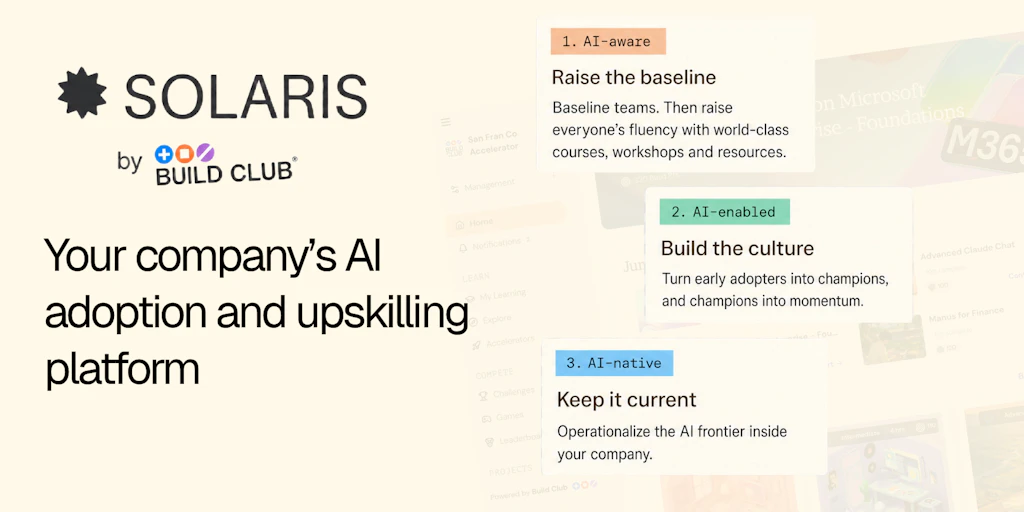
The platform starts where most internal AI initiatives stop: with a baseline. You run an AI fluency assessment that surfaces who is confident, who is stuck, and where the biggest capability gaps sit across your sales, ops, marketing, finance, HR, customer support, and leadership teams. For a cross-border seller, that diagnostic alone is worth the price of entry. I have seen brands waste months trying to train a logistics coordinator on prompt engineering when what they really need is structured help with tariff data extraction — a completely different skill gap.
From the baseline, Solaris serves role-based learning pathways tied to actual workflows. Instead of generic “What is a large language model?” modules, a customer service manager gets scenarios about automating return labels in multiple languages; an Amazon PPC specialist gets exercises on using AI to spot keyword cannibalization. The platform then pushes teams to submit real workflow experiments each week, turning passive learning into application. And it identifies internal champions to spread good behavior beyond the early adopters.
This is not theoretical. In their Product Hunt launch, Liao described the goal bluntly: “AI should not be another tool sitting unused inside the organisation.” Every cross-border operator I know has felt that exact pain — whether it’s an unused Jasper subscription or a Claude Pro license that only one person uses.
How Solaris Differs from the Training That Fails
The incumbent landscape for “AI education” is crowded with two kinds of failures. First, the generic course platforms: Coursera, Udemy, LinkedIn Learning. They offer high-quality content, but the completion rates are dismal, and nothing ties the learning back to the learner’s daily job. Second, the point-tool vendors: Jasper, Copy.ai, Grammarly. They teach you how to use their own product, not how to think about AI as a general capability multiplier.
Solaris occupies a different category. It is not a training library; it is an adoption platform. The differentiation shows in three ways:
Measurement, not just education. Most learning platforms track course completion. Solaris tracks actual workflow experiments and fluency improvement over time. In an e-commerce context, that means you can see that your operations team is now using AI to reconcile inventory discrepancies, not just that they watched a video on Excel macros.
Role-specific, not one-size-fits-all. Your brand manager working on TikTok Shop product descriptions has a completely different AI use case from your fulfillment lead dealing with ShipBob integration errors. Solaris builds separate pathways for marketing, sales, operations, and support. That granularity is critical for a 30-person e-commerce team where every role already has a distinct tool stack.
Internal champions, not top-down mandates. The platform upsells specific team members to become adoption advocates. They share examples, run “lunch and learns,” and help AI behavior spread organically. In my experience, this is the only thing that actually moves the needle. A founder mandating “use ChatGPT” never works; a peer showing how they saved three hours on supplier outreach does.
Why Amazon Sellers Should Care More Than Shopify Ones
If you run a Shopify DTC brand, you probably already have a relatively flat team structure and a tight feedback loop. Your marketing and operations are often the same people. AI adoption can happen quickly because the decision chain is short. But if you are an Amazon FBA seller managing a catalog across three marketplaces, the complexity multiplies. You have multiple account managers, a dedicated PPC agency, an inventory planner, a repricing specialist, and a customer service team handling returns in different languages. The scattered usage problem is exponentially worse.
Solaris’s structured baseline and role-based pathways are almost purpose-built for Amazon teams. The PPC manager’s AI gap (using Claude to analyze search term reports) is completely different from the inventory planner’s gap (using AI to forecast restock dates across EU warehouses). Without a tool like Solaris, you end up with one really good ad optimizer and everyone else guessing. The platform’s “weekly experiment” mechanism also aligns well with the weekly cadence most Amazon sellers already follow — reviewing ad spend, adjusting bids, checking inventory.
That said, the same logic applies to any multi-marketplace seller on eBay, Etsy, or Temu. The more channels you manage, the more you need a deliberate adoption strategy.
What Cross-Border Operators Can Borrow (Even Without Buying the Platform)
You do not have to sign up for Solaris today to use its framework. The core insight — that adoption fails without baselining, role pathways, practical experiments, champions, and measurement — is directly actionable.
1. Run your own fluency baseline this week. Create a simple survey asking each team member: which AI tools have you used in the last 30 days? Where do you feel confident? Where do you feel stuck? Map the answers by role. You will likely find that your content writers are overusing ChatGPT for creative work (producing generic copy) while your logistics team has never touched it for automating customs documentation. That mismatch is the start of a targeted learning plan.
2. Replace generic training with role-specific sprints. Do not send your whole team to a “Generative AI 101” webinar. Instead, for each role, define one concrete workflow experiment. For example: - PPC manager: Use Claude to analyze the last 30 days of search term reports and identify three negative keywords you missed. - Customer service lead: Use ChatGPT to draft a multi-language return email template and run it past a native speaker. - Inventory planner: Use an AI forecasting tool (or a custom GPT) to predict restock dates for your top 10 ASINs.
Have each team member document what they tried, whether it worked, and what they would do differently. That is the Solaris “weekly experiment” model, minus the software.
3. Identify internal champions. Look for the person who already runs a custom GPT for their own tasks. Give them a small title (AI Lead, Automation Champion) and 2–4 hours a week to help others share their experiments. Create a shared Notion or Slack channel where people post “AI wins” and “AI fails.” The champions model works because peer influence beats executive mandate, especially in cross-border teams where colleagues are often remote and asynchronous.
Where the Math Breaks
Solaris is clearly built for organizations with 50+ employees and a dedicated HR or L&D function. For a 5-person Amazon FBA team operating out of a WeWork, the platform may be overkill. The cost (not disclosed on the launch page, but enterprise SaaS in this space typically runs $5,000–$20,000 per year) is hard to justify when the team can implement the same framework with a Google Sheet and Slack.
There is also a deeper structural limitation. E-commerce is a speed business. Your team’s priorities shift every 90 days as marketplaces change rules, ads become more expensive, or supply chains jam. The Solaris model of a baseline, then role pathways, then weekly experiments, then measurement — it assumes a certain organizational stability. In practice, many cross-border operators are in fire-fighting mode. A platform that asks a PPC manager to spend two hours a week on AI experiments when they are already drowning in Q4 ad optimization will be ignored.
Finally, Solaris’s fluency baseline may miss domain-specific AI knowledge. A seller who knows how to use Helium 10’s Cerebro tool is already AI-native in a critical way — but a generic “AI fluency” test that asks about prompt engineering will not capture that. The platform needs to integrate with e-commerce-specific tools to feel relevant to our industry.
What I’d Watch / Test Next
I am not recommending that every cross-border operator rush to buy Solaris today. But I am recommending that you test its premise on your own team. Here is what I would do this week:
Run a 10-minute team survey on current AI usage and confidence. Use any free tool (Google Forms, Typeform). Share the results in a team meeting. The act of surfacing the gaps is often enough to trigger a shift.
Pick one role and run a 30-day AI adoption sprint. Choose the role with the highest potential upside — usually PPC or customer service. Define three concrete experiments they run over the next month. Check in weekly for 15 minutes. Track whether those experiments become habits.
Sign up for Solaris if they have a free tier. The Product Hunt launch did not specify pricing, but Build Club has offered free community access through their previous launches like Build Club Campus. If there is a free pilot, take it. The real value may not be the platform itself but the structured approach it forces you to adopt.
Follow Build Club’s community channels — their Instagram, LinkedIn, and X — to see workflow templates that other operators share. Even if you never use Solaris, the raw templates (how to structure a weekly AI experiment, how to run a lunch-and-learn) are gold.
The hard truth is that AI tools are now table stakes for cross-border e-commerce. The difference between winners and also-rans will not be who buys the most licenses. It will be who builds the team habits that turn scattered access into compounding capability. Solaris offers a structured path to that end. Whether you take their path or build your own, the time to start is now.