Why a DevOps tool on Product Hunt actually matters to your DTC operation
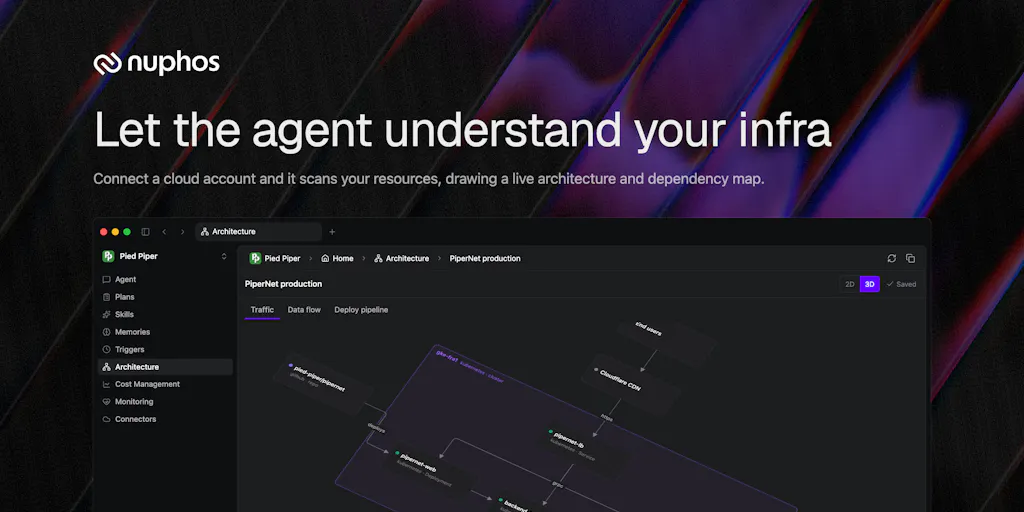
Let me be direct with you: if you run a cross-border e-commerce operation, your first instinct when you see an “AI DevOps workspace” launch on Product Hunt is probably to scroll past. You sell products, not infrastructure. But here’s the uncomfortable truth — the brands that survive the next three years won’t be the ones with the best products or the most aggressive ad spend. They’ll be the ones whose technology stack doesn’t collapse under the weight of their own growth. Every seller reading this has felt that specific dread: the 2 AM notification that your Shopify store is down during a flash sale, the Kafkaesque nightmare of an Amazon Seller Central account suspension with no clear path to reinstatement, the silent cost creep of your logistics APIs that you only discover when the invoice arrives. Nuphos, an AI-native DevOps workspace launched this week on Product Hunt, is ostensibly built for SRE teams managing Kubernetes clusters. But the underlying philosophy — AI agents that work within your existing infrastructure, read-only by default, requiring approval for any mutation — is exactly the operational discipline that cross-border sellers need to borrow, whether or not you ever touch a single kubectl command.
The real problem: your e-commerce stack is already out of control
Here’s what the Nuphos team figured out while building Zeabur, their PaaS: the gap between “AI that can execute a command” and “AI that can be trusted to operate your production environment” is not about capability. It’s about governance. As Yuanlin Lin, founder of Nuphos, put it in the launch post, they originally described Zeabur as “Your AI DevOps Engineer,” but realized that “A PaaS asks you to adapt to its rules. A DevOps engineer adapts to your teams infrastructure.” That distinction is everything.
Now translate that to your world. You’re running a DTC brand on Shopify, maybe with an Amazon FBA operation on the side, a TikTok Shop storefront if you’re feeling adventurous, and a returns management tool that talks to your 3PL. Every one of those platforms has its own dashboard, its own permissions model, its own API rate limits, its own way of silently failing. You probably have a spreadsheet somewhere that’s supposed to be the “source of truth” for inventory levels. You might have a Slack channel where your VA posts daily sales numbers. The tools don’t talk to each other, and the human glue holding it together is you, at 1 AM, cross-referencing three different dashboards to figure out why your best-selling SKU is suddenly out of stock.
The Nuphos team, operating with fewer than 10 engineers across 8+ clouds, 20+ Kubernetes clusters, and more than 10,000 hosts, identified that the hard part isn’t getting an AI agent to run a command — it’s answering four questions: whose permissions is it using, what can it change, who approved it, and what exactly changed. Those same four questions apply to every tool in your e-commerce stack. When your inventory sync tool pushes an update to your Amazon listings, whose credentials is it using? What’s the blast radius if it gets it wrong? Who approved the price change that just went live? And when your supplier ships 500 units to the wrong warehouse, can you trace exactly where the signal broke down?
How Nuphos differs from the AI tools you’re already drowning in
There’s no shortage of AI tools promising to “revolutionize” e-commerce operations. You’ve seen them all: Helium 10 for Amazon keyword research, Klaviyo for email flows, Triple Whale for attribution. They’re all SaaS products that ask you to adapt to their rules. You log in, you configure their dashboards, you export their reports, and you hope the data matches what’s actually happening in your business.
Nuphos takes the opposite approach. Instead of being another dashboard you have to maintain, it’s an AI agent that adapts to the infrastructure you already run. Connect your existing AWS, GCP, Kubernetes, and observability stack, and the agent works within those systems — read-only by default, requiring approval for write actions, keeping context and audit trails shared with your team. The live demo on their homepage doesn’t even require signup, which tells you they’re confident in the product, not just the marketing.
The comparison that matters here is against the AI coding assistants and terminal agents that have proliferated over the past year. Tools like GitHub Copilot or Warp can generate code or run commands, but they operate in a context vacuum. They don’t know your team’s permissions, your incident response playbook, or your compliance requirements. Nuphos explicitly builds shared memory from past investigations and incidents, so “the next session doesn’t start from zero,” as Lin noted in response to a question about learning team-specific runbooks.
For e-commerce operators, this is the difference between an AI tool that can draft a product listing and an AI that knows your brand voice, your compliance constraints, your supplier quirks, and your historical return reasons — and can act on that knowledge without you having to re-explain everything every single time.
Why Amazon sellers should care more than Shopify ones
If you’re a Shopify-only operator, you can get away with a simpler stack. Shopify’s ecosystem is designed to be self-contained. But the moment you add Amazon FBA into the mix, you’re dealing with a fundamentally different beast. Amazon Seller Central is a labyrinth of policies, performance metrics, and suspension risks. Your inventory has to be synchronized across two (or more) fulfillment networks. Your pricing strategy has to account for Amazon’s Buy Box algorithm. Your customer service has to meet Amazon’s response time requirements.
The Nuphos philosophy of “read-only by default, approval for writes” maps directly onto Amazon operations. How many sellers have been burned by an automated repricing tool that went rogue and slashed prices to unprofitable levels? How many have had a listing accidentally suppressed because an AI tool “optimized” a title in a way that violated Amazon’s style guides? The answer is too many, and the reason is that these tools operate with too much autonomy and too little governance. The Nuphos model — where the AI investigates, proposes a plan, and waits for human approval before making any change — is exactly the discipline that Amazon sellers need to apply to their tooling stack.
Where the math breaks: the approval bottleneck during incidents
The most interesting exchange in the launch comments came from Sabber Ahamed, who asked the question that should be on every operator’s mind: during an active incident when minutes matter, does the approval step become the bottleneck itself? The Nuphos team’s answer was honest and revealing. Bruce Du admitted, “You’re right, the approval step can become a bottleneck. Today, we don’t have a universal break-glass bypass, and that’s intentional.” Ling Wu went further, acknowledging that “our SREs are sometimes complaining about the guardrails.”
They do have an Auto Mode where you can define authorization policies ahead of time, so if an action matches those policies, the agent can execute automatically. But the core tension remains: safety and speed are in direct opposition, and the team has chosen safety. That’s the right call for infrastructure, but it’s worth understanding the tradeoff before you apply the same logic to your e-commerce operations.
If your product feed breaks during a Black Friday sale, you don’t want to wait for a human to approve every single fix. The Nuphos approach — pre-authorize the narrow classes of actions you’re confident about, require approval for everything else — is the right framework, but you need to deliberately design those pre-authorization policies before the incident happens, not during it.
What cross-border sellers can borrow from Nuphos right now
You don’t need to adopt Nuphos itself to benefit from its design philosophy. Here are four operational principles you can steal from this launch and apply to your e-commerce stack this week:
1. Audit your tool permissions today. The Nuphos team built the product around the question of whose permissions an agent is using. Go through every tool in your stack — your repricer, your inventory sync, your review management software — and check what level of access each one has. If any tool has write access to your Amazon listings or your Shopify products, ask whether it actually needs that level of access, or whether it could operate with read-only permissions plus human approval for changes. The answer will probably horrify you.
2. Build a shared context document for your operations. Nuphos explicitly builds shared memory from past investigations and incidents. Your version of this is a living document that captures your team’s operational knowledge: which suppliers are reliable, which carriers have been late three times this quarter, which product categories have the highest return rates and why. The goal is that any new team member — human or AI — can get up to speed without starting from zero.
3. Implement a plan-then-approve workflow for pricing and listing changes. Nuphos requires the agent to present a plan before making any mutation. Apply the same discipline to your pricing strategy. Instead of letting an automated repricer make real-time changes, set it to propose changes and require a human to approve them. Yes, it’s slower. Yes, you might miss a few Buy Box opportunities. But you’ll never wake up to a catastrophe where your entire catalog was priced at 50% off because the tool glitched.
4. Treat uncertainty as a first-class state. The Nuphos team’s repeated response to questions about conflicting signals was that uncertainty is a reason to pause, not to guess. How many operational decisions have you made based on incomplete data, only to regret it later? Build a process where any significant decision requires you to explicitly state what you know, what you don’t know, and what evidence would change your mind. It sounds bureaucratic, but it’s the difference between reacting and operating.
The honest limitations: what Nuphos doesn’t solve
I’ve been writing about e-commerce tooling for years, and I’ve seen enough product launches to be skeptical of anything that promises to solve everything. Nuphos is no exception. The team is upfront about what they’re still working on — the lack of a break-glass path during incidents, the absence of a simulated cloud environment for testing unfamiliar failures, the ongoing tension between guardrails and speed. These are real limitations, not marketing copy.
More importantly, Nuphos is built for engineering teams, not e-commerce operators. You’re not going to connect your Amazon Seller Central account to it and have it manage your listings. The product’s focus on AWS, GCP, and Kubernetes is a tell: this is infrastructure tooling, not business tooling. What you can take from it is the philosophy — AI agents that work within your existing systems, respect your permissions, require approval for changes, and keep an audit trail of everything they do.
The broader lesson is that the next wave of AI tools for e-commerce won’t be about doing more with AI. It’ll be about doing less, more carefully. The tools that win will be the ones that understand your existing operations, work within your constraints, and know when to stop and ask for help. Nuphos is a glimpse of that future, even if it’s not the tool you’ll use directly.
What I’d watch / test next
Here’s what I’d do this week if I were running a cross-border e-commerce operation:
First, take an afternoon to audit every tool in your stack and document exactly what permissions each one has. You’ll probably find at least one tool that has far more access than it needs. Revoke the excess permissions and set up a process where any new tool has to justify its level of access before you connect it.
Second, start a shared operations document — a single source of truth for your team’s knowledge about suppliers, carriers, product performance, and recurring issues. The Nuphos team’s insight that “shared memory” is what makes an AI agent feel like a teammate applies equally to human teams. If you ever want to bring an AI agent into your operations, this document is the foundation it’ll need.
Third, watch how Nuphos evolves over the next few quarters. The team’s honest engagement with hard questions about approval bottlenecks and uncertainty handling is rare in the AI tooling space, and they’re actively refining their approach based on real operational use. If they extend beyond pure infrastructure into adjacent territory — say, monitoring cloud costs that affect your logistics or managing the APIs that connect your e-commerce platforms — that’s a signal that the philosophy is maturing into something you might actually use.
Finally, apply the read-only-by-default principle to your own AI experiments. If you’re testing AI tools for product descriptions, customer service, or ad copy, keep them in read-only mode for the first month. Have them propose changes, not make them. You’ll lose some efficiency, but you’ll build trust in what the tool can actually do before you give it the keys to your business.
The cross-border e-commerce operators who win the next decade won’t be the ones with the most sophisticated AI stack. They’ll be the ones who understand that trust is earned through approvals, and that knowing when not to act is just as important as knowing what to do. Nuphos gets that. The question is whether you’ll apply the same discipline to your own operation.