The feedback layer nobody asked for — and why DTC operators should still care
Cross-border e-commerce has quietly become a prototyping business. Every TikTok Shop creative, every Shopify landing page variant, every Amazon A+ module, every Temu-style PDP refresh starts life as a mockup that somebody has to approve — and that approval loop is where margin dies. You burn days shuttling screenshots through WeChat, Slack, and email, then re-brief a designer or a freelancer in prose. So when a tool shows up claiming to pin feedback to the actual prototype element and pipe it straight into a coding agent, I pay attention — not because I’m a designer, but because the same broken loop eats my media buyers’ and CRO contractors’ weeks. Inflight is the launch in question, and the interesting question isn’t whether it’s a nice design tool. It’s whether the “feedback lives on the artifact” pattern is one operators should steal for their own conversion workflows.
What Inflight actually solves, stripped of the design-tool framing
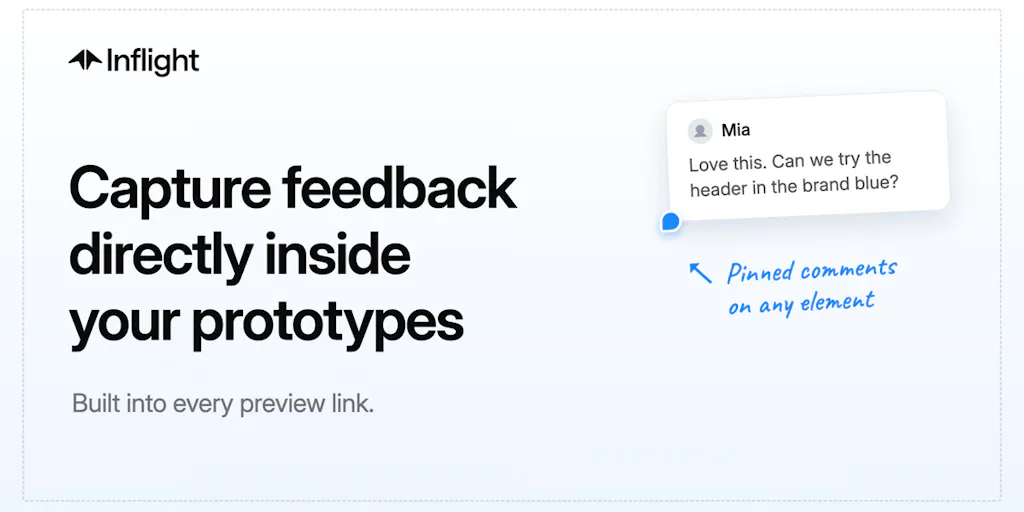
The pitch from maker Tommy Geoco is narrow and specific: design leads told him prototype feedback is “scattered across channels, then someone retypes it into a prompt so the agent can fix it.” Inflight’s answer is to let reviewers pin comments to real elements on a running app — or record video — and then have a coding agent like Cursor, Claude Code, or Codex pull those notes in over MCP as next steps. That’s the whole product. Share a preview link or an HTML prototype, reviewers annotate in place, the agent ingests the annotations.
If you’ve never shipped a prototype, this sounds like a minor UX nicety. If you have, you recognize it as a fix for a genuinely expensive failure mode: the translation tax. Every hop from “reviewer sees a problem” to “person with build access understands the problem” loses fidelity. By the time a comment reaches the person who can act on it, it’s been paraphrased twice. Inflight’s bet is that if feedback is anchored to the element and machine-readable, the agent becomes the translator — and the human round-trip disappears.
Why Amazon sellers should care more than Shopify ones
Shopify operators already live in a world of cheap iteration — you can spin up a landing page variant in an afternoon and let Shopify’s native A/B testing or a tool like Intelligems settle the argument with data. Amazon sellers don’t have that luxury. Your A+ content, brand store, and main image stack are gated by Amazon Seller Central review cycles, and every revision is a mini-project. That makes the quality of the first draft and the speed of internal sign-off far more valuable. If your creative agency sends you a mockup and you can annotate it in place, then have your own dev or an AI agent turn those notes into a revised asset without a three-day email chain, you’ve compressed a review cycle that Amazon’s own tooling won’t compress for you. The leverage is higher on the slower platform, not the faster one.
How it differs from the tools you’re probably already paying for
The obvious comparison set matters here, because “annotation tool” is a crowded category and the differentiation is real but thin.
Start with Figma. Figma already does comments-on-elements beautifully — it’s the default for design review and it’s where most of your agency’s mockups already live. What Figma doesn’t do natively is hand those comments to a coding agent as structured next steps. Inflight’s whole wedge is the MCP bridge from annotation to agent action. If your team already lives in Figma and your devs are happy copy-pasting comments into a prompt, Inflight is solving a problem you’ve already absorbed.
Then there’s the wave of AI prototyping tools — Magic Patterns, whose founder Alex Danilowicz showed up in the comments calling Inflight “the missing feedback layer,” and the broader class of v0-style generators. These tools are great at producing the first draft and terrible at closing the loop on revisions. Inflight is explicitly positioning as the layer on top of whatever generated the prototype, which is smart — it means it doesn’t have to win the generation war to be useful. But it also means it’s a complement, not a replacement, and you’ll be paying for another seat in an already crowded stack.
The honest read: Inflight is closest in spirit to Marker.io or Userback — visual feedback tools that let clients annotate live sites — but with the agent handoff as the headline feature instead of the afterthought. That’s a meaningful difference in 2025, when “agent pulls the ticket and fixes it” is becoming table stakes. It’s also a difference that a competitor can copy in a quarter.
What cross-border operators should borrow, regardless of whether they buy
Here’s the part I actually care about. The specific product is less interesting than the pattern, and the pattern is directly transplantable to e-commerce operations even if you never touch a prototype.
The “feedback lives on the artifact” principle
Most cross-border teams run their creative review in WhatsApp groups and WeChat threads. A media buyer screenshots a TikTok ad, circles the hook in red, sends it to a group, and someone else has to figure out which version of the ad the screenshot refers to. This is insane at scale. The Inflight insight — anchor the comment to the element, not to a chat message — applies just as well to ad creative, PDP images, email templates, and landing pages. Tools like Figma and Frame.io already support this for design and video respectively; the failure is organizational, not technical. If you take nothing else from this launch, take the discipline: stop reviewing creative in chat apps. Review it on the artifact, with the comment attached to the thing it’s about.
The MCP handoff is the real story
The most forward-looking thing about Inflight is that it treats MCP as the integration layer between human feedback and agent execution. That’s a pattern every operator should be watching, because it’s coming for your stack. Imagine your Klaviyo flow review, your Helium 10 listing audit, your Gorgias macro cleanup — all of it annotated in place and handed to an agent as structured tasks. The vendors who expose MCP endpoints will get adopted into agent workflows; the ones who don’t will get bypassed. When you’re evaluating your next SaaS purchase, “does it speak MCP” is a question worth asking now, before it becomes mandatory.
Why the “reviewer doesn’t need an account” question matters for your agency relationships
Buried in the comments, Ankush Chauhan asked the sharpest question on the page: “Does the feedback land somewhere the client can use without an account? The reason prototype feedback ends up in WhatsApp for me is that clients won’t sign up for one more tool just to leave three comments.” That is the adoption killer for every B2B review tool, and it applies double to cross-border work, where your agency counterpart may be in a different timezone, speak a different first language, and have zero patience for onboarding. Any tool you adopt for creative or listing review must have a zero-friction reviewer path — magic link, no login, no app install. If it doesn’t, your team will route around it back to WhatsApp within two weeks.
Where my judgment says this falls short
I’ll be blunt: this is an early-stage product with a narrow wedge, and the launch page tells you more about the team’s design pedigree than about enterprise readiness. Three concerns.
First, the conflict-resolution gap is real. Michelle Bankas asked the obvious operational question — what happens when two reviewers request opposite changes before the feedback reaches the agent? — and as of the scrape, there’s no public answer. For a two-person design team, that’s fine; a human adjudicates. For a cross-border operator running review across a US brand team, a Shenzhen sourcing team, and a Manila VA team, conflicting annotations are the normal state, not the edge case. Until Inflight (or its competitors) ships a resolution layer, you’re trading one coordination problem for another.
Second, the tool assumes your prototype is a running app or HTML. That’s true for software, and increasingly true for Shopify storefronts and landing pages — but it’s not true for the artifacts most cross-border operators actually review: static ad creative, PDP image stacks, video hooks, email HTML. Inflight’s video recording feature helps, but the core value prop is built around interactive prototypes. If your review bottleneck is TikTok creative variants, this isn’t your tool yet.
Third, and this is the structural one: the MCP-to-coding-agent handoff is a feature, not a moat. Cursor, Claude Code, and Codex are all racing to build their own feedback ingestion, and the annotation layer is the easiest part of the stack to commoditize. I’d expect Figma to ship agent handoff natively within a year, and when it does, Inflight’s differentiation collapses to UX polish. That doesn’t make it a bad product — it makes it a feature you should adopt cheaply and not build a workflow dependency around.
Where the math breaks
Do the operator math. If Inflight saves your team one round-trip per prototype review and you run, say, four landing page tests a month, the saved time is real but modest — maybe a few hours of designer and PM time. The ROI only gets compelling when you scale review volume past the point where chat-thread chaos actually costs you money, which for most cross-border operators is somewhere north of a dozen concurrent creative projects. Below that threshold, you’re paying for a tool to solve a problem a disciplined Slack channel could mostly solve. Above it, the tool pays for itself fast. Know which side of the line you’re on before you buy seats.
What I’d watch / test next
This week, before you evaluate Inflight specifically, run a two-part audit. First, count how many of your last twenty creative or landing-page revisions required a clarification round-trip — a “which version did you mean?” or “can you re-explain that comment?” message. If that number is above five, you have a feedback-anchoring problem worth solving, and you should shortlist Inflight alongside Marker.io and Figma’s native comments and test one on a single live project. Second, ask your agency and your internal dev whether their tools expose an MCP endpoint yet. If the answer is no across the board, start factoring that into your next renewal cycle — the agent handoff is coming whether your vendors are ready or not.
If you do trial Inflight, take the maker up on his explicit ask: connect the MCP and report back whether the first next step your agent pulled in was correct. That’s the only test that matters. Everything else — the design pedigree, the launch-day enthusiasm, the “missing feedback layer” framing — is noise until an agent actually acts on a human’s annotation and gets it right. Watch that number, not the upvotes.


