Why a Robinhood Trading Agent Actually Matters for Cross-Border Sellers
Let me start with a confession: when I first saw OpenTrade on Product Hunt, my instinct was to scroll past. Another AI agent wrapper? Another open-source project promising autonomy? But then I read the launch post from Pranav Nair and the Exla (YC W25) team, and something clicked. This isn’t about trading. It’s about the fundamental architecture of trusting AI agents with consequential, irreversible actions — and that is exactly the conversation cross-border e-commerce operators need to be having right now.
We run businesses where a single automated decision can cost thousands of dollars. A repricing algorithm that goes haywire on Amazon. A TikTok Shop ad campaign that blows through a week’s budget in four hours. A Shopify inventory sync that double-orders from a supplier. The stakes are real, the systems are increasingly autonomous, and most of us are flying without guardrails. OpenTrade — an open-source macOS app that manages Claude Code and Codex agents trading via Robinhood — is a fascinating case study in how to build safety rails for autonomous agents. The domain is different, but the lessons transfer directly to our world. Let me break down what this launch tells us about the future of agentic operations in e-commerce.
The Problem: Agents That Can Act, But Can’t Be Trusted
The OpenTrade launch post describes a very specific pain point. When Robinhood released their MCP in May, it became technically possible for AI agents to interact with a real brokerage account. The vision was seductive: a 24⁄7 financial advisor monitoring your portfolio, reacting to market events, executing trades. But what the OpenTrade team actually found was that the foundations were missing. Agents couldn’t proactively react to market events. Mistakes made by agents risked the entire portfolio. And managing multiple agents on the same account was a nightmare.
Sound familiar? It should. This is the exact same gap that exists in e-commerce tooling right now. We have AI tools that can draft product listings, generate ad copy, and even suggest pricing changes. But very few of them can act autonomously in a way that’s safe, auditable, and reversible. The tools that do exist — think repricers like Repricer or Feedvisor — operate in narrow, well-defined lanes. They don’t have the flexibility to react to novel situations. And the moment you try to give a general-purpose agent access to your Amazon Seller Central or your Shopify admin, you’re back to the same problem OpenTrade identified: no proactive monitoring, no per-agent guardrails, no way to manage multiple autonomous actors on the same account.
Why Amazon Sellers Should Care More Than Shopify Ones
Here’s where I’m going to be slightly contrarian. Shopify sellers have a lot of control over their stack — they can pick and choose apps, use APIs freely, and build custom automations. Amazon sellers, by contrast, operate in a walled garden where the API is more restrictive, the consequences of policy violations are severe, and the marketplace itself is constantly changing the rules. The OpenTrade architecture — with its headless sessions, custom monitors, and per-agent approval workflows — is far more relevant to an Amazon operator than a Shopify one. On Shopify, you can afford to experiment with autonomy. On Amazon, you need guardrails before you let an agent anywhere near your account, because one bad repricing decision or one policy-violating listing change can get you suspended.
The Architecture: What OpenTrade Actually Does
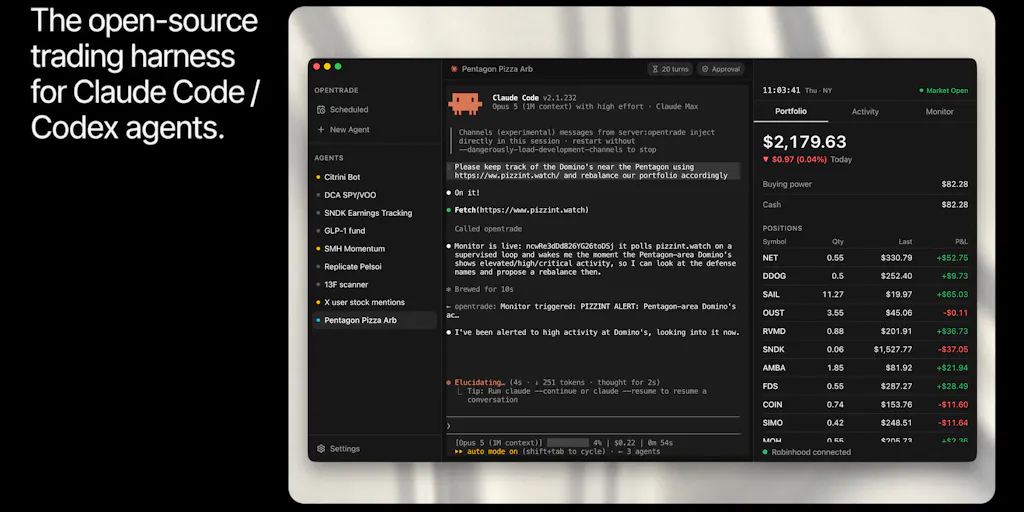
Let me get into the specifics of what OpenTrade provides, because the design decisions are instructive. The core features, as described in the launch post, are:
- Monitors that can notify agents periodically or based on custom scripts the agents write themselves. This is proactive, not reactive — the agent isn’t waiting for a prompt, it’s being triggered by market conditions.
- Headless sessions so agents can work in the background. No need to keep a terminal window open or babysit the process.
- Guardrails and order approvals specific to each agent. This is the big one. Each agent has its own approval workflow, so you can give one agent wide latitude and another almost none.
- An IDE-like environment to manage multiple agents. A control panel, essentially, for your autonomous workforce.
The team also made a deliberate choice to keep everything local-first and open-source. As the launch post states, “OpenTrade spawns your own configured Claude Code or Codex agents on your machine - never on a server.” This is a trust play, and it’s the right one for a tool that touches financial accounts.
Now, the honest assessment: this is early-stage software. The only broker supported is Robinhood, which is US-only (the maker confirms this in a comment responding to a user in India). There’s no position locking — as Pranav Nair admits, nothing stops two agents from placing individually valid orders on the same position at the same time. That’s a real gap. But the architecture is sound, and the philosophy is exactly right.
What Cross-Border Sellers Can Borrow From OpenTrade
Here’s where I want to get practical. You’re not going to use OpenTrade to manage your Amazon business — it’s built for trading, and the Robinhood-only limitation makes it irrelevant for most of us. But the patterns are directly transferable. Let me walk through each one.
1. Per-Agent Guardrails Are Non-Negotiable
The single most important idea in OpenTrade is that guardrails and order approvals are specific to each agent. This is not a one-size-fits-all approval workflow. You can have one agent that’s allowed to execute trades up to $500 without human review, and another that needs approval for every single action.
Apply this to e-commerce. If you’re running AI agents to manage your listings, your repricing, and your ad campaigns, you should not give them all the same level of authority. A listing-optimization agent that’s just tweaking titles and bullet points can have wide latitude — the downside is limited. A repricing agent that can change prices on 10,000 SKUs needs strict guardrails, because a single algorithmic error can destroy your margins or trigger a buy box war. And an agent with access to your supplier ordering system? That one should require human approval for every single PO, no exceptions.
The tooling for this in e-commerce is immature, but the principle is clear. You need to define, for each autonomous process, exactly what it’s allowed to do, what requires human sign-off, and what’s completely off-limits.
2. Monitors Should Trigger Agents, Not the Other Way Around
OpenTrade’s monitors are a key differentiator. Agents aren’t sitting idle waiting for a prompt — they’re being notified by monitors that are watching market conditions. This is a fundamentally different architecture from most e-commerce AI tools, which are reactive: you ask a question, or you set up a scheduled task, and the AI responds.
The monitor pattern is more powerful. Imagine a monitor that watches your Amazon inventory levels and triggers a restock agent when a SKU drops below a threshold. Or a monitor that tracks competitor prices on a specific ASIN and triggers a repricing agent when the gap exceeds a certain percentage. Or a monitor that watches your ad spend and triggers a budget-adjustment agent when you’re burning through your daily cap too fast.
This is the direction the industry is heading, but very few tools have implemented it well. OpenTrade shows what it looks like when the monitoring layer is first-class, not an afterthought.
3. Local-First and Open-Source as Trust Infrastructure
The OpenTrade team’s decision to keep everything local is a smart one. As the launch post says, “we firmly believe that a product to manage your finances should be completely under your control.” This is a trust argument, and it’s compelling.
For e-commerce, the equivalent is being very careful about which AI tools get access to your marketplace accounts. There’s a real tension here. Tools like Helium 10 and Jungle Scout need API access to function, but they’re read-heavy — they’re pulling data, not making changes. The moment you give an AI tool write access to your Amazon account, you need to think hard about where that tool runs, who has access to its servers, and what happens if it goes rogue.
Open-source and local-first is the gold standard for this. If a tool’s code is open, you can audit it. If it runs on your machine, you control the data. Most commercial e-commerce AI tools won’t meet this bar, and that’s a real vulnerability.
4. The IDE-Like Environment for Managing Multiple Agents
This is a feature that sounds niche but is actually critical. As you scale autonomous operations, you need a control panel. OpenTrade provides “an IDE-like environment to easily manage multiple agents” — a single place to see what each agent is doing, what approvals are pending, and what’s been executed.
In e-commerce, we’re going to end up with dozens of agents: one for listings, one for repricing, one for ad optimization, one for inventory forecasting, one for review monitoring, one for supplier communications. If each of these has its own interface, you’re going to drown in dashboards. You need a unified view — a single pane of glass where you can see all your agents, their status, their pending approvals, and their recent actions.
This is a gap in the current e-commerce tooling stack. OpenTrade’s approach — treating the agent manager as a first-class product, not an afterthought — is the right model.
Where the Math Breaks: Honest Limitations
I want to be clear that OpenTrade is not a finished product, and the limitations are instructive in their own right.
The position-locking gap. As the maker acknowledges, there’s no mechanism to prevent two agents from placing conflicting orders on the same position. In trading, this could mean one agent buying while another sells, or two agents both trying to buy the same stock at the same time. In e-commerce, the equivalent would be two agents both trying to update the same listing — one changing the price while another changes the description, resulting in a corrupted state.
This is a hard problem. It requires a locking mechanism at the application level, which means the tool needs to understand the semantics of the underlying system. OpenTrade doesn’t have this yet. Most e-commerce tools don’t either. But it’s a critical gap — without it, you can’t safely run multiple autonomous agents on the same account.
The single-broker limitation. Robinhood-only is a significant constraint. The maker’s response to a user asking about India — “The only broker supported today is Robinhood, which I believe is US-only” — is honest but revealing. The tool is built for a narrow use case. For e-commerce, the equivalent would be a tool that only works with one marketplace or one payment processor. It’s a fine starting point, but it limits the applicability.
The “no advice” philosophy. The maker explicitly says, “One thing we’ve intentionally strayed from is trying to give users trading advice/preferences. OpenTrade is a tool for active Robinhood traders who need agents to help them out.” This is a deliberate choice to be a pure execution layer, not a strategy layer. For e-commerce, this is actually a useful distinction. We have plenty of tools that tell us what to do — repricing recommendations, ad optimization suggestions, inventory forecasts. What we need more of are tools that safely execute those recommendations. OpenTrade’s focus on execution, without trying to be smart about strategy, is a model worth copying.
What Cross-Border Sellers Should Build Next
I’m not suggesting you go out and install OpenTrade today — unless you’re an active Robinhood trader, in which case, go for it, it’s open source. But for the rest of us, the launch raises a bigger question: what would an OpenTrade for e-commerce look like?
Let me sketch the requirements, based on what OpenTrade gets right and where it falls short.
First, you need a monitoring layer that watches your business and triggers agents. This is the most valuable pattern. You want monitors for inventory levels, competitor prices, ad spend, review sentiment, supplier lead times, and marketplace policy changes. When a monitor fires, it should spawn an agent with a specific task and a specific set of permissions.
Second, you need per-agent guardrails. Each agent should have a defined scope of authority. What actions can it take without human approval? What requires sign-off? What’s completely forbidden? This isn’t just about safety — it’s about accountability. When something goes wrong, you need to know which agent did what, and whether it was acting within its remit.
Third, you need a unified control panel. A single dashboard where you can see all your agents, their current tasks, their pending approvals, and their action logs. You should be able to pause any agent, revoke its permissions, or force a human review of its pending actions.
Fourth, you need conflict resolution. The position-locking problem is real. If two agents are both trying to update the same SKU, you need a mechanism to prevent conflicts. This could be as simple as a per-SKU lock that prevents concurrent writes, or as sophisticated as a transaction manager that can detect and resolve conflicting actions.
What I’d Watch / Test Next
Here’s my concrete advice for operators who want to act on this this week, not just nod along:
Audit your current automation stack. List every tool that has write access to your marketplace accounts, your payment processors, or your supplier systems. For each one, ask: what are the guardrails? What happens if this tool makes a mistake? Can I audit its actions? If you can’t answer these questions, you have a problem.
Define your own agent hierarchy. Before you add more AI tools, decide which processes are safe to automate and which need human oversight. Start with the low-risk, high-volume tasks — listing optimization, review monitoring, report generation. Keep the high-stakes tasks — repricing, ordering, ad budget changes — on a human-in-the-loop workflow.
Test a monitor-driven workflow. Pick one metric that matters to your business — say, inventory levels for your top 10 SKUs. Set up a manual monitor (a spreadsheet, a dashboard, a daily report) that triggers a specific action when a threshold is crossed. Run this manually for a week. Then look for a tool that can automate it. The pattern is more important than the tool.
Watch the agentic e-commerce space closely. We’re going to see a wave of tools that try to do for e-commerce what OpenTrade does for trading. Some will be open-source, some will be commercial. The ones that get the guardrails right — per-agent permissions, approval workflows, audit logs — are the ones worth trying. The ones that promise full autonomy without safety rails should be treated with suspicion.
The OpenTrade launch is a small event in the grand scheme of things — an open-source macOS app for Robinhood traders. But it’s a signal. The architecture of safe agentic autonomy is being figured out, and the patterns are transferable. Cross-border sellers who pay attention to this now will be ahead of the curve when the e-commerce equivalents arrive. Those who don’t will be playing catch-up, trying to bolt guardrails onto systems that were never designed for them.