The Invisible Work Problem Is Eating Your Ops Team — and Meridian Accidentally Built the Fix
Every cross-border operator I know has the same recurring nightmare: you spend a week untangling a fulfillment bottleneck, negotiating with a freight forwarder who keeps changing ETAs, or debugging why your Amazon PPC account suddenly doubled its ACoS — and then Friday comes and your weekly report to the partners says “worked on operations.” That’s it. The real work — the investigations, the rejected approaches, the unglamorous judgment calls — evaporates the moment it happens. Your value becomes invisible, your decisions look arbitrary, and your team starts believing the only work that counts is the work that ships. This is not a developer problem. This is an operator problem. And it’s why I spent a full afternoon digging into Meridian, an open-source AI work journal that launched on Product Hunt this week, because it accidentally articulates the exact disease that’s been quietly killing cross-border teams for a decade.
What Meridian Actually Does — and Why It’s Not a Time Tracker
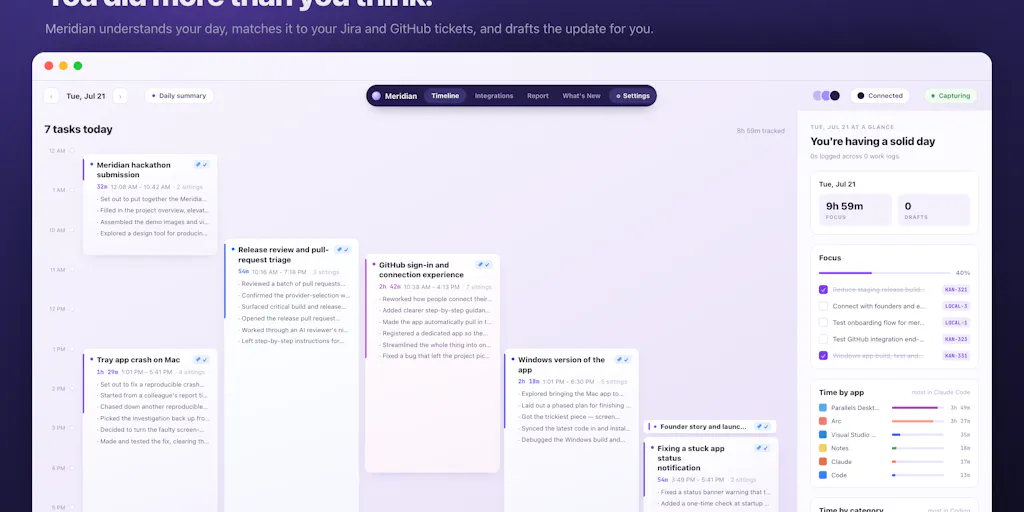
Let me be clear about what this thing is. Meridian is a local-first, open-source desktop app built by two developers, Akarsh Hegde and Adithya harish, who quit their jobs three months ago to build it. The pitch is simple: it runs in the background on your macOS or Windows machine, observes what you’re actually doing — which files you touch, which tickets you open, which terminal commands you run — and then automatically generates a timeline, a worklog, and a daily summary. It matches your activity to open Jira and GitHub tickets, drafts the update for you, and hands you something you can paste into your standup without reconstructing your entire day from memory.
The origin story is worth reading because it explains the product philosophy. Hegde describes the exact pain: they’d ask Claude to write an update, then spend ten minutes reconstructing the context it had missed. The AI knew what they told it, but not the four unexpected problems they solved along the way. That unplanned work — the investigation, the failed approaches, the technical judgment, the review work, the interruptions — is precisely what disappears from daily updates. He posted about this on Reddit and it went viral, which confirmed they weren’t alone.
Now here’s the part that should make every cross-border operator sit up: the makers explicitly describe this as not a monitoring tool. In their launch thread, they position it as designed first for developers themselves, to help them understand their work patterns. That’s the philosophical line that matters. Traditional time tracking tools, and the surveillance-ware that some agencies deploy, measure activity. Meridian is trying to measure meaning.
The technical details are deliberately privacy-forward: nothing leaves your device until you hit approve, it’s open source so you can audit what it does, and it’s free for individual developers — no seat, no credit card. It runs on the Claude Code, Cursor, or Codex CLI you already have, or Groq for free if you don’t. For a tool that watches your screen, that’s a meaningful commitment.
Why Amazon Sellers Should Care More Than Shopify Ones
Here’s where I’m going to make an argument that might surprise you. The Shopify crowd — the DTC brand operators, the paid acquisition folks — they live in a world where work is already visible. Your ad spend is in the dashboard. Your conversion rate is in the dashboard. Your email flows are in Klaviyo. Your work product is the data itself. When something breaks, the evidence is right there in the numbers.
Amazon sellers live in a different universe. Your work is scattered across Amazon Seller Central, supplier chats on WhatsApp and WeChat, freight forwarder emails, Helium 10 exports, and the increasingly opaque black box of Amazon’s internal algorithms. When your listing gets suppressed, when your inbound shipment gets stuck at a warehouse for three weeks, when your Buy Box percentage drops for no apparent reason — the actual work of diagnosing and fixing that is invisible. It’s investigation. It’s failed approaches. It’s judgment calls. And none of it shows up in any dashboard.
This is the exact problem Meridian is solving, just for a different audience. The makers admit their messaging is developer-focused, but in the comments they confirm it works for PMs, managers, and other roles. One commenter — a PM — asked whether it could help with weekly reviews, and the makers said yes, they’ve tested it with PMs and managers. That’s the opening. Because cross-border operations is, at its core, a discipline of invisible work. The person who manages your supply chain doesn’t have a dashboard that shows the 47 emails they sent to chase down a delayed container. They have a memory, and a Friday report that says “still waiting on shipment.”
The “Where the Math Breaks” Subsection
Let me do the math on what a tool like this actually saves. The makers say the average developer spends ten minutes reconstructing context for an AI-written update. Scale that across a team of five operators, five days a week, and you’re looking at roughly four hours a week of pure context-reconstruction time. That’s the direct saving. The indirect saving is bigger: when work is invisible, decisions get repeated, mistakes get remade, and knowledge walks out the door when someone leaves. The cross-border e-commerce industry has a turnover problem — people burn out, move to competitors, or just quit. Every time that happens, the institutional knowledge of why you chose that supplier, why you set that reorder point, why you stopped using that freight forwarder — it all evaporates. Meridian, or something like it, is a defense against that.
What Cross-Border Sellers Can Borrow — Right Now
I’m not going to tell you to install Meridian on your ops team’s laptops tomorrow. It’s a developer tool, it’s macOS and Windows only, and it’s early. But there are four concrete things you can steal from this launch, regardless of whether you ever touch the product.
First, the “work behind the work” framing is a management practice, not a software feature. Start asking your team — and yourself — to document not just what you completed, but what you investigated, what you rejected, and what judgment calls you made. The makers lay this out beautifully in their forum post about what’s hardest to explain in a daily update. A short update might say “Fixed the issue and opened a PR” — for us, it’s “Resolved the listing suppression.” That sentence hides investigation, failed approaches, technical judgment, review, and unplanned work. Start capturing that.
Second, the BYO-AI model is the future of ops tooling. Meridian runs on the AI you already have — Claude Code, Cursor, Codex CLI, or Groq. It doesn’t force you into a proprietary model. For cross-border operators, this is the template for how AI should work: the tool observes, the AI drafts, you approve. Nothing leaves your device until you say so. That’s the trust model that will actually get adopted in an industry where your supplier list, your margins, and your sourcing strategy are your competitive moat.
Third, the local-first, open-source approach is worth supporting even if you never use the tool. The makers are explicit that nothing leaves your device until you hit approve and that the code is open source for auditing. In an industry where data leaks are catastrophic — imagine your entire supplier network and cost structure getting scraped — this is the right posture. The fact that they’re free for individual developers with no seat and no credit card is a trust-building move that enterprise vendors should study.
Fourth, the roadmap is a preview of where this category is going. The makers mention integrations with Linear, GitHub, Azure DevOps, and Trello coming next, along with more personalized productivity insights. For cross-border ops, the equivalent integrations would be Amazon Seller Central, Shopify, your ERP, your freight management system, and your supplier communication tools. That’s the stack that needs an AI layer on top, and whoever builds it first — whether it’s Meridian or a competitor — is going to own the operations workflow.
Where I’m Skeptical — and You Should Be Too
Now let me be honest about the gaps, because this is a Product Hunt launch, and Product Hunt launches are where good ideas go to get overhyped before they’ve earned it.
The privacy claims are shakier than the marketing suggests. One commenter, ingrid.e, who says they build in an adjacent space, called this out directly: the app requires an account, asks for screen recording and accessibility permissions, and — at least at launch — wasn’t on the App Store where there’s third-party attestation. The makers responded that the account is only for usage analytics, that they don’t record audio, that everything stays on-device, and that they’re working on removing the account requirement. They also confirmed the app has been submitted for App Store review. That’s a reasonable response, but the initial claim mismatch — “no account needed” vs. “account required” — is exactly the kind of thing that erodes trust in a privacy-first product. If you’re going to put this on your team’s machines, you need to audit the code yourself, not take the README’s word for it.
The browser observation is also not fully proven. Another commenter, Anant Gupta of GrowMeOrganic, said they tried it and it didn’t log Chrome activity. The makers called it a bug and asked for setup details. That’s fine for a beta, but it’s a reminder that this is a three-month-old tool, not a mature platform. If your team’s work happens primarily in a browser — which is true for most cross-border operators — you’re relying on a feature that’s still being debugged.
The SSH question is interesting but narrow. One commenter, Clint Deygoo, asked whether Meridian captures work done on a remote VM via SSH. The makers said yes, it captures terminal activity through accessibility. That’s a useful answer for developers, but it highlights that Meridian is fundamentally a local-machine tool. If your ops team works across multiple devices, or if a significant chunk of work happens on shared machines or in cloud-based tools, the coverage will be spotty.
And the biggest gap: Meridian is built for individual insight, not team accountability. The makers explicitly say it’s not a monitoring tool, and they mean it. But that means it doesn’t solve the management problem — it solves the individual documentation problem. If your issue is that your team’s work is invisible to you, Meridian won’t fix that unless your team voluntarily shares their worklogs. For cross-border operators, the pain is often that the person running logistics doesn’t have visibility into their own work patterns, and that’s a personal productivity issue, not a reporting issue. Meridian addresses the former. The latter still needs a different tool.
The “Why the Privacy Debate Matters for Ops” Subsection
The privacy debate around Meridian is not academic for cross-border sellers. Your cost structure, your supplier relationships, your unit economics — these are the crown jewels of your business. A tool that watches your screen and sends data to an LLM, even with “approve before sending” controls, is a tool you should evaluate with extreme care. The makers’ commitment to local-first processing is the right answer, but it’s a promise, not a guarantee. Open source helps — you can audit the code — but as the commenter pointed out, “as long as the user doesn’t compile the app themselves there is less visibility into what it does.” If you’re going to deploy this across your ops team, you need someone who can actually read the code, or you need to wait for the App Store version with third-party attestation.
What I’d Watch and Test Next
This week, here’s what I’d do if I were running a cross-border operation and wanted to borrow from Meridian without adopting it wholesale.
First, run a two-week experiment with your own team using a simple template. At the end of each day, have each operator write three bullets: what they investigated, what they rejected, and what judgment call they made. No completion lists. No “sent emails.” Just the invisible work. See what happens to your Friday reports. I suspect you’ll discover that the work you thought was straightforward is actually a web of unplanned decisions, and that your team’s value is dramatically understated by your current reporting.
Second, if you have a technical person on staff — even a part-time freelancer — have them clone the Meridian repo and audit it before anyone installs it. The makers are open source for a reason. Use that. Check what data leaves the device, what the LLM egress looks like, and whether the privacy claims hold up under scrutiny. If they do, run a pilot with one person for a week — preferably your supply chain lead, not your most technical person. See if the generated worklogs actually capture the work you know is happening.
Third, watch the roadmap and the competitive landscape. The makers are looking for B2B SMB pilots — if you have an engineering team, or if you’re willing to be a design partner, reach out. The integrations they’re building — Linear, GitHub, Azure DevOps, Trello — are the developer equivalents of the tools you actually use. If they add the right integrations, or if a competitor emerges with an ops-focused version, this category is going to matter for you within twelve months.
Fourth, and this is the one I’d bet on: take the “work behind the work” concept and apply it to your AI workflows. The makers’ origin story — asking Claude to write an update and then spending ten minutes reconstructing context — is exactly what’s happening when you ask ChatGPT or Claude to draft a supplier email or a weekly ops summary. The AI doesn’t know what you investigated, what you rejected, or why you made the call. Start giving it that context explicitly, and your AI-generated reports will stop being generic and start being useful.
The bottom line: Meridian is a developer tool that accidentally diagnosed a disease affecting every cross-border operator. The invisible work problem is real, it’s expensive, and it’s not going away. Whether you adopt this specific tool or not, the discipline it’s pushing — capturing the work behind the work — is the practice that will separate the ops teams that scale from the ones that burn out. Start the experiment this week. Your Friday reports will never look the same.