Why a Headless CMS with an MCP Server Actually Matters for Cross-Border Sellers
Let me start with a confession: when I saw another headless CMS launch on Product Hunt, my first instinct was to scroll past. We’re drowning in content infrastructure options — from the monolithic comfort of Shopify’s built-in blog to the developer-flexible world of Sanity, Contentful, and Payload. But then I read the launch thread more carefully, and something clicked. The maker, Taqib Ibrahim, didn’t just ship another dashboard. He shipped an MCP server — a connector that lets AI agents like Claude, Cursor, and Codex read and write content directly, without a human ever touching the CMS interface. For cross-border sellers running multiple storefronts, marketplaces, and regional landing pages, this isn’t a developer nicety. It’s the difference between content operations that scale across time zones and languages, and content operations that collapse under their own weight. The tool itself is simple. The workflow shift it signals is not.
The Real Problem: Content Is the Silent Tax on Cross-Border Growth
Every serious cross-border operator I know hits the same wall around month six of expansion. You’ve got your Amazon listings optimized, your Shopify storefront looking sharp, maybe a TikTok Shop catalog synced. Then someone says, “We should start a blog for SEO,” or “We need a changelog for our SaaS product,” or “Our regional landing pages need to be localized for Germany and Japan.” And suddenly you’re looking at a content workflow that involves: a Google Doc passed between three people, a Slack thread where the final version gets lost, a CMS login that only the one developer remembers, and a publishing process that takes two business days.
That’s the problem Marble is actually solving, even if the Product Hunt page frames it in developer terms. The launch thread mentions a user named Dominik Koch who used Marble to build Notra Image Generation, a completely different product, and chose it over Payload specifically because “Marble powers our Blog and Changelogs, their MCP made it super easy to sync content from Notra to Marble and display it on our landing page.” Read that again. He’s not praising the editor. He’s praising the sync. The MCP server is what made the difference.
For cross-border sellers, the content tax is even heavier. You’re not just publishing blog posts. You’re managing product descriptions across multiple marketplaces, each with its own character limits and SEO rules. You’re maintaining landing pages in multiple languages. You’re updating shipping policies, return instructions, and promotional copy that changes weekly. Every one of those updates is a context switch — logging into a different system, finding the right field, hoping you don’t break the formatting.
Why the MCP Server Changes the Workflow Math
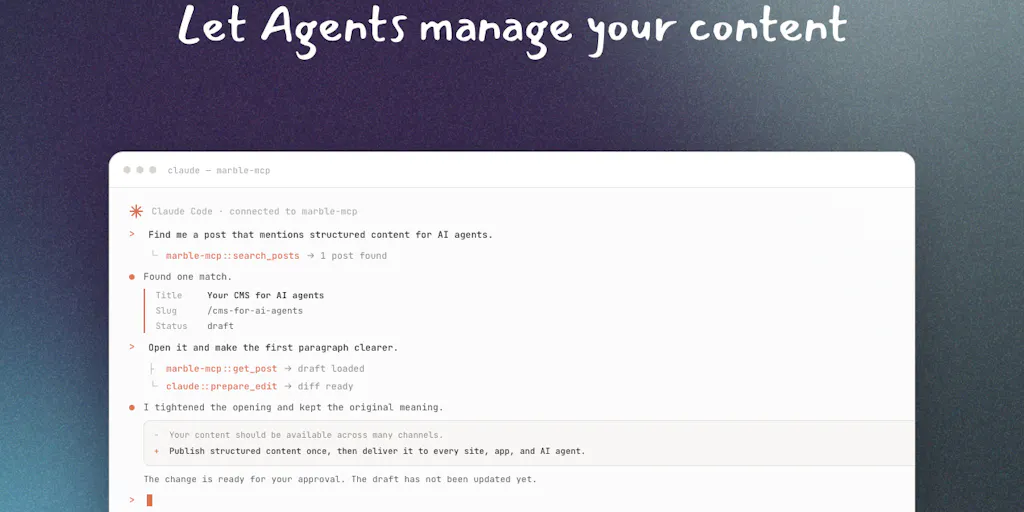
Here’s where I want to slow down, because this is the part most sellers will skim past and shouldn’t. MCP — Model Context Protocol — is essentially a standard way for AI tools to talk to your data. When Marble ships an MCP server, it means an AI agent working in Cursor or Claude can pull your content, suggest edits, and push updates back — all without you opening the Marble dashboard. The maker’s own words in the launch thread: “A lot of work is increasingly happening through AI agents now, so this gives you full access to managing your content — creating posts, updating fields, managing media directly from tools like Claude, Cursor, and Codex, without ever touching the dashboard.”
Think about what that means for a cross-border operation. Your copywriter drafts a product description in English. Your AI agent translates and localizes it for the German market, pushes it to Marble, and flags it for review. Your Amazon listing manager reviews it in their own workflow tool, not by logging into yet another CMS. Your Shopify store pulls the same content via API. The content is created once, managed in one place, and distributed everywhere — with the AI agent as the connective tissue.
This is not theoretical. The same launch thread shows a user review describing exactly this pattern in production. And the “alternatives considered” box lists Payload — which tells me the comparison shoppers are looking at developer-centric CMS platforms, not at the content operations problem from a business owner’s perspective.
How Marble Differs from the Incumbents You’re Already Using
Let me be specific about the competitive landscape, because “headless CMS” is a crowded category and most of the options are overkill for a cross-border seller’s actual needs.
Shopify’s built-in blog is the default for most DTC operators, and it’s fine for basic SEO posts. But it’s tethered to your store. If you’re also selling on Amazon, you can’t reuse that content. If you want to publish a changelog for a SaaS product you’re launching alongside your physical goods, you’re stuck with the same blog template. And if you want AI agents to manage content, Shopify’s admin API is workable but not MCP-native — you’re building custom integrations.
Contentful and Sanity are powerful, but they’re built for enterprise teams with dedicated content engineers. The learning curve is real, and the pricing scales with usage in ways that hurt small operators. Sanity’s structured content approach is genuinely great for multi-channel distribution — I’ve recommended it to sellers running complex localization workflows — but the setup cost is high.
Payload is the one Marble is directly compared to in the launch thread. It’s a solid open-source headless CMS with a strong developer experience. But it requires you to run and maintain your own infrastructure. For a three-person cross-border operation, that’s a distraction from the actual business of selling.
Marble’s positioning — “Super simple headless CMS” — is the key differentiator. It’s not trying to be Contentful. It’s trying to be the CMS you can set up in an afternoon and forget about, until an AI agent needs to update something. The previous launch from December 8th, 2025, got 280 upvotes, which tells me there’s real demand for simplicity in this category.
Why Amazon Sellers Should Care More Than Shopify Ones
Here’s a contrarian take: Amazon FBA sellers should be paying more attention to this than pure Shopify DTC operators. Why? Because Amazon’s content ecosystem is fragmented by design. You’ve got your A+ Content, your backend search terms, your product bullets, your brand story — all managed through Seller Central’s clunky interface. You can’t use Marble directly for Amazon listings (it’s a CMS, not a listing tool), but the pattern of MCP-driven content management is exactly what Amazon sellers need.
Imagine your AI agent drafting A+ Content modules, your team reviewing them in a familiar tool, and the final copy being pushed to Seller Central — while the same content gets adapted for your Shopify store and your Etsy listings. That’s the workflow Marble enables, even if the Amazon integration itself isn’t built yet. The MCP server is the foundation; the integrations can come later.
Shopify sellers, by contrast, already have a reasonably unified content experience. They can use the blog, add apps, and manage most things from one dashboard. The pain is lower, so the value of a headless CMS is less obvious.
What Cross-Border Sellers Can Borrow from Marble’s Approach
Even if you never install Marble, the launch teaches three lessons worth stealing.
First: design for the AI agent as a first-class user. Most CMS platforms treat AI as an afterthought — maybe a text generation widget in the editor. Marble’s MCP server treats AI as a primary interface. The dashboard is still there, but it’s not the center of gravity. For cross-border sellers, this means you should be evaluating every tool in your stack by one question: can an AI agent interact with it programmatically? If your email marketing platform, your review management tool, your inventory system don’t have APIs or MCP servers, you’re going to be manually moving data between systems forever. Klaviyo has strong APIs. Helium 10 has some automation. But the MCP-native approach is still rare — and it’s coming.
Second: separate content creation from content publishing. The reason Marble works for Dominik Koch’s Notra product is that he can write content in his own tools and have it synced to Marble for display. That separation is powerful. For cross-border sellers, it means you can have your copywriting team working in Google Docs or Notion, your AI agent handling translation and formatting, and your CMS purely as a distribution layer. You stop fighting your tools and start shipping content.
Third: reduce the number of dashboards you check daily. Every dashboard is a context switch. Every context switch is a tax on your team’s attention. Marble’s bet is that you shouldn’t need to open the CMS at all most days. The same logic applies to your entire tool stack. If you’re logging into five different systems every morning — Amazon Seller Central, Shopify admin, your email tool, your ad platform, your analytics — you’re losing the efficiency game. Consolidate where you can, automate where you can’t.
Where My Judgment Says Marble Falls Short
I want to be honest, because blind enthusiasm helps no one. Marble is early, and there are real gaps.
The review count is thin. The Product Hunt page shows “5.0 Based on 1 review” and one detailed user story. That’s not validation; that’s a beta test. The fact that the MCP server launch is dated 7 days ago means this is very fresh. You’re betting on a tool that could pivot, stall, or get acquired and changed.
The MCP server is powerful but dangerous. Giving AI agents write access to your content is a double-edged sword. If an agent hallucinates a pricing change or mangles a localization, you could publish something wrong across multiple channels before anyone notices. The launch thread doesn’t mention version control, approval workflows, or rollback capabilities in any detail. For cross-border sellers with multiple storefronts, that’s a risk you need to manage carefully. I’d want to see audit logs and human-in-the-loop approval before letting AI agents push production content.
The “super simple” positioning cuts both ways. Simplicity is great until you need advanced features. Cross-border operations inevitably need: multi-language support with proper locale handling, scheduled publishing across time zones, content versioning for A/B testing, and granular user permissions for distributed teams. The launch page doesn’t address any of these. Payload and Contentful handle them, but with more complexity. Marble needs to prove it can grow from “simple” to “simple but powerful” without becoming bloated.
Pricing is not disclosed. The launch page doesn’t list pricing. For a small cross-border operation, that’s a yellow flag. You need to know whether this scales with your content volume or your team size, and whether it stays affordable as you expand into new markets.
There’s no mention of marketplace integrations. The launch thread is entirely about websites, blogs, and changelogs. There’s no mention of Amazon, Etsy, eBay, or TikTok Shop connectors. That’s fine for now — it’s a CMS, not a marketplace tool — but it means you’re still managing your marketplace content separately. Marble solves your owned-channel content, not your marketplace content.
Where the Math Breaks
Let’s do the arithmetic on whether this is worth your time. If you’re a solo seller with one Shopify store and a basic blog, Marble is overkill. You can use the built-in blog, write in Google Docs, and copy-paste. The MCP server is a solution looking for a problem in that scenario.
If you’re a team of three to ten people managing a Shopify store, an Amazon brand, and maybe an Etsy shop, with content in two or more languages, the math changes. You’re probably spending five to ten hours per week on content coordination — moving drafts between tools, checking formatting, fixing broken updates. At $50 to $100 per hour of your team’s time, that’s $250 to $1,000 per week in hidden costs. A tool that cuts that in half pays for itself quickly, even at a premium price point.
If you’re a larger operation with dedicated content teams and enterprise CMS needs, Marble is probably too simple. You need workflows, approvals, and integrations that a young tool won’t have.
The sweet spot is the mid-sized cross-border operator — and that’s a genuinely underserved segment. Most CMS tools are built for either solo bloggers or enterprise teams. The middle is where Marble could win.
What I’d Watch / Test Next
Here’s what I’d do this week if I were running a cross-border operation and this launch caught my attention:
First, test the MCP server with a non-production workflow. Set up a Marble instance, connect it to Claude or Cursor, and have the agent draft a blog post or update a changelog. Don’t publish it to your live site yet. Get a feel for how the agent interacts with the CMS, where it gets confused, and whether the output quality is acceptable. The launch thread’s user story — syncing content from Notra to Marble via MCP — is a real-world example, but you need to test it with your own content types.
Second, map your content workflow end-to-end. Write down every piece of content you publish in a typical month: blog posts, product descriptions, shipping policies, promotional copy, changelogs. Note where each piece starts, who touches it, and where it ends up. Identify the biggest friction points. If Marble’s approach — AI agents writing directly to a CMS — addresses your biggest pain, it’s worth a deeper look.
Third, watch for integrations with your existing stack. Marble’s MCP server is the foundation, but the real value for cross-border sellers will come when it connects to the tools you already use. I’d watch for Shopify integration, marketplace connectors, and translation workflow support. Until those exist, Marble is a promising piece of infrastructure, not a complete solution.
Fourth, compare it against the cost of doing nothing. Your current workflow might be messy, but it works. The question isn’t whether Marble is better than Payload or Contentful — it’s whether the MCP-native approach is better than your current process. For teams already using AI agents for content creation, the answer is likely yes. For teams still writing everything manually, the jump might be too far.
The bigger trend here — and the reason I’m writing about a small CMS launch at all — is that content operations are becoming AI-native. The tools that win the next five years won’t be the ones with the best editors. They’ll be the ones that let AI agents do the work while humans handle judgment. Marble is an early signal of that shift. Whether it becomes the standard or gets acquired by someone bigger, the pattern is worth studying. Cross-border sellers who understand it now will have a real advantage when the rest of the market catches up.