The document layer is where cross-border ops quietly bleed margin
Every cross-border seller I know has the same dirty secret buried in their back office: a folder of PDFs nobody wants to open. Supplier invoices from three continents, freight forwarder bills of lading, customs declarations, marketplace settlement reports, 1688 purchase orders, TikTok Shop payout statements, Amazon FBA reimbursement summaries. Some are clean digital exports. Many are scanned, skewed, faxed, photographed at an angle on someone’s phone in a Shenzhen warehouse. All of them contain numbers that have to end up in a spreadsheet, an ERP, or a bookkeeping system before anyone can answer the only question that matters — did this SKU actually make money?
That is the problem space Invofox is attacking, and its new self-serve launch matters to operators far more than the average Product Hunt drop. Not because document parsing is glamorous, but because the moment a tool like this becomes cheap and API-first, the cost of building your own reconciliation layer collapses. And for sellers running multi-marketplace, multi-currency, multi-supplier operations, that layer is the difference between knowing your unit economics and guessing at them.
What Invofox actually does — and why the timing is interesting
The maker, Alberto Gimeno, frames the origin story bluntly: engineering teams kept losing entire quarters to document processing. The weekend prototype works, then reality arrives — scanned faxes, multi-document PDFs, tables spanning three pages, tax IDs hidden in footers — and suddenly two engineers are maintaining an OCR pipeline instead of shipping product. That is a familiar arc for anyone who has tried to wire up Amazon Seller Central settlement reports against supplier invoices in-house.
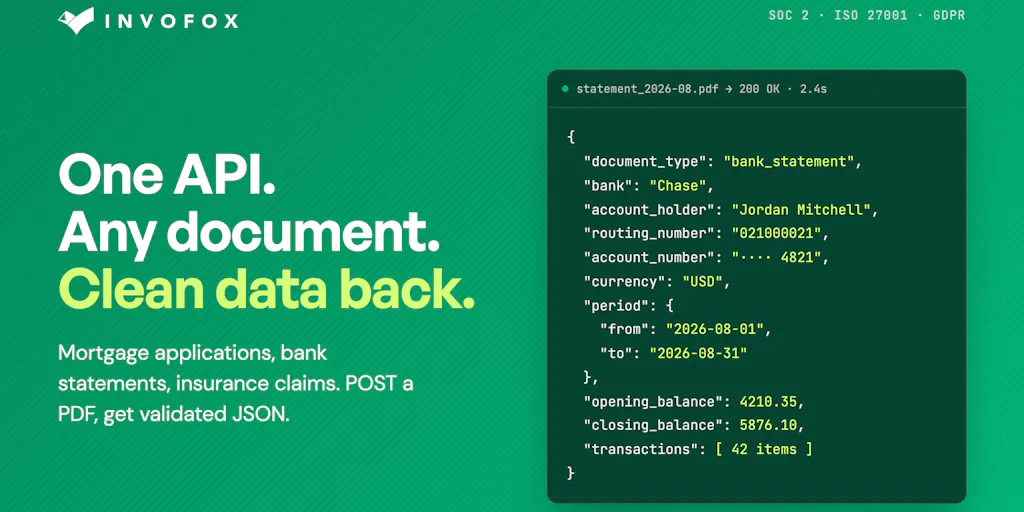
The pitch is a single endpoint: you POST a file, you get validated JSON back. Behind that sits a pipeline the team describes as intake, dual-pass OCR, splitting, classification, extraction, cross-field validation, confidence scoring, provenance, and a feedback loop that improves on your specific documents. Crucially, they claim this same pipeline previously only existed behind enterprise contracts — they were serving large tech companies and enterprises in Europe and the US, and never built a way for a small team to just try it. The self-serve tier is that same pipeline and the same accuracy bar, gated by a signup form rather than a sales call.
Two commercial commitments stand out. First, accuracy is part of their SLAs, and any document where they make a mistake is free. Second, pricing is per page, decreasing with volume, with no credit systems to decode. For the launch, the free tier is 500 pages with no credit card, plus 1,000 extra pages for anyone signing up from Product Hunt — so effectively 1,500 pages during the launch window, as Gimeno confirmed in the comments. That is enough to run a real pilot on your messiest supplier paperwork, not a toy demo.
Why Amazon sellers should care more than Shopify ones
Shopify merchants mostly deal with clean, structured data: order exports, payout reports, Klaviyo event streams. The document pain is real but shallow. Amazon FBA brand owners live in a different universe. Their cost basis depends on supplier invoices, freight and duty documents, FBA fee reconciliation, reimbursement claims, and returns data — much of it arriving as PDFs from parties who have no incentive to standardize. If you have ever tried to reconcile a Helium 10 profitability estimate against what your 3PL actually charged you, you know the gap is documents. A per-page API that turns a freight invoice into structured line items is worth more to an FBA operator than to almost anyone else in e-commerce.
How it stacks up against the incumbents you’re probably already paying
Let me be specific, because “document AI” is a crowded label.
The obvious comparison is Amazon Textract. It is cheap, it is AWS-native, and if you already run on AWS it is the default. But Textract gives you raw extraction primitives — you still build splitting, classification, validation, and the feedback loop yourself. That is exactly the “two engineers maintaining an OCR pipeline” trap Gimeno describes.
Then there is the managed-document-AI tier: Google Document AI, Azure AI Document Intelligence, and the newer LLM-based extractors like Reducto and LlamaParse. These are strong on clean documents and increasingly good on messy ones, but the operational burden — schema design, confidence thresholds, retry logic, human review routing — still lands on your team. Invofox’s bet is that sellers and small ops teams would rather buy the whole pipeline than assemble it.
There is also the finance-ops SaaS lane: Ramp and Brex bake invoice extraction into spend management, and Bill.com does it for AP. But those are closed systems. You cannot POST an arbitrary customs declaration and get JSON back to feed your own warehouse. Invofox is positioning as infrastructure, not an end-user app — which is the right call for cross-border operators who already have a stack and just need a parsing layer.
The differentiator the team leans on hardest is the validation and feedback loop. As one commenter, Monir, put it, getting reliable structured data is usually harder than simply reading the document. Invofox’s answer is cross-field validation and confidence scoring baked into the output, plus a per-client fine-tuning loop. On paper, that is the part that separates a parser from a system you can trust unattended.
Where the accuracy claims need scrutiny
Angela Anna asked the right question in the comments: real-world benchmarks comparing extraction accuracy across invoices from different countries and formats. Gimeno’s answer was honest — they are working on exactly that and will release it publicly, with signups getting notified. Until that lands, treat accuracy as unverified. The “mistakes are free” policy is a genuine commercial commitment, but free pages do not recover the hours you spent reconciling a bad batch. Ask for the benchmark when it ships.
What cross-border sellers can borrow from this playbook
Even if you never sign up, the launch is a useful mirror for how to think about your own back office.
Treat document intake as a pipeline, not a task. The Invofox breakdown — pre-processing (orientation, deskewing, noise reduction, contrast enhancement), then routing through different OCR engines depending on document quality, then extraction, then validation — is a template. If you are doing this manually or with a single brittle script, you are skipping steps that exist for a reason. The messy-scan handling is described in Nacho Gabaldón’s reply to Rohit Kushwaha, and it is worth reading as a checklist.
Schema flexibility matters more than model choice. Muhammad Ahmed asked whether you can define custom schemas or use pre-built ones for invoices, receipts, and bank statements. The answer was both — pre-built out of the box, custom for specific fields. For cross-border sellers, this is the unlock: your Chinese supplier invoice, your EU VAT invoice, and your US freight bill have almost nothing in common. A tool that forces one schema is useless. One that lets you define per-document-type schemas is infrastructure.
Confidence scoring is not optional at scale. Once you are processing hundreds of documents a month, you cannot review everything. You need the system to tell you which extractions to trust and which to route to a human. This is the single most underrated feature in any document AI stack, and it is where most homegrown pipelines quietly fail.
Data residency is a real procurement question. Anastasiia asked whether it can be used locally for sensitive information. The team confirmed zero data retention and on-premise deployment options, available by talking to their team. For sellers handling supplier contracts or customer PII across jurisdictions, that matters — and it is the kind of thing you should ask every vendor before you send them a single invoice.
Where the math breaks
Per-page pricing that decreases with volume sounds clean until you model it. A mid-size FBA brand processing, say, 300 supplier invoices, 200 freight documents, and 500 marketplace settlement files a month is looking at roughly 1,000 pages. At small-team volumes that is fine. But if you are a 3PL or an aggregator processing tens of thousands of pages, the per-page model can quietly exceed the cost of running Textract plus a part-time ops contractor. The “no credit systems to decode” promise is a UX win, but it is not automatically a unit-economics win. Run your own numbers before you commit.
The second place the math breaks is the free-tier psychology. 1,500 launch pages is generous, but it is a pilot, not a production budget. The real test is what happens on page 1,501 — whether the accuracy holds and whether the per-page cost still beats your alternative. That is a question only your own document mix can answer.
Where my judgment says it falls short
Three things I would flag before you build on this.
First, the benchmark gap. The team is candid that cross-country, cross-format accuracy benchmarks are not yet public. Until they are, you are buying on faith. That is fine for a 1,500-page pilot. It is not fine for a system you route your entire AP function through.
Second, the “same pipeline as enterprise” claim is a double-edged sword. Enterprise pipelines are often tuned for enterprise document types — think standardized invoices from large vendors. The long tail of cross-border SMB paperwork (a WeChat screenshot of a supplier quote, a hand-annotated packing list) is a different distribution. The feedback loop should close that gap over time, but “over time” is doing a lot of work in that sentence.
Third, the tooling is API-first. That is a feature for technical teams and a barrier for the operator who just wants a dashboard. If you do not have an engineer or a no-code integration layer like Zapier or Make in your stack, the value is theoretical. This is infrastructure for builders, not a plug-and-play app for merchants.
What I’d watch / test next
This week, if you run any meaningful volume of supplier or logistics documents, do three things.
First, sign up for the Invofox self-serve tier and pull your ten worst documents — the ones that broke your last parser or that you have been manually retyping. Run them through and measure not just extraction accuracy but how much cleanup the JSON actually needs before it is usable. That cleanup time is the real cost.
Second, ask the team directly for the accuracy benchmark when it ships, and ask what happens to your data under zero-retention versus on-premise. Get the answers in writing before you scale.
Third, model the per-page cost against your actual monthly document volume, and compare it honestly against Amazon Textract plus the engineering hours you would spend building the surrounding pipeline. If you do not have those engineering hours, the comparison is not close — and that is precisely the gap Invofox is selling into.
Document processing is unglamorous, but it is the layer where cross-border margin either gets measured or gets lost. A tool that makes that layer cheap and trustworthy is worth a serious look — with your eyes open about what is proven and what is still a promise.