The Omnichannel Support Bill Is Coming Due — and Cross-Border Sellers Are Paying It in Night Shifts
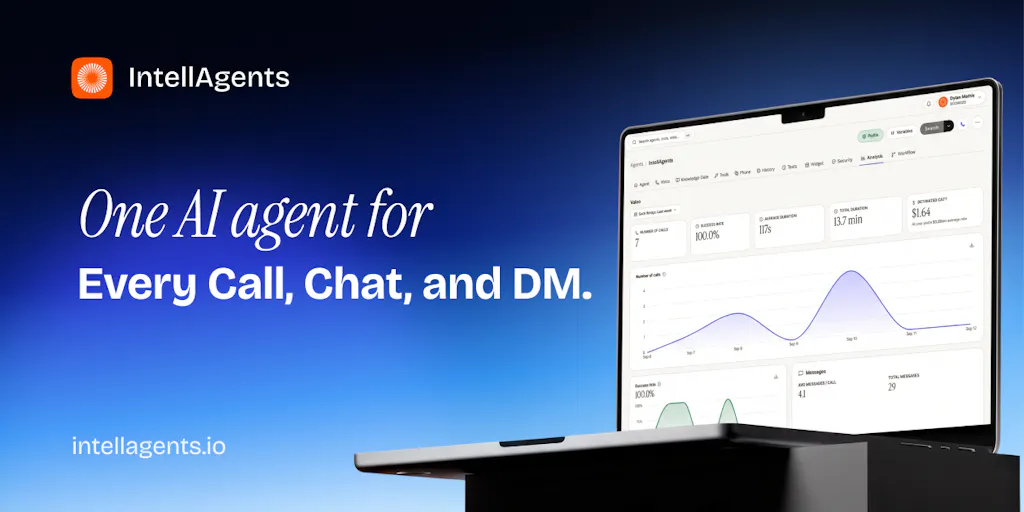
Every operator I know who has scaled past seven figures on Shopify, Amazon, or TikTok Shop hits the same wall, and it isn’t ad spend or inventory. It’s the support inbox. A Brazilian customer DMs your Instagram at 2 a.m. your time. A German buyer emails about a VAT invoice. A US wholesale lead calls the number on your Amazon Seller Central storefront while your team is asleep in Shenzhen. Each channel needs its own tool, its own login, its own human. IntellAgents.io is a new entrant betting that one AI agent with one knowledge base can absorb all of it — calls, WhatsApp, Instagram, Facebook, Telegram, and website chat — in up to 36 languages. That’s a claim worth stress-testing, because for cross-border sellers the multilingual, multi-timezone support burden is not a nice-to-have. It’s the single biggest hidden tax on international growth.
What IntellAgents Is Actually Selling
Strip away the launch-day language and the product does something fairly specific: it lets a small business load its knowledge base once, then deploys a single AI agent across voice calls and the major messaging channels. The maker, Vilen Bezhanyan, frames the origin story bluntly — every small business they talked to had customers reaching out on five different channels, each requiring a separate tool, a separate setup, and someone watching all of them. The pitch is that IntellAgents replaces that stack with one agent, one brain, one knowledge base, running 24⁄7 in up to 36 languages.
The company’s own framing is that this is “genuinely one agent, one brain, one knowledge base — not five bolted-together integrations pretending to be unified.” That distinction matters more than it sounds, and I’ll come back to why.
Pricing, seat counts, and channel-specific limits are not disclosed on the launch page, which is itself a signal — early-stage products often keep pricing quiet until they’ve figured out their unit economics on voice minutes, which are brutally expensive compared to text.
Why Amazon sellers should care more than Shopify ones
Here’s a pattern I’ve watched play out repeatedly: Shopify DTC brands treat support as a brand-experience problem, so they’re willing to pay for polish. Amazon sellers treat support as a compliance problem, and that changes the calculus entirely.
If you sell on Amazon, your response time to buyer messages is a metric Amazon watches, and your Seller Central inbox is only one of the places buyers try to reach you. They’ll DM your Instagram, comment on a TikTok, or call whatever number they can find. Miss those, and you get negative reviews that tank your listing ranking — which costs far more than any support tool subscription.
An agent that genuinely unifies channels means an Amazon operator doesn’t need to hire a VA to babysit five tabs. For a seller running FBA plus a Shopify storefront plus a TikTok Shop, that’s the difference between one hire and three.
The Hard Part Isn’t the Channels — It’s the Memory
The most useful thing on that launch page isn’t the maker’s pitch. It’s the pushback.
Gal Dayan, who works on Dial, a phone-only AI product, asked the question that actually determines whether “one agent” is real or marketing: if a customer messages on WhatsApp, doesn’t get what they need, then calls the same number, does the voice agent pick up that WhatsApp thread’s context — or does the call start cold? Dayan’s framing is sharp: continuity is the actual promise of “one agent” over just having five bots share a knowledge base.
This is not a nitpick. For cross-border sellers, it’s the whole ballgame. Consider a real scenario: a customer in Mexico messages your WhatsApp in Spanish asking about a return, gets a partial answer, gets frustrated, and calls. If the voice agent has no idea that conversation happened, the customer has to start over — in a second language, on a phone call, which is the highest-friction channel there is. That’s not a support experience. That’s a churn event.
The maker did not answer that question in the thread, at least not in the visible comments. That silence is worth noting. Cross-channel memory is genuinely hard engineering, and it’s the difference between an omnichannel product and a multi-channel product. Those are not the same thing, and sellers should refuse to let vendors conflate them.
The “one knowledge base” trap
Igor Gurovich, who builds voice AI at Refocus, raised the second objection, and it’s the one I’d tattoo on every operator’s forearm before they buy any voice agent: a knowledge base tuned for chat reads terribly out loud.
His example is perfect. A three-bullet answer that scans fine in WhatsApp becomes forty seconds of monologue on a call, and people hang up. Anyone who has listened to real call recordings knows this. Text support rewards completeness. Voice support rewards brevity and interruption-handling. The same source of truth cannot naively serve both.
Gurovich asked whether IntellAgents keeps one source of truth with a voice-specific rendering layer on top, or whether makers have to write separate short answers for the phone channel. He also asked how the agent decides to stop talking and hand off to a human on voice — noting that the threshold usually has to be much lower on calls than in chat.
Neither question appears answered in the thread. And these aren’t edge cases. They’re the core product questions.
What Cross-Border Sellers Should Borrow From This
Even if you never buy IntellAgents, the launch surfaces three lessons that apply to any operator running international support.
One: audit your channel sprawl before you buy anything. Before evaluating tools, spend an afternoon mapping every place a customer can reach you. Website chat, WhatsApp Business, Instagram DMs, Facebook Messenger, Telegram, email, phone, plus marketplace-native inboxes on Amazon, Etsy, eBay, and TikTok Shop. Most sellers I talk to discover two or three channels they forgot existed — usually the ones generating the angriest messages.
Two: treat language coverage as a revenue lever, not a cost center. The 36-language claim is the kind of number that sounds like spec-sheet padding until you do the math. If you sell into the EU, LATAM, or Southeast Asia, a meaningful share of your potential buyers will not complete a purchase if support is English-only. Multilingual support isn’t a nice-to-have for cross-border; it’s conversion infrastructure.
Three: demand cross-channel continuity in writing. When you evaluate any AI support vendor — IntellAgents, Intercom’s Fin, Zendesk AI, or the growing field of voice-first startups — ask specifically: if a customer switches channels mid-problem, does context follow them? Get it in the contract or the demo, not the marketing page.
Where the math breaks
Let me be the skeptic here, because that’s the job.
Voice AI minutes cost real money — typically far more per interaction than text tokens. If IntellAgents prices per-resolution or per-minute and you’re running high-volume support across 36 languages, your unit economics can invert fast. A $30 order with a five-minute voice support call can become a loss-making transaction. That’s fine if you’re a SaaS company. It’s fatal if you’re a DTC brand with 40% gross margins and rising return rates.
The 36-language claim also deserves scrutiny. There’s a wide gap between “the agent can respond in 36 languages” and “the agent can handle a refund dispute in Thai without escalating.” Translation quality, cultural nuance in tone, and local payment or shipping terminology all degrade at the edges. I’d want to see per-language resolution rates, not a language count.
And the unaddressed handoff threshold worries me most. Gurovich is right that voice escalation needs to happen faster than chat escalation. If IntellAgents’ agent doesn’t know when to shut up and transfer, you’ll get the worst outcome in support: a customer who was already frustrated, now trapped in a loop with a bot that won’t let them reach a human.
The Strategic Read: Why This Category Is Heating Up
The timing here isn’t random. Three forces are converging.
First, voice AI quality crossed a usability threshold in the last eighteen months. What used to sound like a 2015 IVR now sounds close enough to human that customers tolerate it for simple queries.
Second, cross-border commerce keeps fragmenting across channels. A brand selling on Shopify plus Amazon plus TikTok Shop plus Temu plus SHEIN has customers arriving from five different discovery paths, each with different expectations. Support has to meet them where they are.
Third, labor costs for multilingual support have risen everywhere. The old playbook — hire a night-shift team in a low-cost timezone — is getting more expensive and harder to staff, especially for languages like German, Japanese, or Arabic.
That’s the gap IntellAgents is aiming at. Whether it fills it depends entirely on the two unanswered questions from the comment thread: cross-channel memory and voice-native knowledge rendering. Everything else — the channel list, the language count, the 24⁄7 claim — is table stakes that competitors will match within a year.
A note on the tooling stack
If you’re building out your support layer this quarter, think of it as three tiers. Tier one is your marketplace-native inboxes, which you cannot opt out of. Tier two is your owned channels — website chat, WhatsApp, email — where you control the experience. Tier three is social DMs, which are high-noise but often where your youngest, highest-intent buyers live.
An omnichannel agent makes the most sense when tier two and tier three are generating enough volume that staffing them separately is irrational. If you’re doing fewer than a few hundred support contacts a month, a good Klaviyo flow plus a part-time VA will beat any AI agent on cost and quality. Don’t buy the future before you need it.
What I’d Watch / Test Next
If you’re intrigued, here’s what I’d do this week — no commitment, just diligence.
First, pull your last 90 days of support tickets and tag them by channel and language. You’ll likely find that 70% of volume comes from two channels and one language. That tells you whether you even have an omnichannel problem, or just a WhatsApp problem.
Second, run a live test with the IntellAgents agent on your two highest-volume channels. Specifically test the cross-channel handoff Dayan described: start a conversation on WhatsApp, then call the same number, and see whether context carries. That single test will tell you more than any demo.
Third, ask for per-language resolution data and voice-minute pricing in writing. If they can’t provide it, that’s your answer.
Fourth, listen to ten real voice recordings. Not transcripts — recordings. You’ll hear within thirty seconds whether the agent knows when to stop talking.
The category is real and the pain is real. But “one agent, one brain” is a promise that has to be proven at the seam between channels, not at the feature list. Until someone shows me that seam holds, I’m keeping my night shift.