Why This Matters to a Cross-Border Seller Before You Read Another Word
If you run an Amazon FBA operation, a Shopify DTC brand, or a marketplace account team, you already know the dirty secret of modern e-commerce: the hardest part of your business isn’t sourcing products or running ads anymore — it’s the glue. It’s the middleware hell of syncing inventory between your ERP and your marketplaces. It’s the returns workflow that requires three humans and a spreadsheet. It’s the customer service escalation that dies in a shared inbox. Every ops leader I talk to is running a business held together with n8n flows, Zapier zaps, and a prayer. The promise of AI agents has been loud, but the reality has been fragmented, brittle, and terrifying to put in front of a live customer. So when a new orchestration layer claims it can fix this, I pay attention — not because I believe the hype, but because the pain is real, and the window for operators who solve it first is closing fast.
The Product That’s Not Really About “AI” — It’s About Ops Sovereignty
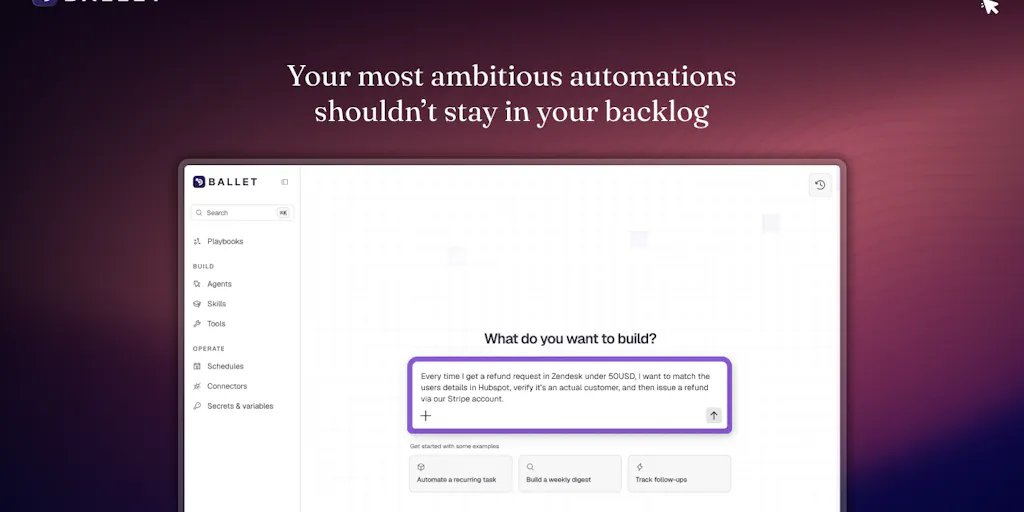
The launch page in front of me is for Framer AI Agents, which is a bit of a red herring. The actual product being pitched is Ballet, built by the team at Brainfish. Daniel Kimber, CEO and co-founder, frames it as the answer to 12 months of conversations with ops leaders. And the three patterns he names are so painfully accurate for cross-border sellers that I nearly choked on my coffee.
First: everyone in ops has become “human middleware.” That’s the exact phrase I’ve heard from DTC operators who spend their days gluing Shopify to their 3PL, or Amazon sellers who manually reconcile FBA inbound shipments because their WMS and Seller Central refuse to talk. The n8n flow that breaks the moment a process needs judgment — that’s not a hypothetical. That’s Tuesday.
Second: every team is building their own disconnected AI agents. Your customer service rep has a ChatGPT prompt that helps draft responses. Your logistics manager has a custom bot that tracks carrier delays. Your ads person has something that summarizes spend. None of them talk to each other. None of them share context. This is the “agent sprawl” problem, and it’s getting worse, not better.
Third — and this is the one that matters most: nobody wants full autonomy. The market has been flooded with “autonomous agents” that promise to run your business while you sleep. Most operators I know have been burned by that promise. They want graduated control. They want to trust the system enough to put it in production. That’s a profound insight, and it’s the core of what Ballet is trying to do.
So what is Ballet, actually? It’s an orchestration layer between your systems and your agents, built for ops folks who need production-grade reliability without hiring engineers to babysit it. The pitch is that it lets operations teams automate their hardest business problems in minutes. Not weeks. Minutes. That’s a bold claim, and I’ll get to where I think the math breaks in a moment. But first, let’s talk about why this specific positioning is so smart for the e-commerce operator specifically.
Why Amazon Sellers Should Care More Than Shopify Ones
Here’s a hot take: the Shopify crowd has it easy. Shopify’s app ecosystem is mature, and most of the heavy lifting — inventory, payments, shipping labels — is handled natively or through polished integrations. Amazon FBA sellers, on the other hand, live in a world where the platform is simultaneously your biggest customer and your most adversarial counterparty. You’re constantly fighting with Seller Central’s clunky UI, reconciling settlement reports, and managing the nightmare that is FBA inbound placement fees and removal orders. The “human middleware” problem is exponentially worse on Amazon because the system was never designed to be integrated with — it was designed to be a walled garden.
Ballet’s promise of an orchestration layer that sits between your systems and your agents is exactly the kind of thing an Amazon seller needs. Imagine a workflow where a customer return triggers an agent that checks your FBA inventory levels, generates a removal order, updates your accounting software, and sends a personalized apology email — all with human approval checkpoints at each stage. That’s not science fiction. That’s what graduated control actually looks like. And it’s why I think the Amazon seller audience should be paying more attention to this than the Shopify DTC crowd, who can mostly get by with a good ERP and a half-decent automation suite.
How Ballet Differs From the Incumbents You’re Already Using
Let’s be honest about the current landscape. If you’re an e-commerce operator, you’ve probably already dipped your toes into n8n for workflow automation, or you’re paying for Zapier because it’s the default. And if you’re a bit more sophisticated, you might have looked at Make or even tried to build something with LangChain. The problem with all of these is the same: they’re tools for engineers, or they’re tools for simple, deterministic workflows. The moment you need a workflow that requires judgment — like deciding whether a particular customer complaint warrants a refund or a replacement — the flow breaks. You have to hardcode the logic, and hardcoded logic in a dynamic e-commerce environment is a ticking time bomb.
Ballet’s differentiation, as I read it, is the “graduated control” model. Instead of building a fully autonomous agent that you’re terrified to let loose on your live customer data, you build workflows where the AI proposes and the human disposes. You set the guardrails. You define the approval points. This is not a new concept in enterprise software — it’s how most “intelligent automation” platforms work — but it’s rare in the accessible, ops-focused tier. The closest comparison I can think of is Workato, which does something similar but is priced for enterprises and requires a level of technical sophistication that most ops teams don’t have. Ballet is positioning itself as the Workato for the rest of us.
There’s also the “agent sprawl” angle. Most teams I talk to have a graveyard of half-built agents — a Slack bot that used to work, a customer service prompt that got stale, a data enrichment script that nobody maintains. Ballet’s pitch is that it becomes the single orchestration layer that connects all of these. Whether that’s true in practice is an open question, but the concept is exactly right. The market doesn’t need more AI agents. It needs a way to manage the ones we already have.
What Cross-Border Sellers Can Steal From This Playbook (Without Buying the Product)
Here’s where I get pragmatic. You don’t need to sign up for Ballet tomorrow to benefit from the thinking behind it. The three patterns Daniel identified are a diagnostic tool for your own operations. Let’s run through them.
Pattern one: Are you human middleware? Do a time audit this week. How many hours are you or your team spending on tasks that are essentially moving data from one system to another? If the answer is more than 20% of your week, you have an automation opportunity. The fix doesn’t have to be an AI orchestration layer. It can be as simple as a Make scenario that syncs your Shopify orders to your accounting software, or a Zapier zap that creates a Trello card every time a negative review comes in on Amazon. The point is to start identifying the glue work and systematically eliminate it.
Pattern two: Do you have agent sprawl? Take an inventory of every AI tool you’re using. That ChatGPT subscription your VA uses. The Claude prompts your content person relies on. The custom GPT you built for product research. None of these are bad in isolation, but if they’re not sharing context, they’re creating more work, not less. The fix is to establish a single source of truth — a knowledge base or a shared prompt library — that all your AI tools can draw from. This doesn’t require a fancy platform. A well-organized Notion database can do the job.
Pattern three: Are you afraid of autonomy? Good. You should be. But the answer isn’t to avoid automation entirely — it’s to implement it with guardrails. Pick one workflow that’s currently painful, and automate it with human approval checkpoints. For example, automate your low-stock alerts so that when inventory hits a threshold, a draft purchase order is generated and sent to you for approval. You’re not letting the AI make the final call. You’re just removing the tedious part of creating the PO. That’s graduated control, and it’s the single most important concept you can adopt this quarter.
Where the Math Breaks
Now let me pour some cold water on this. The “automate in minutes” claim is the kind of marketing language that makes me skeptical. In my experience, any automation that touches real business data takes longer than the demo suggests. The first workflow you build in any new platform is always the hardest — you’re learning the tool, mapping your systems, and debugging the inevitable edge cases. The “minutes” in the demo become “hours” in reality. That’s not a knock on Ballet specifically; it’s a universal truth of software adoption. But it’s worth keeping your expectations calibrated.
There’s also the question of cost. The product page mentions that Ballet has been in development for 12 months and is the result of hundreds of conversations, but pricing is not disclosed. For a cross-border seller running thin margins, the cost of another SaaS tool has to be justified by a concrete ROI. If Ballet’s pricing is in the enterprise tier — which I suspect it might be, given the “production-grade reliability” language — it’s going to be a hard sell for smaller operators who are already paying for a dozen other tools.
Finally, there’s the integration question. Ballet claims to be an orchestration layer between your systems and your agents, but the launch page doesn’t list specific integrations. For an Amazon seller, the integration with Seller Central is non-negotiable. For a Shopify seller, the integration with the Shopify API is table stakes. If Ballet doesn’t have deep, reliable integrations with the platforms you actually use, the “minutes” claim becomes even more suspect.
My Judgment: Where Ballet Succeeds and Where It Falls Short
Let me be clear about where I stand. Ballet is solving a real problem, and the team behind it clearly understands the pain of operations teams. The “graduated control” philosophy is exactly right, and it’s the kind of thinking that separates mature software from hype-driven AI toys. If Ballet delivers on its promise of being an orchestration layer that non-engineers can use to build reliable, production-grade workflows, it could be a genuinely useful tool for e-commerce operators.
But here’s where I’m skeptical. The market for “AI orchestration for ops” is getting crowded fast. You’ve got n8n adding AI capabilities, Zapier pushing its Agents feature, and a dozen startups doing something similar. The differentiation is going to come down to integrations and reliability, not vision. And reliability is hard. Building workflows that handle edge cases, API rate limits, and data inconsistencies is a thankless job that requires constant maintenance. The “set it and forget it” promise is a myth, and any platform that implies otherwise is setting you up for disappointment.
There’s also the question of who actually uses this. Daniel says it’s built for “ops folks who need production-grade reliability without hiring engineers to babysit it.” That’s a noble goal, but in my experience, ops folks who have been burned by brittle automations are often the most skeptical of new tools. The audience that most needs Ballet is also the audience that’s hardest to convince. That’s a marketing challenge, not a product challenge, but it’s a real one.
The “Human in the Loop” Trap
One thing I want to flag: the “graduated control” model has a hidden cost. Every approval checkpoint is a moment where a human has to stop what they’re doing and make a decision. If your workflows have too many checkpoints, you’ve essentially recreated the human middleware problem you were trying to solve. The key is to design workflows where the AI handles the high-volume, low-judgment tasks and the human only steps in for the exceptions. That requires a level of workflow design thinking that most ops teams don’t have. It’s a skill, and it’s a skill that takes time to develop.
What I’d Watch / Test Next
If I were running a cross-border e-commerce operation right now, here’s what I’d do this week, without buying anything.
First, I’d run the “human middleware” audit I mentioned earlier. Track every hour you and your team spend on tasks that are essentially data movement. Quantify it. If it’s less than 10% of your week, congratulations — you’re in the top percentile of operators. If it’s more, you have a problem worth solving.
Second, I’d pick one workflow to automate with graduated control. Don’t start with something complex like returns management. Start with something simple, like low-stock alerts or order confirmation notifications. Use whatever tool you already have — Zapier, Make, or even a simple script. The point is to build the muscle of designing workflows with human checkpoints. Once you’ve done one, the next one gets easier.
Third, I’d watch Ballet’s product page and community discussions. The fact that the team spent 12 months talking to ops leaders is a good sign — it means they’re building for real needs, not hype. If they publish pricing and a list of integrations, I’d evaluate it seriously. If they can show a real-world example of a cross-border e-commerce workflow — something involving Amazon Seller Central or Shopify — I’d be much more inclined to test it.
Finally, I’d keep an eye on the broader trend. The “orchestration layer” is going to be the next big battleground in e-commerce software. Whoever wins will be the company that makes it easiest for ops teams to build reliable, AI-assisted workflows without needing a PhD in prompt engineering. Ballet has the right philosophy. Whether they have the right execution is a question I can’t answer yet. But it’s a question worth watching.
In the meantime, stop being human middleware. Start building workflows that work for you — not the other way around. That’s the real lesson from this launch, and it’s one you can apply today, with or without Ballet.