The Real Product in This Launch Isn’t Project Management — It’s Memory
Cross-border e-commerce teams are structurally terrible at remembering things. Not because the people are careless, but because the work is scattered across time zones, languages, and a dozen disconnected tools. A factory in Dongguan confirms a revised MOQ over WeChat. Your US-based brand manager adjusts the ad creative brief in Figma. A 3PL sends a fulfillment exception to a shared Gmail inbox at 2am. A supplier thread in Slack quietly changes the packaging spec. Six weeks later, someone asks why the launch date moved, and nobody can reconstruct the chain. That reconstruction tax — the hours spent digging through threads to answer “what changed and why” — is one of the most expensive hidden costs in a cross-border operation, and almost no tooling addresses it directly. Which is why Bracket, a relaunched product from Saksham Shukla and Tanay Vyas, caught my attention — not as a project management app, but as a memory layer. Here’s what it actually does, where it fits, and where I think it breaks for sellers.
What Bracket Actually Solves (And What It Isn’t)
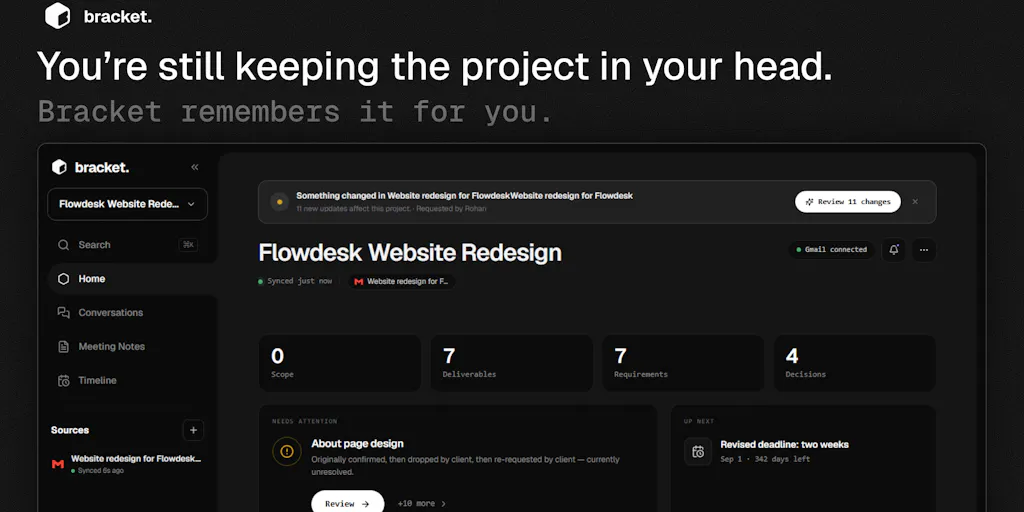
The core idea, per the maker’s own framing, is a reversal of how project tools normally work: instead of asking you to constantly feed a project tracker, Bracket connects to where the work is already happening — Gmail, Slack, Figma, and GitHub — and keeps track of requirements, decisions, scope, deliverables, deadlines, and changes as they occur. It also ingests meeting notes and transcripts. The pitch is that you can ask it things like “why did the launch date change?” and get an answer with the original source attached.
That last part is the whole ballgame. Every operator I know has some version of this problem. The difference is that most of us solve it with tribal memory, a Notion doc that’s three weeks stale, and a Slack search that returns 400 results. Bracket’s bet is that the answer should live in a system that watched the conversation happen in the first place.
What it explicitly is not, based on the launch thread, is a decision-maker. When a commenter asked how it handles conflicting information — say, a Slack thread says scope changed but the Figma doc still shows the old version — the maker’s answer was careful: Bracket doesn’t silently overwrite one piece of context with another. It preserves the source and timeline behind both, and when recency alone can’t resolve the conflict, it surfaces the contradiction rather than confidently guessing. That’s the correct design choice, and it’s also the one that tells you what Bracket really is: a memory and audit layer, not an autonomous PM.
Why this matters more for operators than for agencies
The maker’s own framing is agency-flavored — the launch threads talk about clients changing one sentence on a homepage and everything downstream shifting. Fair. But the cross-border use case is arguably sharper, because in e-commerce the “project” is the business. A supplier changing a spec isn’t a scope creep problem; it’s a product liability, a customs classification question, and a listing accuracy issue all at once. The cost of a forgotten change isn’t a missed deadline — it’s a recall, a chargeback wave, or an Amazon suspension.
How It Differs From the Incumbents You’re Already Paying For
Let’s be honest about the competitive set, because “AI project memory” is a crowded shelf right now.
Versus Notion and Asana. These are manual-input systems. Someone has to write the update. In a cross-border team, “someone” is often a contractor in a different time zone who doesn’t know the update matters. The whole failure mode of manual PM tools is that the people closest to the change are the least likely to log it. Bracket’s integration-first approach sidesteps that, at least in theory.
Versus Linear or Height. These are engineering-native. They’re excellent if your “project” is a software release. They’re near-useless for a supply chain, because your factory doesn’t have a Linear account and never will.
Versus Atlassian’s ecosystem. Jira plus Confluence plus Loom plus whatever AI add-on you bolted on is the enterprise default. It’s also a full-time job to maintain. Bracket’s positioning — the moment you finish organizing your work, it starts becoming outdated — is a direct shot at that maintenance tax.
Versus generic AI notetakers like Otter.ai or Fireflies. These capture meetings. Bracket’s claim is broader: it captures the conversation around the work, across four tools, and links changes to sources. That’s a meaningfully different scope.
The honest comparison, though, is that Bracket is competing less with any single tool and more with the accumulated mess of using all of them. That’s a harder sell, because “we replace your stack” always sounds like a threat to the person who built the stack.
The integration list is the product — and the constraint
Gmail, Slack, Figma, GitHub. That’s the entire surface area as described. For a US-based SaaS team, that’s a complete workflow. For a cross-border seller, it’s maybe 60% of one. Where’s WhatsApp Business, where most China supplier communication actually happens? Where’s WeChat? Where’s the Shopify admin, the Amazon Seller Central case log, the Klaviyo campaign history? The maker acknowledged in the thread that this is one of the areas they’re actively refining, which is honest, but it’s also the gap that determines whether this is a tool for your ops team or a tool for the two founders.
What Cross-Border Sellers Can Borrow From This — Right Now, Without the Tool
Here’s the part that matters more than the product review. The pattern Bracket is selling is worth stealing even if you never sign up, because the underlying problem is real and the fix is mostly process.
1. Treat “decision provenance” as a first-class asset. Every meaningful change in your operation — a supplier swap, a MOQ change, a listing rewrite, a price move — should have a source, a date, and a reason attached, in a place that survives the person who made the call. Most sellers do this for financial decisions and almost none do it for product and content decisions. That asymmetry is where the surprises come from.
2. Stop letting Slack be your system of record. Slack is where decisions happen; it’s a terrible place for them to live. The Bracket thesis — that context should be captured where work happens and surfaced where decisions are made — is correct. You can approximate it today with a disciplined “decision log” channel and a weekly digest, no AI required.
3. Instrument the handoffs, not the tasks. Cross-border operations fail at handoffs: factory to freight forwarder, forwarder to 3PL, 3PL to marketplace, marketplace to customer. Task trackers don’t model handoffs well. Change trackers do. If you’re evaluating any tooling in this category, ask it to show you a handoff audit trail, not a Gantt chart.
Why Amazon sellers should care more than Shopify ones
Shopify DTC operators have one customer-facing surface and a relatively simple supply chain. Amazon FBA brand owners have a marketplace policy layer, a case-log layer, a reimbursement layer, and a compliance layer — and every one of those generates change events that can bite you months later. A supplier quietly switching a component can trigger a listing suppression, a safety complaint, or an Amazon IP claim. The value of a memory layer that can answer “when did this component change and who approved it” is dramatically higher in that environment. If you’re running both channels, start with the Amazon side.
Where My Judgment Says This Falls Short
I want to be fair, but I also want to be useful, and useful means naming the failure modes.
It’s free right now, which is both the pitch and the warning. The maker repeatedly notes that Bracket is completely free right now and asks people to try it with real projects. That’s a smart launch tactic. It’s also a signal that pricing, packaging, and the business model are unresolved. For a tool you’d potentially route sensitive supplier and financial context through, “free and pre-pricing” is a real diligence question, not a nitpick.
The conflict-resolution story is aspirational. The maker’s answer on contradictions is the right intent — preserve both, surface the conflict — but it’s also described as actively being refined. In practice, the hard part isn’t detecting that two sources disagree; it’s deciding which one matters, and doing that at scale without generating so many “conflict” flags that users tune them out. Every alerting product dies this death. I’d want to see it on a project with 200+ live threads before believing it.
No reviews yet. The Product Hunt page shows no reviews at the time of writing. That’s normal for a launch-day product, but it means every claim here is maker-sourced. Treat the launch thread as a spec, not a track record.
The accidental-launch story is charming and irrelevant. The team forgot to unschedule their Product Hunt relaunch and it went live while both founders were out of town. It’s a great story and it hit #8. It also tells you nothing about whether the product works. Don’t let narrative bias your evaluation.
The real competition is inertia. The hardest thing to beat isn’t Notion or Linear. It’s the status quo of “we just ask [name] in Slack, he remembers everything.” That works until he quits, goes on leave, or gets too busy. Bracket’s entire value proposition is insurance against that single point of failure. That’s a compelling pitch — but it’s also a pitch that only lands after the failure has happened once. Selling pre-emptively against a disaster that hasn’t occurred yet is the hardest motion in B2B.
What I’d Watch / Test Next
If you run a cross-border operation and want to pressure-test this category — Bracket or otherwise — here’s what I’d do this week, in order.
First, pick one live project with real stakes: a product launch, a supplier transition, or a Q4 promo build. Not a pilot. Something where a forgotten change costs money.
Second, before installing anything, write down the five questions you most often can’t answer quickly. Mine would be: “Who approved the last packaging change?”, “When did the MOQ move?”, “Why did the ship date slip?”, “Which version of the creative brief is live?”, and “What did the 3PL actually commit to?” If a tool can’t answer those five, it’s not solving your problem.
Third, run Bracket against that project for two weeks and specifically stress-test the conflict behavior. Deliberately create a contradiction — change something in Slack and leave the old version in Figma — and see whether it flags it or quietly picks one. The maker’s stated intent is to surface the conflict rather than confidently remember the wrong thing, so hold them to it.
Fourth, log your own time. Track how many minutes per week you spend reconstructing context. That number is your real budget for this category, and it’s usually bigger than people expect.
Finally, watch the integration roadmap. Gmail, Slack, Figma, and GitHub is a strong start for software teams and an incomplete one for sellers. If WhatsApp Business, WeChat, and marketplace admin surfaces don’t show up in the next few quarters, this stays a tool for your agency partners — not your supply chain.