Why a Cross-Border Seller Should Care About AI Billing Leakage
Every cross-border operator I know runs the same playbook on autopilot: optimize ad spend, squeeze logistics costs, renegotiate with the freight forwarder — and then blindly pay the invoice for whatever AI tools power their catalog generation, customer support, and review analysis. That asymmetry is now the most expensive blind spot in the modern e-commerce stack. If you’re running AI agents to draft listing copy, respond to buyer messages, or summarize return reasons, you’re almost certainly paying for tokens that died mid-sentence, retries that silently doubled charges, and cache discounts you never claimed. The provider’s dashboard shows you totals, not truth. That’s why a new open-source tool called ElevenAgents by ElevenLabs — launched by Inferock Bench — deserves your attention, even though it’s pitched at developers rather than merchants. The underlying problem it solves is yours: you’re paying for AI answers that never arrived, and nobody can tell you where the money went.
The Receipt You Never Get From OpenAI, Anthropic, or Gemini
Let me be blunt about the structural problem here. When you run an AI-powered operation — whether that’s a Shopify chatbot handling post-purchase flows, an Amazon Seller Central assistant drafting dispute appeals, or a TikTok Shop content engine generating product descriptions — you’re transacting with a provider who holds all the cards. They decide what counts as a failure, they keep the only detailed records, and they send you a monthly total that lumps legitimate usage together with waste. The Inferock Bench team describes this exact frustration in their launch post: “Providers give you totals. They don’t give you the per call receipt you’d need to prove which answer broke, which retry ran, or which token count changed.”
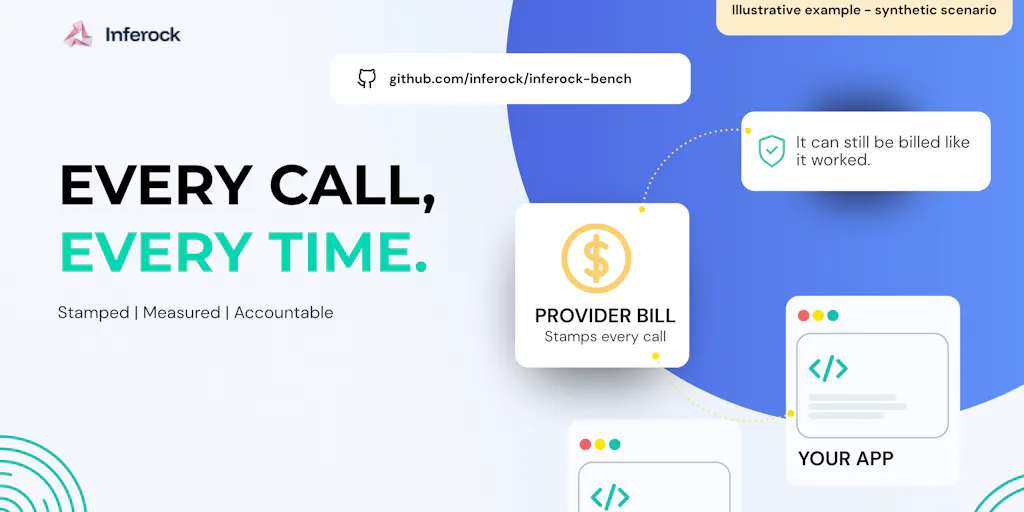
What Inferock Bench does is simple and radical at the same time. It runs locally as a proxy in front of OpenAI, Anthropic, Gemini, and OpenRouter-shaped calls. You point your existing SDK at it by changing two settings — apiKey and baseURL — and it captures every single call as an independent, per-call record. Your provider key never touches their servers; it’s used locally only, attached to provider requests. The tool catches the four things that quietly bleed money from any AI-dependent operation:
- Answers cut off mid-stream that still got billed
- Empty replies with billed tokens attached
- Token counts that don’t match visible output
- Retries that may have silently doubled a charge
Plus it flags cache discounts you might be missing on your invoice. Every run produces a receipt showing spend observed, bill-bounded money loss, time loss, and a separate “invoice-check exposure” line that never gets summed into money loss — because, as the makers put it, they don’t want a louder headline at the cost of a weaker claim.
The most telling detail in the entire launch thread is the honest admission from maker Bharath Koneti when asked whether anyone has actually disputed an AI provider bill and gotten a credit: “honest answer: no credit to brag about yet, that’s exactly why we threw the question to the community. What we can stand behind today is the receipt itself, knowing which call failed and what it cost, instead of arguing from a monthly total.”
That’s the real value proposition, and it’s worth sitting with.
Why Amazon Sellers Should Care More Than Shopify Ones
If you’re running a DTC brand on Shopify, your AI spend is probably modest — a few hundred dollars a month on support bots and email classification. If you’re an Amazon FBA operator, the calculus is different. You’re dealing with marketplace complexity that demands constant AI intervention: listing optimization across dozens of SKUs, repricing logic, review sentiment analysis, and appeal drafting for suspended listings. Every one of those use cases involves multiple model calls, often chained together. When a chain breaks mid-stream, you’re billed for the failed link and the retry. Multiply that across thousands of SKUs and you’re not talking about pocket change. The comment from Yolanda S. in the launch thread captures this perfectly: “I run agents that call out to multiple models depending on the task complexity and every so often the bill jumps in a way I can’t explain from usage alone.” That’s the Amazon seller experience in one sentence.
How This Differs From the Incumbents You Already Know
If you’re a serious operator, you’re probably already using cost-monitoring tools. Let me tell you why they don’t solve this problem. Helium 10 gives you keyword data and listing analytics, but it doesn’t sit inside your AI call path. Klaviyo tells you about email revenue attribution, not token waste. The cloud-native observability platforms like DataDog or LangSmith can show you traces and latency, but they’re not designed to reconcile what you were billed against what you actually received. They’re monitoring tools, not billing forensics.
The closest comparison is something like LiteLLM or one of the other AI gateway proxies that sit between your application and model providers. Those tools handle routing, fallbacks, and load balancing — but they don’t produce per-call receipts designed for cost dispute. Inferock Bench’s differentiator is its forensic orientation. It’s not trying to manage your traffic; it’s trying to give you evidence. The maker’s response to a comment about historical data makes this clear: “Today it works by sitting in front of your live traffic, so the receipts start from the moment you point your SDK at it, it can’t vouch for calls it never saw.” That’s a limitation, but it’s also a design choice. This is a forward-looking audit tool, not a retroactive one.
The open-source angle matters too. It’s released under FSL-1.1-Apache-2.0, converting to Apache-2.0 in two years. That means you can inspect exactly what it does with your data, which is crucial when you’re dealing with proprietary listing strategies and customer conversation logs. A closed-source tool asking to sit in your AI call path would be a non-starter for most serious operators.
Where the Math Breaks
Here’s where I want to push back on the hype. The tool has a documented blind spot, and it’s not a small one. In the launch thread, Dmitriy Semenkevich raises the case of “a tool call that returns 200 with a silently corrupted value.” He measured this on Anthropic models: 40 calls, none flagged the value as wrong, so it bills as a clean success and retry logic never fires. The maker’s response is honest: “A well-formed 200 with a wrong value inside would pass as a clean call, we simply can’t tell from the outside that the value was wrong.”
That’s a real limitation for e-commerce operators. If your AI support agent returns a wrong shipping policy to a customer, the token cost is trivial — but the return rate and negative review impact are not. Inferock Bench can’t catch semantic errors, only structural ones. It proves what you were billed and what actually came back — truncations, empty replies, token mismatches, retries. It cannot prove that the content was correct. For cross-border sellers, where a single wrong answer about customs duties or return windows can trigger a cascade of negative feedback, that’s a meaningful gap.
There’s also the question of whether per-call receipts actually translate into credits. The maker’s honest admission — no credit to brag about yet — tells you this is still an unproven path. You might build a beautiful evidence package and still get stonewalled by provider support. The tool gives you leverage, but leverage is only useful if you’re willing to pull the trigger.
What Cross-Border Sellers Can Borrow From This
Even if you never install Inferock Bench, the mindset behind it is directly transferable to your operation. The core insight is that you should never accept a bill without per-unit evidence. That applies to AI tokens, but it applies equally to your logistics invoices, your advertising spend, and your marketplace fees. The tool is essentially applying the same logic you’d use to audit a freight forwarder’s bill of lading against actual container contents — except for AI calls.
The practical borrowings are immediate. First, the idea of running a local proxy means you can implement this without sending sensitive data to a third party. That’s a privacy architecture worth copying in any tool you adopt. Second, the separation of “money loss” from “invoice-check exposure” is a smart accounting distinction. The tool doesn’t inflate its headline number with speculative claims; it keeps the hard evidence separate from the softer findings. That’s how you should present any cost-saving analysis to your partners or investors — clean claims, not padded numbers.
Third, the tool’s focus on retries is directly relevant to your customer support operations. If your AI support system is silently retrying failed calls, that’s not just a token cost — it’s a latency cost that degrades the buyer experience. A customer waiting on a response during a return window is a customer who’s already drafting a negative review. Catching retry loops is about customer satisfaction, not just cost control.
The Multi-Provider Reality
Most cross-border operators I know aren’t married to a single AI provider. They’re using one model for listing generation, another for translation, another for sentiment analysis. That’s smart — different models have different strengths — but it creates a billing nightmare. Each provider has its own dashboard, its own definition of a failure, its own token counting methodology. Inferock Bench’s approach — sitting in front of all of them and producing a unified receipt — is the right architecture. The maker confirms this: “Multi model agent setups are where this gets most interesting. Every call gets its own record whichever provider it went to, so a jump breaks down into failed calls, retries, etc.”
For an operator running a TikTok Shop content pipeline that generates dozens of video scripts daily, or an Etsy seller using AI to localize product descriptions across EU markets, the multi-provider reality is the norm. A unified receipt across all of them is genuinely useful — not because you’ll necessarily dispute every bill, but because you’ll finally know where the waste is concentrated.
Where My Judgment Says It Falls Short
I’ve been generous with the praise, so let me be equally direct about the shortcomings. First, the tool is developer-oriented. The setup requires changing apiKey and baseURL — that’s not a five-minute task for a non-technical brand owner. If you’re running a three-person operation and your tech stack is managed by a freelance developer you talk to once a month, this tool is probably beyond your reach. The “run it in about a minute: npx inferock-bench” claim assumes you know what npx is. Many cross-border sellers don’t, and that’s fine — but it means this tool serves agencies and tech-forward brands first.
Second, the retroactive gap is a real problem for the exact audience that needs this most. The comment from Kimberly West hits the nail on the head: “The overspending I’m most curious about already happened and I’d love a way to audit it after the fact.” The maker’s response — receipts start from the moment you point your SDK at it — means you can’t use this to audit last month’s bill. You can only use it going forward. For an operator who suspects they’ve been overpaying for months, that’s frustrating.
Third, the tool doesn’t help with web-based subscription products like Claude.ai or ChatGPT Plus. The maker is explicit: “we don’t touch that layer. inferock-bench works where there’s an API key and a baseURL to point somewhere, and web app subscriptions don’t expose the per call detail we’d need.” Many small operators are using exactly those web-based tools for their AI workflows, not API calls. They’re excluded from this solution entirely.
Fourth, and this is the one that matters most to me: the tool solves the billing problem but not the quality problem. A clean receipt for a wrong answer is still a receipt for a wrong answer. The comment from Dmitriy Semenkevich about silently corrupted values is the canary in the coal mine. As AI agents take on more customer-facing tasks — drafting appeals, responding to negative reviews, generating product descriptions — the cost of a wrong-but-well-formed answer is far higher than the token cost. Inferock Bench can’t catch that, and no billing forensics tool will.
What I’d Watch / Test Next
Here’s what I’d do this week if I were running a cross-border operation with meaningful AI spend.
First, run the tool in parallel with your existing traffic for a week. Don’t switch your production SDK over immediately — run it alongside, pointing the same calls through the proxy in a staging environment. The setup is minimal: change two settings and let it capture calls. After seven days, look at the receipt. I’d bet real money you’ll find at least one of the four failure patterns — truncated answers, empty replies, token mismatches, or silent retries — and the cost will be higher than you expect.
Second, take the dispute question seriously. The maker asked the community whether anyone has gotten a credit from an AI provider, and the honest answer was no. But that’s because nobody has had per-call evidence before. If you find a pattern of truncated responses that were billed as complete, build the evidence package and open a support ticket. You might not get a credit, but you’ll establish a paper trail — and providers who know you’re tracking per-call behavior will be more careful.
Third, apply the forensic mindset beyond AI. Take the same “receipt for every call” logic to your logistics invoices, your advertising platform bills, and your marketplace fee statements. If you’re not auditing those with per-transaction evidence, you’re leaving money on the table — probably more than your AI bill.
Fourth, watch how the tool evolves on the semantic error question. The maker acknowledged the limitation openly. If they add a layer that can flag well-formed but suspicious responses — perhaps by cross-referencing expected token counts or validating against known-good outputs — that would close the gap that matters most for customer-facing AI. Until then, treat the tool as a billing auditor, not a quality auditor.
Finally, if you’re not technical, find someone who is. The tool is open source, which means you can hire a freelancer to set it up and produce a weekly receipt report. The cost of that setup will be recovered in the first month if you have any meaningful AI volume. The problem Inferock Bench solves is real, the timing is right, and the honest approach of the makers — no fabricated credit stories, clear limitations, open code — is exactly the kind of transparency the AI billing landscape needs.