Why a CRM That “Builds Itself” Matters More to a Seller in Shenzhen Than a Founder in San Francisco
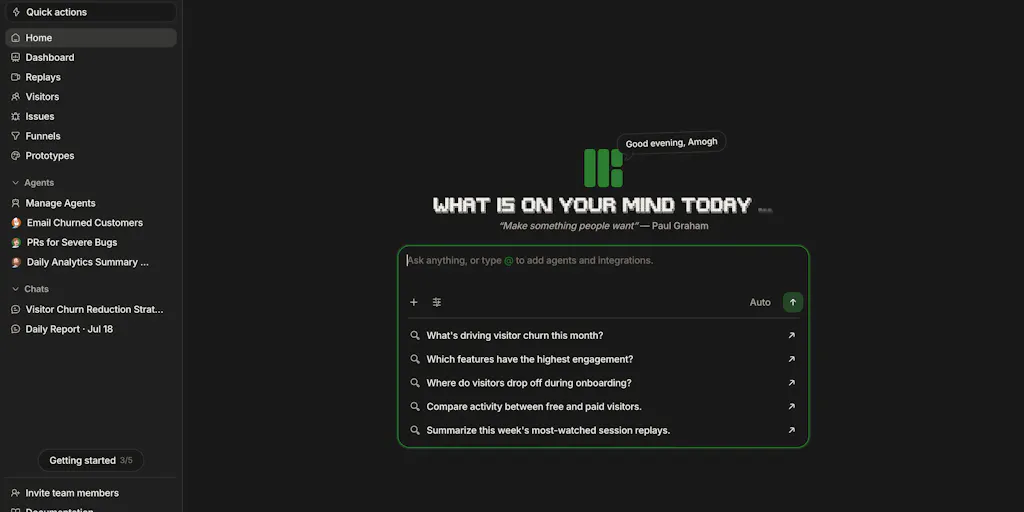
Every cross-border operator I know has the same dirty secret: we collect more behavioral data than we know what to do with, and we act on almost none of it. Your Shopify store logs every hover, your Amazon Seller Central account tracks every session, your email service provider records every open — and yet your product roadmap is still driven by whichever customer complained loudest on LinkedIn last week. The gap between data collected and insight acted upon is where your margin dies. That’s why the launch of Human Behavior, an AI-native CRM that claims to “build itself and do work for you,” caught my attention — not because I need another CRM, but because the underlying thesis is one that cross-border sellers have been ignoring for years: your dashboards are where insights go to die. The founder, Amogh Chaturvedi, spent 1.5 years building an AI accounting platform before pivoting into this. The internal tool he built to watch his own session replays became the product. That’s a story worth unpacking for anyone who sells across borders, because the same problem — too much data, too little action — is strangling your international expansion.
The Problem: Dashboards Are Cemeteries, Not Control Rooms
Let me be blunt: the average DTC operator has more analytics tools than SKUs. You’ve got Google Analytics for traffic, Hotjar or FullStory for session replays, Klaviyo for email, and whatever your Shopify admin panel spits out. Each tool generates charts. Each chart generates a weekly review meeting. And each meeting ends with the same conclusion: “We should look into that.” Then you never look into it, because the next shipment is delayed, the next ad account gets banned, and the next marketplace fee hike eats your margin.
Human Behavior’s pitch is that it removes the “look into it” step entirely. The AI watches your session recordings — thousands of hours of user behavior — and then does something about it. In their own dogfooding, the team watched 15,000 sessions of people using their product and made 16 pull requests in their codebase. Dead buttons, silent errors, layout shifts. None of them arrived as a bug report first. The full write-up is on their blog, and it’s worth reading for the sheer audacity of the claim: an AI that doesn’t just tell you what’s wrong but fixes it.
For a cross-border seller, translate that to your world. You’re not fixing code — you’re fixing a checkout flow that drops 60% of German customers at the payment step. You’re not patching layout shifts — you’re patching a product listing that gets zero clicks in Japan because the size chart uses US measurements. The insight isn’t that AI can watch replays. It’s that the action — the fix, the adjustment, the A/B test — is where the value lives, and that’s precisely where most teams stall.
Why Amazon sellers should care more than Shopify ones
Here’s a contrarian take: this tool matters more for Amazon FBA sellers than for Shopify DTC operators, even though it’s built for SaaS products. Why? Because on Amazon, you don’t own the customer experience. You own the listing, the images, the bullet points, and the backend search terms. The session replays you’d want to watch are on Amazon’s servers, not yours. But the behavioral patterns — where customers drop off, what they hover over, what they ignore — are inferable from your conversion data, your ad performance, and your return reasons. Human Behavior’s approach of “watch everything, fix what’s broken” is exactly the mindset you need to apply to your Amazon Seller Central account. Stop waiting for the negative review to tell you the product is defective. Start watching the absence of conversions as a signal.
The tool itself is a CRM, which sounds like a mismatch. But think about it: a CRM that builds itself means your follow-up sequences, your segmentation, your lead scoring are all generated by AI based on observed behavior, not by a marketing manager guessing at buyer personas. For a seller running TikTok Shop campaigns in three time zones, that’s not a luxury — it’s survival.
How It Differs From the Incumbents (and Where It Doesn’t)
The comment section on Product Hunt is already making the obvious comparison: PostHog released a similar feature, as noted by Kevin Brown in the thread. That’s the right comparison to make, but it’s not the only one. The broader landscape includes Salesforce for enterprise CRM, HubSpot for mid-market, and Attio for the modern startup crowd. What separates Human Behavior is the autonomy layer. PostHog will show you a session replay and let you tag it. Salesforce will give you a dashboard with 400 fields you’ll never fill out. HubSpot will send you 47 emails about their new AI features.
Human Behavior’s bet is that the AI should not only watch but act — opening PRs, sending emails, updating tickets. In their dogfooding, they made 16 PRs in their own codebase. That’s a fundamentally different value proposition than “here’s a heatmap, good luck.”
But here’s where I get skeptical. The comments on Product Hunt raise the exact question that matters for cross-border sellers: what’s the bar for autonomous action? Jernej Jan Kočica asks it perfectly in the thread: “a PR or a linear ticket is reversible, an email to a customer is not. Is there a human in front of that one, or does it clear the same bar as opening a PR?” That’s the right question for any seller thinking about using AI to automate customer communication. A PR to your own codebase is low-risk — you can revert it. An email to a customer in a new market, in a language you don’t speak, with cultural nuances you don’t understand? That’s high-risk. If Human Behavior’s AI clears the same bar for both, I’d run the other way. If it has a human-in-the-loop for irreversible actions, then it’s worth a look.
Where the math breaks
The dogfooding stat is impressive: 16 PRs from 15,000 sessions. But Sabber Ahamed’s comment asks the question that should make any operator pause: “of those 16, how many merged clean vs needed a human to say actually that’s expected behavior?” That’s the hidden cost of AI autonomy. It’s not the 16 PRs that cost you — it’s the 40 false positives you have to review to find them. For a cross-border seller, multiply that by every market you operate in. What looks like a “silent error” in a US checkout flow might be standard practice in a Japanese one. What looks like a “dead button” in Germany might be a regulatory requirement you’re not aware of. The AI will find issues. The human will still need to judge whether they’re actually issues. That’s not a criticism — it’s a reality check on the “does work for you” promise.
What Cross-Border Sellers Can Actually Borrow From This
You don’t need to buy Human Behavior to benefit from its thesis. Here’s what you can steal this week, regardless of your stack:
1. Instrument your funnel for behavior, not just conversion. The insight that drove Human Behavior’s pivot is that dashboards are where insights go to die. Your Shopify analytics, your Helium 10 keyword tracker, your Etsy stats — they’re all telling you what happened, not why. Start watching session replays of your own store, even if it’s just 10 sessions a week. Look for the dead buttons, the confusing layouts, the silent errors. You’ll find more issues in a week than your customer support tickets will surface in a quarter.
2. Build a “fix it, don’t report it” culture. The most powerful line in the launch is “none of them arrived as a bug report.” That’s the shift. Your team should be empowered to fix the checkout flow, not just report that conversion dropped. For a cross-border operation, that means your local market managers should have the authority to adjust listings, tweak pricing, and rewrite copy without waiting for HQ approval. The AI can find the problem. Your local team should be able to fix it.
3. Treat your CRM as a behavior log, not a contact list. The “AI-native CRM that builds itself” framing is marketing, but the underlying idea is sound: your CRM should be built from observed behavior, not from manual data entry. For a seller running eBay and Etsy stores simultaneously, that means syncing buyer behavior — what they viewed, what they bid on, what they abandoned — into a single view that your AI can act on.
The “email to a customer” test for your own automation
Before you let any AI tool send emails to your customers, apply the Jernej Jan Kočica test: is this reversible? A PR is reversible. A ticket is reversible. An email to a customer is not. For cross-border sellers, this is doubly true. A poorly worded email in a new market can burn a brand for years. Start with reversible actions — internal notes, ticket updates, listing adjustments — before you let AI draft customer-facing communication.
Where I’d Push Back: The Limits of Autonomy
Here’s my honest judgment: Human Behavior is solving a real problem, but it’s solving it for SaaS products, not for e-commerce. The session replays it watches are your product’s UI. For a cross-border seller, your “product” is a listing on a marketplace you don’t control, or a checkout flow on a platform you half-own. The AI can’t watch Amazon’s session replays. It can’t fix a Temu listing that’s being suppressed by the algorithm. It can’t rewrite your SHEIN product page to match local trends.
What it can do is serve as a model for how you think about your own data. The “dashboards are where insights go to die” thesis is universal. The “AI that watches and acts” approach is the future. But the execution is still early. The founder himself says they pivoted more times than he’d like to admit, starting as “an AI accounting platform.” That’s not a knock — it’s a sign that the team is iterating. But it also means the product is young.
The pricing isn’t disclosed on the launch page, which is a yellow flag for anyone trying to budget. The signup process is a “book a call” — again, typical for early-stage B2B, but annoying for a seller who just wants to test it. If you’re a solo operator or a small team, the sales-led onboarding might be more friction than it’s worth. Wait for self-serve or a free tier.
What I’d Watch / Test Next
If you’re a cross-border seller and this thesis resonates, here’s what I’d do this week, without waiting for Human Behavior to mature:
1. Run a “silent error” audit on your own store. Pick your top-selling SKU on Shopify. Watch 20 session replays this week — not the full recordings, just the drop-off points. Look for the dead buttons, the confusing layouts, the silent errors. Fix three of them. Don’t report them. Fix them. That’s the Human Behavior approach, applied manually.
2. Set up a “fix it” channel in Slack. Create a channel where anyone on your team can post a screenshot of something broken — a listing, a checkout flow, an email template — and the first person to fix it wins a coffee. The goal is to build the muscle of acting on insights, not just collecting them.
3. Apply the reversibility test to your email automation. Go through your Klaviyo flows and tag every email as “reversible” (low risk, informational) or “irreversible” (high risk, promotional, or culturally sensitive). Only let AI draft the reversible ones. Keep a human in front of anything that goes to a customer in a new market.
4. Watch the Human Behavior dogfooding blog post. The write-up of their 16 PRs is a masterclass in how to turn behavioral data into action. Steal the format for your own weekly review: what did the data show, what did you fix, what did you ignore, and why.
5. Book a call with the founder if you’re curious. The comments show Amogh is responsive and genuinely interested in feedback. Even if the product isn’t a fit for e-commerce yet, the conversation might surface a use case you hadn’t considered. At worst, you’ll learn something about how AI-first tools are thinking about customer data.
The bottom line: Human Behavior’s launch is a signal, not a solution. The signal is that the market is finally ready for tools that don’t just collect data but act on it. For cross-border sellers drowning in dashboards and starving for insights, that’s the direction to push your own stack. The tool itself may not be built for you yet. But the thesis — dashboards are where insights go to die — is one you can’t afford to ignore.