Why This Matters for Anyone Running a Cross-Border Operation
As cross-border e-commerce operators, we are constantly building workarounds — spreadsheets for multi-currency pricing, Slack bots for inventory alerts, manual customer service flows that barely scale. The dream of a custom internal tool that exactly fits our operations has always been out of reach for all but the deepest pockets. That’s why a tool like G.I.A.ac caught my eye — not as a consumer toy, but as a potential backbone for the kind of lean, bespoke software that could save a seven-figure seller weeks of manual labor each month. When I saw the product’s proposition — describe an app in plain language, watch it build itself, and own the code — I immediately thought of every cross-border seller I know who is tired of paying developers to rebuild the same order-management dashboard for the third time. The core question for us isn’t whether AI can write code: it’s whether that code can actually run a business without adding technical debt. G.I.A.ac is trying to solve that specific tension, and it’s worth a deep look.
The Real Problem: Custom E‑commerce Software Is Still Too Expensive and Too Slow
Every serious cross-border operator eventually hits the ceiling of off-the-shelf tools. Shopify works brilliantly for basic DTC, but try to build a multi-warehouse returns system that syncs with a Chinese freight forwarder and a European tax accountant — you’ll be duct-taping together apps and scripts within a month. Amazon Seller Central offers some automation, but custom reporting or supplier portals are out of the question. The standard path has been to hire a freelance developer, spend weeks on specifications, then wait for a buggy MVP. Or you turn to no‑code platforms like Bubble or Adalo, which can get you 80 % of the way but leave you locked into their hosting, their pricing tiers, and their database schemas. You never truly own the code, and migrating out later is a nightmare.
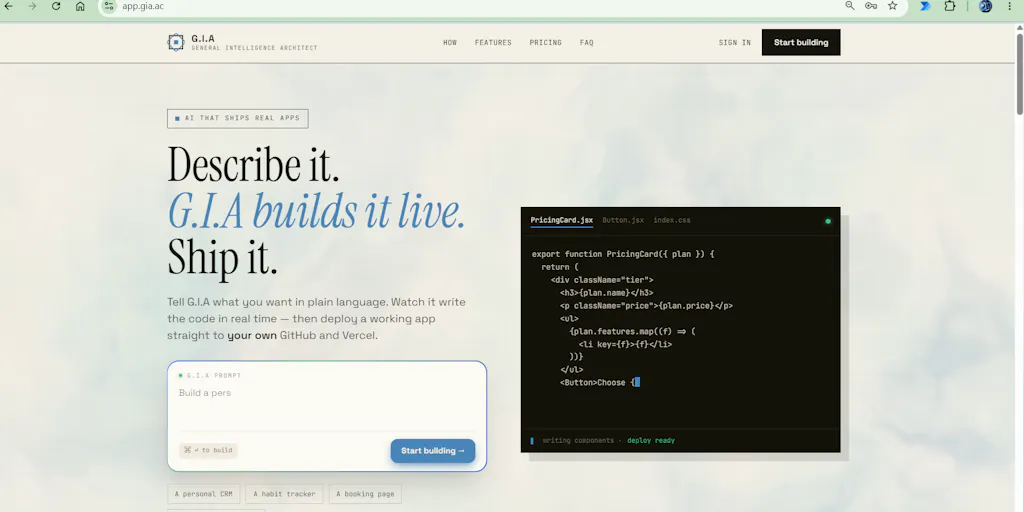
G.I.A.ac attacks the problem from a different angle. Instead of a visual drag‑and‑drop editor, you give it a text prompt — “a booking site for a nail salon in Paris” or “an inventory tracker for my Amazon FBA shipments” — and it writes actual code, deploys it to your own GitHub and your own Vercel accounts, and gives you full export rights. That’s not just a feature difference; it’s a business-model difference. The maker, Elhoucine Idousaid, explicitly states: “Not hosted on my platform, no per-app hosting fees, export anytime.” For cross-border sellers who have been burned by platform lock-in (remember when a certain marketplace changed its API pricing overnight?), this is a breath of fresh air.
The pricing is also worth noting: you pay €9.99/mo only when you want to download or deploy the code. The full build and live preview are free, no credit card required. That’s a low-friction way to test whether AI‑generated apps can handle your specific workflows. Compare that to Bubble’s paid plans starting at $29/mo with limited app capacity, or the time cost of a freelance developer at $50–150/hour. G.I.A.ac is practically free to evaluate.
How It Differs from the Incumbents — and Why That Matters for Sellers
1. Code Ownership: The Killer Differentiator
Most AI app builders, including Lovable and Replit, generate code that lives inside their cloud environments. You can export snapshots, but the underlying infrastructure and database remain on their turf. G.I.A.ac flips that: your app is deployed directly to your own GitHub repo and Vercel project. That means you can later hire a developer to extend it, fork it, or integrate it with your existing e‑commerce stack (e.g., connecting to Klaviyo flows or ShipStation APIs). For an Amazon FBA brand owner who already manages multiple AWS accounts, having the code in your own repo is a non‑negotiable security and compliance requirement.
2. Transparent Build Process — Not a Black Box
In his Product Hunt comment, Idousaid emphasizes: “You see the actual files being written, tested, and repaired in real time — not a loading bar and a reveal.” For sellers who are not developers themselves but need to trust the output, this transparency is huge. You can watch the agent fix its own mistakes. That removes the fear of “garbage in, garbage out” — a common objection to AI‑generated business tools. If you’ve ever used ChatGPT to write a Python script only to hit a cryptic error, you know the frustration. G.I.A.ac’s agent surfaces errors and fixes them live.
3. Built‑In AI Assistant Per App — A Hidden Gem for Customer Service
Every app ships with a “built‑in AI assistant that knows that specific business — services, prices, availability, pulled from the app’s own data — answering that app’s customers from day one.” For a cross-border seller, this could translate into a customer‑facing bot that knows your current inventory levels, shipping policies, and return windows across different markets. No more manually updating a Zendesk knowledge base every time you launch a new product line. The assistant is generated automatically from the app’s own data. If you build a supplier portal, the assistant could answer logistics queries. If you build a pricing calculator, it could handle margin questions. This feature alone could save a multi‑channel seller hours of support tickets per week.
Where the Math Breaks
But I’m not ready to replace my entire tech stack with a single prompt. The nail‑salon example is a clean, bounded use case. E‑commerce is messy. Real operations involve multiple currencies, tax calculations, inventory synchronization across Amazon, eBay, Etsy, and TikTok Shop. The data schemas aren’t simple. When a user in the Product Hunt comments says they built a working habit tracker in under a minute, that’s encouraging — but a habit tracker and a multi‑warehouse order management system are worlds apart.
I also wonder about the scalability of the AI assistant. Right now, it appears to be a retrieval‑augmented generation bot over the app’s own data. For a high‑volume seller with thousands of SKUs and real‑time inventory changes, that assistant would need to be updated on every transaction. G.I.A.ac likely hasn’t solved that yet. The pricing at €9.99/mo is suspiciously low — it may work beautifully for simple B2B tools but break at scale.
Why Amazon Sellers Should Care More Than Shopify Ones
Shopify has a rich app ecosystem and a decent built‑in automation engine. Amazon sellers, on the other hand, are starved for custom tools. Amazon’s API is notoriously fragile, and most third‑party tools (like Helium 10 or SellerSprite) are locked into specific use cases. If you need a dashboard that combines PPC spend, inbound shipping tracking, and competitor price analysis, you often have to build it yourself. G.I.A.ac could let an Amazon seller describe that dashboard in natural language, get a working version in minutes, and then tweak it via the same agent. The fact that the code is on your own GitHub means you can later hire a developer to connect it to the Amazon SP‑API without starting from scratch.
Where I See the Tool Falling Short for Now
The biggest gap is integrations. G.I.A.ac’s generated app is a self‑contained web app — it doesn’t come with pre‑built connectors to Stripe, PayPal, ShipBob, or the Amazon API. The AI can presumably write custom integration code if you prompt it to, but that’s a skill in itself. For a non‑technical seller, getting a generated app to talk to existing SaaS tools might still require a developer’s help. Also, the tool seems optimized for apps that are essentially CRUD (create, read, update, delete) — booking systems, habit trackers, internal logs. Complex business logic like multi‑currency tax calculations or real‑time inventory reservation may exceed its current capabilities.
Another concern: long‑term maintenance. The code is yours, but where do you get support when something breaks? G.I.A.ac’s pricing doesn’t include ongoing maintenance. You’re essentially buying the code generator, not a managed service. If your business depends on that app, you need someone to monitor it — which means either learning to code or hiring a fractional developer.
What I’d Watch / Test Next
If I were running a cross‑border operation today, here’s the concrete test I’d run this week:
Take one painful manual process — for example, a daily spreadsheet that tracks inbound shipments from your Chinese factory to your US warehouse. Write a prompt describing exactly what that spreadsheet needs: fields for container number, departure date, ETA, customs status, and a simple alert system. Use G.I.A.ac to build a web app version. See if the generated app can handle file uploads or manual data entry. If it works, you’ve saved hours.
Test the AI assistant with real customer questions. After building the app, ask the assistant something like “Do you ship to Germany?” or “What’s the return policy for electronics?” See how well it pulls data from the app’s schema. If it can handle the complexity of your business, consider using it as a live chatbot on your DTC storefront.
Check the export and integration path. Deploy the generated app to your own Vercel account. Then try to connect it to a webhook from ShipStation or Zapier — even if you need to hire a freelancer for an hour. If that integration is straightforward, you now have a custom tool chain with no monthly per‑app fees.
Scale the test: If the first app works, try a multi‑region use case — e.g., a portal where your European distributors can place bulk orders. The tool’s ability to handle user roles and permissions will be the real test.
G.I.A.ac is not a silver bullet for all e‑commerce automation. But it’s promising precisely because it gives sellers ownership, transparency, and a low cost to experiment. In a space where the typical “no‑code” solution locks you into its ecosystem, this tool feels like the opposite. That alone makes it worth a closer look.