Why a Phone Number for Your AI Agent Is Suddenly a Cross-Border Seller Problem
Every e-commerce operator I know has hit the same wall. You automate the listing, the ad optimization, the inventory forecasting, the customer service triage — and then something breaks because a supplier in Shenzhen won’t reply to email, a carrier in Frankfurt requires a phone call to release a shipment, or a bank verification text lands on a phone nobody in your automation stack can read. The last mile of commerce was always physical. But we assumed the digital last mile — the verification code, the phone call, the SMS — was solved infrastructure. It wasn’t. It was just legacy infrastructure that happened to require a human thumb. Dial is a product that attacks exactly this seam: the point where your agent has done everything right and then stalls because the world still speaks in six-digit codes and voice menus. For anyone running cross-border operations, this isn’t a novelty. It’s the missing connector between your software and the physical reality of ports, customs brokers, and local payment gates.
The Problem Isn’t That Agents Fail — It’s Where They Fail
The founder’s own origin story, posted in the launch thread, is the cleanest articulation of the problem I’ve seen in months. Gal Dayan describes building an AI agent that needed to sign up for a service, got all the way through the form, and then hit “we’ve texted you a code” — and died. Not because the agent was dumb. Because the agent didn’t have a phone, and the signup form assumed every entity in the world does. That’s the real insight here: the AI agent economy has spent two years building smarter models, better tool-calling, and richer context windows, but the physical world hasn’t changed. It still wants to verify you’re human by sending a text to a device. It still wants you to press 1 for sales. It still wants a human voice on the other end of a booking line.
The launch post frames this as a universal agent problem, and it is. But for cross-border sellers, the stakes are higher than for a developer building a side project. When you operate across time zones, your “agent” isn’t a novelty — it’s your only presence during the 14 hours you’re asleep and your Chinese supplier is awake. If your agent can’t receive the verification code from a new marketplace registration, can’t call the freight forwarder to confirm the container pickup, can’t SMS the customs broker about a missing document — then you’re not running an automated operation. You’re running a scheduled operation that happens to have a chatbot in front of it. The distinction matters because the failure mode is silent. Your systems report “task complete” right up until the last step, and then nothing happens. You discover the problem three days later when the shipment hasn’t moved.
Dial’s answer is to give the agent a phone number it actually owns — provisioned via API in about ten seconds, according to the product description in the thread. Not a virtual number that requires paperwork. Not a SIP trunk you have to configure. A real number with SMS, voice, iMessage, and RCS fallback, all routed through one webhook. The specific capabilities listed in the launch post are worth parsing for what they reveal about the underlying assumption: the agent can now receive inbound codes, read the full SMS (not just an extracted digit), and decide what to do next. That last bit — the agent reading the whole message — is the unlock. A verification code is a dead end. A message that says “your code is 482913, and by the way your account is restricted pending a call to this number” is an actionable instruction.
How Dial Differs from the Incumbents You’re Already Using
If you’re running a cross-border operation, you’ve likely already evaluated — or are paying for — a stack of communication tools. Let me name the incumbents and explain why Dial isn’t just another Twilio wrapper.
Twilio is the obvious comparison. It’s the default for programmatic SMS and voice, and it’s powerful. But it’s also a toolkit, not a solution. You need to understand phone number provisioning, carrier registration, 10DLC compliance, webhook routing, and media handling. For a developer building a SaaS product, that’s fine. For an e-commerce operator who wants an agent to call a supplier, it’s a distraction. Dial’s pitch is that it collapses the entire telecommunication engineering layer into one API call. The launch thread specifically addresses the pain point of 10DLC registration — the founder mentions their “Self-Healing 10DLC” gets approved in 1-3 days instead of the standard 10-15 days. For anyone who has waited two weeks for a US short code or 10DLC approval while their campaign sat idle, that speed differential alone justifies a look.
Voice AI platforms like Retell or Vapi are closer competitors in spirit. They handle the speech-to-speech stack, the latency optimization, the turn-taking. Dial’s founder explicitly acknowledges this in the thread, noting they use in-house small language models to decide which speech-to-speech model to use per turn for latency and human-likeness. But those platforms typically assume you’ll bring your own telephony or use their bundled numbers. Dial’s differentiation is the number itself as a first-class programmable asset — the ability to receive inbound SMS, read the code, and then act on it in the same conversation flow. That’s an architectural choice, not a feature add.
The MCP angle is where this gets interesting for the Shopify and Amazon crowd. Dial exposes a context MCP server that you can plug directly into Claude Code or Cursor via a single command. The thread shows the exact snippet: claude mcp add --transport http docs-getdial-ai https://docs.getdial.ai/_mcp/server. For operators who are already using AI coding assistants to manage their store scripts, inventory tools, or ad automations, this means the phone number isn’t a separate dashboard you check — it’s a tool your agent can pull out of its belt mid-task. That’s a meaningful shift from “I have a phone API” to “my agent has a phone.”
Why Amazon Sellers Should Care More Than Shopify Ones
Here’s my contrarian take for the section. Shopify sellers live and die by their storefront, and most of their customer communication is asynchronous — email, chat, social DMs. Amazon sellers live and die by Seller Central, and the communication pattern is different. Amazon’s own messaging system is notoriously clunky, and account verification, tax form processing, and brand registry approvals all involve phone verification steps. When your Amazon business gets flagged for a review, the response window is measured in hours, not days. An agent that can receive the verification SMS, parse the whole message, and then call the Amazon support line to navigate the IVR — that’s not a convenience. That’s a survival tool. The thread’s example of an agent pressing keypad digits mid-call to navigate phone menus is directly applicable to calling Amazon Seller Support, which is still a phone-tree labyrinth. Shopify’s admin panel never requires you to call anyone. Amazon’s does.
What Cross-Border Sellers Can Borrow from Dial’s Approach
Even if you don’t adopt Dial tomorrow, the product reveals three operational principles worth stealing.
First, the physical world is the last integration. Every automation you build will eventually need to touch something that isn’t an API. A customs form that requires a signature. A bank that needs a call to authorize a wire. A supplier who only confirms orders by phone. If your automation stack doesn’t have a strategy for this — a human fallback, a virtual phone presence, a documented escalation path — you’re building a system that will fail at the worst possible moment. Dial’s thesis is that the solution isn’t a better human-in-the-loop workflow. It’s giving the agent its own identity in the phone network.
Second, read the whole message, not just the extracted field. The launch thread has a telling exchange where a commenter asks whether the agent sees the whole SMS or just the extracted code. The founder’s answer: “the whole sms. your agent can decide what to do next.” That’s a design philosophy. Most verification workflows treat an SMS as a one-time password token. But in a cross-border context, the SMS from a carrier or bank often contains context — “your shipment is delayed, reply Y to reschedule” or “your payment failed, call this number within 24 hours.” If your agent only extracts the code and discards the rest, you’re blind to the follow-up action. The principle extends beyond SMS: don’t build automations that discard context at the extraction step.
Third, speed of provisioning is a competitive advantage. The 10DLC approval timeline — 1-3 days versus 10-15 — isn’t just a convenience metric. In cross-border commerce, compliance and registration delays are often the critical path. If you’re launching a new storefront in a new market and need a local number for customer service, a two-week wait is a launch delay. A two-day wait is a scheduling detail. Dial’s managed approach to the regulatory mess — the founder calls it “fully managed 10dlc” — is the right instinct. The compliance burden shouldn’t be your problem; it should be your vendor’s.
Where the Math Breaks
Now let me be the skeptic. The pricing question in the thread is revealing. A commenter asks if the $3 per number price is the same in every country. The founder’s answer is vague: “not same pricing, you can contact [email protected] and we will take it from there.” That’s a red flag for cross-border operators who need predictable unit economics. If you’re running an agent that needs numbers in five countries for different storefronts, and the pricing is quote-based, you can’t model your cost per transaction. The thread also confirms they offer a calling service without a number associated, but again — pricing not disclosed. For a tool that’s pitching itself as an API-first utility, the lack of transparent, country-specific pricing is a gap. Twilio publishes its rates per country. Dial needs to do the same if it wants serious evaluation from operations teams that build P&Ls, not just prototypes.
The second issue is reliability. The thread’s example of the agent pressing keypad digits mid-call to open a gated entrance is clever, but it assumes the other end of the call is a deterministic IVR. Real-world phone systems — especially in emerging markets where many suppliers operate — have voice quality issues, background noise, and human operators who don’t follow scripts. The founder’s claim of using in-house SLMs to select the best speech-to-speech model per turn is impressive, but it’s also a sign of complexity. Every model selection adds a point of failure. For high-stakes calls — a bank confirmation, a customs hold — I’d want to see failure-rate data before trusting an agent to handle it unmonitored.
My Judgment: Where Dial Falls Short and Where It Wins
Let me be direct about where I think Dial is overhyped and where it’s genuinely useful.
The overhype: The “fully autonomous agent” narrative in the launch post is marketing. The founder’s own example — an agent signing up for a service — is a low-stakes task. The real cross-border use cases involve money, legal liability, and relationships. I’m not ready to let an agent call my freight forwarder and negotiate a demurrage charge without human oversight. The tool is a capability enabler, not a trust replacement. The thread’s commenters are already imagining sci-fi use cases — gated estates, deliveries, visitors — which is fun but not commercial. The commercial use cases are narrower: verification, scheduling, status checks, IVR navigation. That’s still valuable, but it’s not “the agent runs my logistics.”
The genuine win: The 10DLC speed and the inbound code reading are real, differentiated capabilities. For any seller who has automated account creation or supplier onboarding, the ability to programmatically receive and read verification codes is the difference between a fully automated workflow and one that requires a human to check a phone. The MCP integration is also a smart bet — it lowers the barrier to adoption for the developer-operator crowd that’s already building with Claude or Cursor. And the iMessage support with RCS/SMS fallback is a nice touch for markets where iMessage penetration is high, like the US and parts of Europe.
The missing piece for cross-border: The thread mentions SMS in 200+ countries, but the launch examples are all US-centric (10DLC, iMessage). For cross-border sellers, the critical test is whether Dial can handle the messy reality of non-US carriers — the Chinese suppliers who use WeChat, not SMS; the European carriers with strict opt-in rules; the Latin American markets where WhatsApp is the default. The founder’s comment about pricing varying by country suggests they’re aware of this, but the product page doesn’t foreground it. If Dial wants to win the cross-border operator, it needs to speak the language of WhatsApp Business API and WeChat integration, not just SMS and iMessage.
What I’d Watch / Test Next
Here’s my concrete playbook for the next week if you’re a cross-border operator intrigued by this.
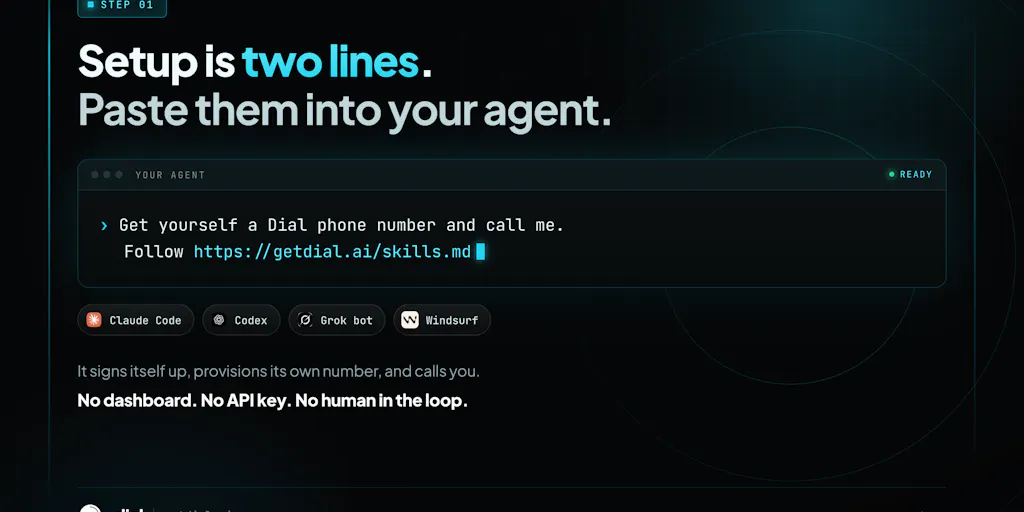
First, run the 30-second test the founder suggests. Paste the skills.md URL into Claude Code or Cursor and let the agent provision a number and call you. Don’t do it with a critical workflow. Do it with a test scenario — have the agent call your own phone and leave a voicemail. This costs you nothing and tells you immediately whether the setup friction is real or marketing.
Second, pick one verification dead-end in your current stack and try to automate it. Do you have a supplier portal that texts you a code every time you log in? A bank that requires SMS confirmation for wire transfers? A marketplace that sends OTPs for account changes? Pick the lowest-risk one and see if Dial can close the loop. The thread’s exchange about reading the whole SMS is the key insight here — don’t just extract the code, see if the message contains other instructions you’ve been ignoring.
Third, evaluate the 10DLC angle for your US operations. If you’re running SMS campaigns to US customers and you’ve been waiting on approval, the 1-3 day turnaround is worth a pilot. Even if you don’t switch your entire stack, testing the approval speed with a single number gives you a data point on whether the managed compliance approach is worth the opaque pricing.
Finally, watch the roadmap for non-SMS channels. The thread’s founder says the answers to “what would you have your agent call or text” drive their roadmap. If you need WhatsApp or WeChat integration, say so — either in the thread or directly to [email protected]. The product is early enough that user feedback genuinely shapes the build. For cross-border sellers, the window to influence that roadmap is now, before the product solidifies around a US-only, SMS-first default.
The bottom line: Dial isn’t the solution to all your automation gaps. But it’s a sharp answer to a specific one — the dead end where your agent meets a phone number. For cross-border operators, that dead end appears more often than you think. Worth thirty seconds to test whether it’s real.


