The Server Room You Never See Is Now Your Conversion Rate Problem
Cross-border sellers obsess over the visible stack — the Shopify theme, the Amazon listing, the TikTok Shop creative, the Temu price war. Nobody puts the Linux box in the pitch deck. Yet every DTC brand past a certain GMV is quietly running infrastructure: a headless storefront, a middleware layer syncing inventory across marketplaces, a returns portal, a webhook receiver for payment disputes. When that box misbehaves at 2 a.m. Shenzhen time, your ads keep spending and your orders stop confirming. That is why CtrlOps — a second-launch product from TST Technology — is worth ten minutes of an operator’s attention even though it was not built for us. It is a signal about where “AI-assisted ops” is heading, and the operating model it implies will reach e-commerce tooling within a year.
What CtrlOps actually is, in operator terms
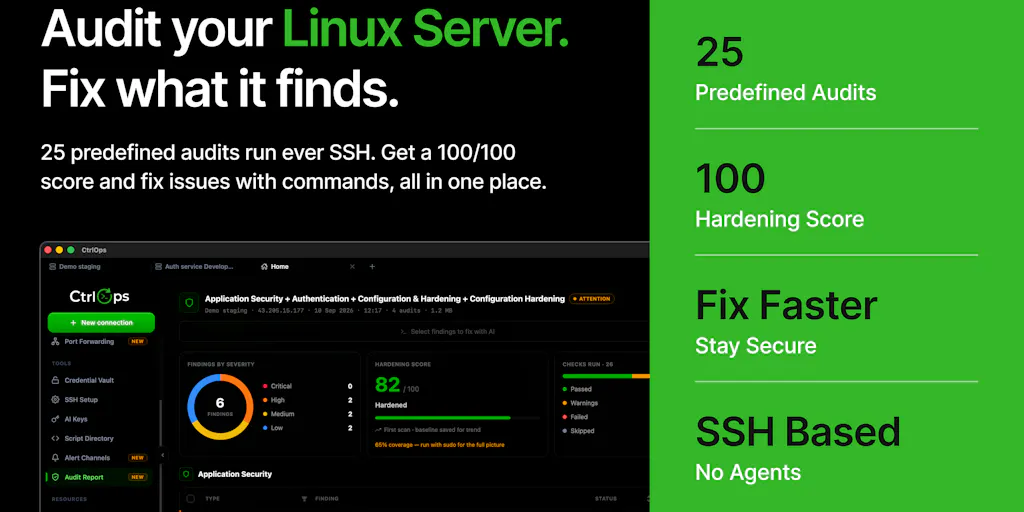
The maker’s own framing is the cleanest: they are going “beyond SSH clients” (launch post). The first version connected you to Linux servers. This version wraps eight named capability areas around that connection: a security audit that runs 25 checks over SSH and returns a hardening score plus a downloadable PDF report and a fix command per finding; global access management that onboards or offboards a person across the whole fleet in one action; custom user roles you create from a UI; log management that finds and groups every log file and lets you search, tail live, or download without typing a command; a PM2 process manager with live CPU and memory per process and one-click restart/reload/stop; Vault Lock, a passphrase that seals the app; a Termius migration that imports hosts and SSH keys in about 30 seconds; and centralized backup and restore.
It runs locally, keeps credentials on the machine, and requires no agent installed on each server — a point reviewer Bhavesh raised as a like, not a complaint. Pricing is not disclosed on the page beyond “try CtrlOps free for one month at ctrlops.io. No credit card.”
Why an e-commerce operator should read a DevOps launch at all
Here is the uncomfortable arithmetic of a mid-seven-figure cross-border brand. You run Shopify as the storefront, Amazon Seller Central as the demand engine, TikTok Shop as the growth bet, and a 3PL integration plus a returns tool plus a subscription app on top. Somewhere underneath, someone — often a freelancer in a different timezone — holds SSH keys to the VPS that runs your custom inventory sync. That person leaves. Nobody knows which cron jobs they wrote. Nobody knows whether the box has been patched. That is the exact failure mode CtrlOps’ access management and security audit features are aimed at, and it is a failure mode most sellers will not discover until a marketplace integration silently stops pushing stock levels and they oversell on Amazon.
The Product Hunt thread surfaces the real anxiety better than the marketing does. One commenter asks the sharpest question on the page: “How do you prove a generated server command is safe to run?” — specifically wanting the exact command, expected blast radius, prior command output, remaining debug context, and whether this is a new failure state or a retry, especially for teams mixing read-only production users with fuller staging access (forum thread). That question is not a DevOps question. It is a risk-management question, and it is the same one you should be asking about every AI agent you let touch your order data, your ad accounts, or your supplier POs.
How it differs from what you are probably using
If you are a seller reading this, your current “server management stack” is almost certainly one of three things.
The ChatGPT-plus-terminal workflow. One commenter on the launch admitted they know roughly 20% of the commands they need and paste the other 80% out of ChatGPT (thread). This is the modal seller behavior, and the maker’s rebuttal is the most interesting technical claim on the page: the AI terminal reads your actual server — live CPU, memory, running processes — rather than guessing generically, and shows the exact command, explains it, and waits for approval before anything runs. That is a meaningfully different trust model from copy-pasting a hallucinated rm -rf variant.
The Termius / traditional SSH client. CtrlOps explicitly built a migration path from Termius that imports hosts and keys in about 30 seconds. If you have ever tried to get a contractor’s saved hosts out of their laptop and into yours, you know why that line item exists.
The monitoring-platform bolt-on. Reviewers repeatedly describe the old workflow as “SSH client + SFTP tool + monitoring dashboard + deployment tool” stitched together, and the pitch is consolidation. Compare that to where the e-commerce world actually lives: Datadog or New Relic for infra observability, PagerDuty for alerting, Cloudflare for edge. CtrlOps is not trying to replace those at the enterprise tier — reviewers explicitly ask for “deeper monitoring and alerting” as a gap.
Why Amazon sellers should care more than Shopify ones
Shopify-first DTC brands can stay remarkably infrastructure-light. Shopify hosts the storefront, Shopify Flow handles a lot of automation, and the app ecosystem covers most middleware. If your stack is Shopify plus Klaviyo plus a 3PL, you may never own a Linux box.
Amazon-native sellers are the opposite. The moment you build anything beyond a spreadsheet — a repricing bot, a review-monitoring scraper, an inventory sync between Amazon Seller Central and your own warehouse, a Helium 10 data pipeline — you are running servers. And you are running them with thin margins, no dedicated DevOps hire, and a strong incentive to let a cheap contractor hold the keys. That is precisely the profile CtrlOps’ security audit and fleet-wide offboarding features target. The 25-check audit and hardening score is not a compliance artifact for you; it is a way to find out whether the box holding your inventory sync has an open SSH port and a default user.
Where the math breaks
The approval-flow gap is the whole product. The single most-engaged forum question on the page is the one about proving a generated command is safe, and it has no visible answer from the team in the scraped thread. Until CtrlOps publishes what an operator actually sees before clicking approve — blast radius, rollback, diff against last known state — the “AI terminal” is a faster way to make a mistake, not a safer one. For a seller, the equivalent question is: if the AI decides to restart the process that runs your order webhook during peak, what stops it?
Local-only cuts both ways. Running locally with credentials on the machine is a genuine security win on a single laptop. It is a genuine operational problem for a team of five across three countries. Vault Lock protects a stolen machine; it does not give you a shared, auditable control plane. Reviewers asking for more cloud and DevOps integrations are circling this gap.
The integrations list is thin where sellers live. The page names no e-commerce integrations, no cloud provider integrations beyond the implied AWS EC2 use case, and no deployment platform tie-ins. Reviewers ask for exactly these three times over. If your stack is Vercel, Railway, or a managed platform, CtrlOps may be solving a problem you outsourced away.
“Free for one month” is the only pricing signal. No tiers, no seat pricing, no fleet-size limits disclosed. That is fine for a trial, useless for a budget line.
What cross-border sellers can borrow from this, even if they never install it
The transferable idea is not the tool. It is the pattern: AI proposes, human approves, everything is logged. CtrlOps’ best-reviewed feature is the approval step before execution — Piyush Kalathiya called it “especially useful when working with production servers.” That same pattern is what you should demand from every AI agent entering your e-commerce stack in the next twelve months.
Concretely: when a repricing tool wants to drop a price 30%, when an ad automation wants to shift budget between campaigns, when an inventory tool wants to reallocate stock across marketplaces — you want the exact action, the expected blast radius, and a log. Most of the AI tools currently being sold to sellers do not offer this. They offer autopilot. Autopilot is how you get a $40,000 ad spend mistake on a Sunday.
The second borrowable idea is fleet-wide offboarding. CtrlOps lets you remove someone’s access across every server in one action. Translate that to your stack: when a VA or agency leaves, how many places do you have to revoke access — Seller Central, Shopify admin, Klaviyo, your ad accounts, your 3PL portal, your domain registrar? If the answer is “I’d have to think about it,” you have the same problem CtrlOps is selling against, just with different logos.
What I’d watch / test next
Three things, this week, no purchase required.
First, audit your own access sprawl. List every human and every service account with write access to anything that touches orders, inventory, or ad spend. If offboarding one contractor takes more than one action per system, you have a CtrlOps-shaped hole in your stack regardless of whether you buy CtrlOps.
Second, if you do run Linux infrastructure, take the free month and run the security audit specifically to see the hardening score and the per-finding fix commands. That output is useful even if you churn — it is a free external review of the box holding your integrations.
Third, watch whether the team answers the approval-flow question publicly. Their roadmap, per maker replies, includes “more automation, deeper monitoring & alerting, and cloud/deployment integrations,” and they have committed to “ready-made workflows” for people less comfortable with Linux. If those ship with a real pre-execution diff and rollback story, CtrlOps becomes interesting to seller-operators, not just developers. If they ship as autopilot, it becomes a liability with a nice UI. That distinction — propose-then-approve versus just-do-it — is the one I would bet on across the entire e-commerce tooling market this year, and CtrlOps is a clean early test case.


