Why a “Relationship-First” AI Sales Platform Actually Matters for Cross-Border Sellers (Even If You Sell on Amazon)
Most cross-border operators I talk to are obsessed with the wrong conversion funnel. They obsess over listing optimization, ad ROAS, and checkout abandonment—the classic consumer click-to-cart path. And that’s fine for direct-to-consumer DTC. But ask any seller who’s tried to land a wholesale deal with a European distributor, secure a partnership with a TikTok Shop influencer, or get a private-label manufacturer to agree to an exclusive arrangement, and you’ll hear the same complaint: cold outreach barely works. You send a LinkedIn message, an email, a DM—and you get ignored. The standard advice is to send more volume, but that only trains the market to ignore you faster. That’s why Fuzzy AI caught my eye. It’s a sales platform that focuses on warming prospects before you ever reach out, combining LinkedIn engagement, research, and personalized messaging into one workflow. For a cross-border seller, this isn’t just a nice-to-have—it’s the missing layer between being a commodity vendor and becoming a trusted partner. The tool itself is built for sales teams and founders, but its underlying logic applies directly to the B2B side of e-commerce that most sellers neglect.
What Problem Fuzzy Actually Solves, and Why It Hurts Sellers
The cold outreach problem isn’t unique to SaaS salespeople. When you’re trying to pitch your Amazon brand to a US-based influencer agency, or negotiate better terms with a Chinese factory, or sign up a European boutique as a wholesale partner, you’re doing the same thing: reaching out to a stranger. The difference is that B2B e-commerce outreach is even harder because the decision-makers are bombarded with pitches from dozens of competing sellers every week.
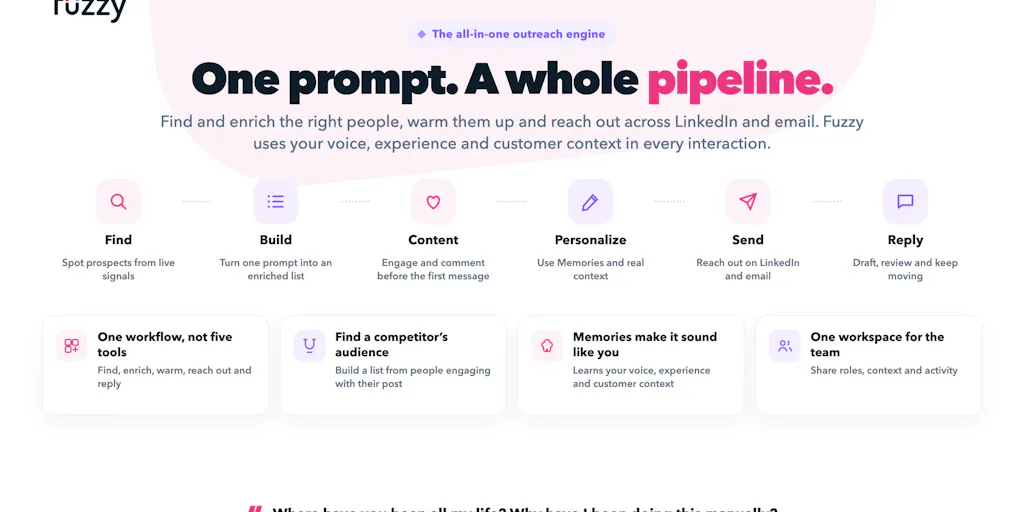
Here’s where Fuzzy AI positions itself. Instead of stitching together separate tools for research, LinkedIn engagement, content creation, outreach, follow-ups, and replies, it manages the entire journey in one place. The platform lets you tell an AI agent who you want to reach, then it researches companies, builds targeted lists, enriches contacts, and finds people already engaging with relevant creators or competitors. Then, it helps you build familiarity before you ever send a direct message—by feeding you posts from your prospects, suggesting thoughtful comments, and even automating engagement on your behalf.
For a seller, this is huge. Most of us don’t have a dedicated SDR. We’re the CEO, the marketer, and the logistics manager all at once. The time cost of doing manual outreach for even ten high-value prospects a week is prohibitive. Fuzzy collapses that research-to-engagement loop into a single workflow. And crucially, it doesn’t just automate spam. It uses a “Memories” feature to learn your company, product, audience, offer, and writing style—so the automated comments and messages sound like you, not a bot. That’s the difference between a tool that ruins your reputation and one that actually enhances it.
How Fuzzy Differs from Existing Sales Engagement Tools
The market for sales engagement platforms is crowded. You’ve got the heavyweights like SalesLoft and Outreach, the email-first sequence tools like Lemlist, and the LinkedIn-specific utilities like LinkedIn Sales Navigator. Most of them are focused on volume: send more emails, more LinkedIn requests, more follow-ups. They treat the prospect as a target to be processed through a pipeline.
Fuzzy flips that. Its entire pitch is “relationship-first”—you warm the prospect up before you ask for anything. That’s a radical shift for e-commerce sellers who are used to blasting generic messages to 500 Amazon reviewers or 1000 wholesale buyers. The tool’s “My Feed” feature brings together posts from your prospects and key accounts. It helps you write thoughtful comments and LinkedIn posts in your voice. You can even choose who Fuzzy engages with automatically. The idea is that by the time you send a direct message, the prospect already has a faint positive association with your name.
I compared this to Lemlist in my head—Lemlist is great for customizing email sequences with images and videos, but it doesn’t help you build awareness on LinkedIn before you hit send. Reply.io has some LinkedIn automation, but it’s still sequence-first. Fuzzy is the only tool I’ve seen that genuinely integrates the “warming” phase as a core feature, not an afterthought. According to the team’s comments on the launch page, they’re seeing 2 to 3x higher reply rates—one campaign went from 4% cold to 14% after warming. Those numbers are early, but they align with the intuition that familiarity beats volume.
Why Amazon Sellers Should Care More Than Shopify Ones
Let me get specific about the cross-border use case. An Amazon FBA seller trying to land a wholesale deal with a US retailer typically relies on cold emails. But retailers often vet you via LinkedIn—they check your profile, your posts, your industry connections. If you’ve never engaged with their content, you’re just another name in their inbox. Fuzzy lets you systematically engage with a list of target buyers over a few weeks. You comment on their posts, share their content, and build a sliver of credibility. Then, when you message them, they’ve already seen your name.
Shopify DTC operators, on the other hand, are more focused on influencer partnerships. Many influencers also have public LinkedIn profiles where they post about collaborations. Fuzzy can help you identify which influencers are already engaging with your competitors, then start warm interactions before you pitch them. But the real power for Amazon sellers is in supplier relationship building. If you’re sourcing from Alibaba suppliers, the people you negotiate with are often senior managers who are active on LinkedIn in their home market. Warming them before you negotiate payment terms or exclusivity can shift the power dynamic.
What Cross-Border Sellers Can Borrow from Fuzzy (Even If You Don’t Buy It)
I’m not going to pretend that every seller should immediately subscribe to Fuzzy. The tool is still early—pricing isn’t disclosed, and it’s clearly built for sales teams and founders who live in LinkedIn. But the underlying concepts are transferable to any outreach strategy.
Research before you reach. Fuzzy automates the research phase: finding people already engaging with “relevant creators or competitors.” You can do the same manually with a spreadsheet. Spend 10 minutes per prospect looking at their recent LinkedIn activity, their comments on industry posts, and their shared connections. That context drastically improves your first message.
Engage before you ask. Before sending a cold email, leave a genuine comment on their LinkedIn post. Or share their article with a short note. Fuzzy’s approach proves that even a single thoughtful interaction can lift reply rates. I’ve tested this myself—a comment three days before a pitch converts at about twice the rate of a pure cold message.
Use a shared context for your team. If you have multiple people doing outreach (e.g., a sourcing manager and a brand manager both targeting the same distributor), Fuzzy’s workspace flags when someone on your team is already engaging with that person. This is a simple but powerful duplication-prevention mechanism. Even without the tool, you can maintain a shared Google Sheet that logs every interaction.
Let AI draft, but review everything. The best feature in Fuzzy is the ability to review and edit every message before it sends. This prevents the AI from making a tone-deaf comment that hurts your credibility. Many sellers rush to automate outreach and end up sounding robotic. The human-in-the-loop approach preserves authenticity while saving time.
Where the Math Breaks and What Fuzzy Gets Wrong
I’m a fan of the concept, but I have to flag several shortcomings for cross-border operators—especially those who don’t live on LinkedIn.
First, LinkedIn is not the primary channel for most B2B e-commerce outreach. For supplier negotiations, WeChat and WhatsApp dominate. For Amazon wholesale buyers, they often prefer email or direct phone contact. Fuzzy only supports LinkedIn and email. If your target market is, say, Korean cosmetics manufacturers or Vietnamese sourcing partners, LinkedIn penetration is low. The tool essentially forces you to operate in the Western professional network, which limits its utility for sellers targeting Asian or Middle Eastern markets.
Second, LinkedIn automation has a risky compliance side. LinkedIn actively penalizes accounts that use automation for liking, commenting, or sending connection requests. Fuzzy claims it uses a “humanizer” and requires review, but no automation is completely safe. I’ve seen accounts get restricted after using similar tools. For a cross-border seller whose LinkedIn profile is their digital business card, getting hit with a 30-day restriction could cost real deals. The team acknowledges that it “still gets things wrong sometimes” and prefers to “post nothing” when in doubt—which is honest, but it means the tool is not fully autonomous.
Third, the reply rate improvement is from a low baseline. A 4% cold reply rate to 14% after warming sounds impressive—and it is—but 14% still means 86% of prospects ignore you. For high-ticket wholesale deals, you need persistence and multiple touches across channels. Fuzzy handles follow-ups automatically, but it doesn’t integrate with sales CRMs like HubSpot or Pipedrive natively (based on the source). There’s a comment asking about CRM sync, and the maker says it’s in the works, but for now you’d have to manually export.
Fourth, the tool is overkill for small operations. If you’re a solo seller managing 10–20 key accounts, you can do the warming manually with less risk. Fuzzy’s value emerges when you have a team targeting 100+ prospects. The team workspace, duplicate prevention, and automated engagement cycles become meaningful only at scale. For a bootstrap seller, the cost (unknown) might not justify the complexity.
Where the Math Breaks: The Hidden Cost of AI-Generated Comments
Here’s my biggest skepticism. Fuzzy’s “Memories” feature learns your voice, but AI-generated comments—even human-reviewed—still tend to be generic or slightly off. In a professional network like LinkedIn, people can smell inauthenticity. A comment that says “Great insights on supply chain challenges” is better than nothing, but it doesn’t build a real relationship. The real warming happens when you share an opinion that leads to a conversation.
The tool’s maker, Serena Lam, says in a comment that “Fuzzy only comments when there’s a real overlap between what someone posted and what you actually know something about.” That’s the right philosophy. But in practice, the AI might overestimate the overlap. If you’re a seller of kitchen gadgets and you try to comment on a supply chain executive’s post about container rates, you might sound like you’re parroting industry jargon. The review step helps, but it adds time—and if you’re reviewing every AI-generated comment, you’re not saving that much effort.
What I’d Watch / Test Next
If you’re a cross-border seller with a solid roster of high-value B2B prospects—whether they’re Amazon aggregators, wholesale buyers, or influencer agencies—I’d test Fuzzy on a small cohort before committing. Here’s my concrete three-step plan:
Identify 20 prospects you’ve been meaning to reach out to but haven’t because cold outreach felt futile. Feed them into Fuzzy’s agent and let it research their recent LinkedIn activity. Spend one hour reviewing the generated list and adding any missing context.
Run a one-week warm-up campaign. Set Fuzzy to engage with three to five of their posts using your reviewed comments. Do not go fully automated—insist on reviewing every comment. Track how many prospects actually engage back (like or reply to your comment).
After the warm-up, send a personalized LinkedIn message (not a salesy pitch) asking for a 15-minute call. Compare the reply rate to a control group of 20 identical prospects that you sent a cold LinkedIn message to without any prior engagement. Use a simple spreadsheet to log results.
If you see a real lift (Fuzzy’s 2-3x claim is plausible based on my own manual tests), then consider expanding to 50 prospects. If not, you’ll know the tool’s value is limited to specific industries or personas. Either way, you’ll learn a valuable lesson about the power of warming—and that’s worth the time investment.
I’ll be watching Fuzzy’s development closely, especially if they add integrations with Klaviyo or Shopify to bridge B2B outreach with DTC customer data. For now, it’s a promising but niche tool for the cross-border operator who takes relationship-building as seriously as they take ad spend.


