The “Which ARR Is It?” Problem Is Coming for Your Ad Spend Data
Every cross-border operator I know is running the same quiet experiment right now: pointing an AI agent at their stack and asking it a simple question. What was our blended ROAS last week? Which SKUs are bleeding money after returns? What’s our true landed cost per unit on the Temu listings? The demo always looks great. Then someone in finance asks for net revenue, the agent picks one of four definitions floating around the company, and the number it hands back is confidently wrong. That failure mode — not hallucination, not model quality, but undefined business vocabulary — is the actual bottleneck between “AI that demos well” and “AI you’d let near a P&L.” It’s also exactly the problem the Upsolve AI team is attacking with their new Data Models context layer, and it’s worth ten minutes of your attention even if you never buy the product.
What Upsolve Data Models Actually Solves
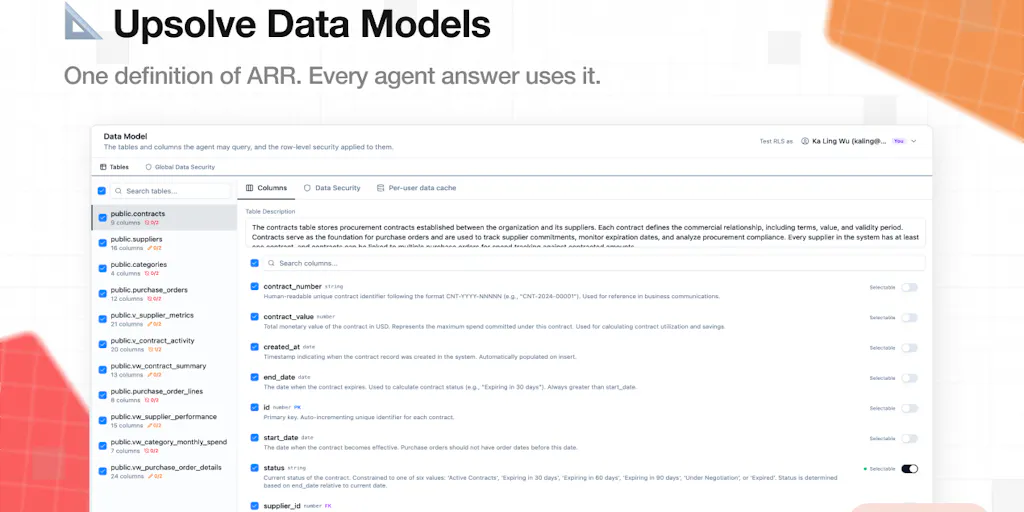
The pitch, in co-founder Ka Ling Wu’s own framing on the launch page: “Every data agent demo looks great. Then in production someone asks for ARR, and the agent picks one of the ten definitions floating around your company.” Their fix is a versioned context layer where you register your tables, fields, keys, and descriptions, so your business vocabulary lives in one governed place rather than in six analysts’ heads and a stale Notion page.
The mechanic that matters most for operators is pre-caching. Columns you mark as selectable get their values pre-cached and refreshed on a schedule, so when a contract status changes — or, in your world, when a shipment clears customs or a return gets dispositioned — the agent already knows without re-querying a live warehouse. That’s a meaningful architectural choice, and it’s the difference between an agent that’s fast and cheap on repeat questions and one that burns warehouse credits every time someone asks the same question twice.
This is day one of what the team describes as a two-week launch series, with the full stack for “data agents that stay accurate in production” shipping daily. The launch page itself shows a public request board — Hypership requests — where users upvote and submit feature requests, with shipping points tied to a leaderboard. The most-upvoted shipped items include custom skills, canvas presentation theming, and including an impact assessment when modifying metric definitions. That last one is the tell: they understand that the hard part of governed metrics isn’t defining them, it’s changing them without breaking every dashboard downstream.
Why this is a seller problem, not just a data-team problem
Here’s where I diverge from the typical Product Hunt comment section. Most of the upvotes on a tool like this come from SaaS product teams — the reviews on the page come from people at Fini and Every, both SaaS companies evaluating buy-versus-build for embedded analytics. That’s the natural audience for Embedded BI and Embedded GenBI, the company’s earlier launches.
But cross-border sellers have a worse version of the same disease. A SaaS company argues about ARR definitions. You argue about:
- Net revenue — before or after marketplace fees, FBA fees, return shipping, and chargebacks?
- ROAS — platform-attributed, blended, or new-customer-only?
- Contribution margin — does it include the 3PL storage bill, the customs duty, the TikTok Shop commission, and the affiliate payout?
- Sell-through rate — by SKU, by variant, by marketplace, or by parent ASIN?
If you’ve ever had a Shopify dashboard, an Amazon Seller Central report, and a spreadsheet from your ops lead all disagree on last month’s revenue, you already understand why a governed vocabulary layer is not a nice-to-have. It’s the precondition for trusting anything an AI agent tells you.
How It Differs From What You’re Probably Already Using
Let me be specific about the comparison set, because “AI data agent” is a crowded category and the differences matter.
Versus Helium 10 or Jungle Scout: These are marketplace-intelligence tools. They tell you what’s happening on Amazon’s side of the wall — keyword rankings, competitor sales estimates, buy-box history. They are not trying to model your business vocabulary, and they shouldn’t. Upsolve is playing a different game entirely: it assumes you already have a warehouse or a set of connected sources and wants to govern the semantic layer on top.
Versus Klvaiyo-style marketing analytics or a Looker / Metabase stack: Traditional BI tools give you dashboards. They don’t give you an agent that answers ad-hoc questions in natural language while respecting a versioned metric definition. The gap Upsolve is targeting is the space between “we have a semantic layer” and “our LLM can use it safely.”
Versus dbt: This is the most interesting comparison, because a commenter on the launch page — Priya K — asked directly whether it integrates with existing dbt setups. Ka Ling’s answer was refreshingly honest: “This is something we could extend to support!” and an invitation to submit it to the Hypership request board. Translation: not today. If your data team has already invested heavily in dbt models and a Snowflake or BigQuery warehouse, you’d be adding a parallel governance layer rather than plugging into the one you have. That’s a real integration tax, and it’s currently an open request (UPSO-001) rather than a shipped feature.
Versus rolling your own with OpenAI function calling: This is what most mid-size sellers actually do. You wire up a GPT wrapper, point it at a few tables, and pray. It works until someone asks a question that touches a contested metric, at which point the agent invents a definition. Upsolve’s bet is that the pre-cached, versioned vocabulary is worth paying for versus building. Given that the “build” path requires you to solve metric governance anyway, the buy case is stronger than it looks.
Why Amazon sellers should care more than Shopify ones
If you’re a pure DTC Shopify brand, your data is annoying but coherent. One order stream, one customer record, one currency (mostly). The governance problem is real but bounded.
If you sell on Amazon, TikTok Shop, Temu, SHEIN, Etsy, and eBay simultaneously, you’re living in a semantic nightmare. Every marketplace has its own definition of “order,” its own fee structure, its own return window, its own payout timing, and its own attribution model. A single SKU can have six different “revenue” numbers depending on which marketplace report you’re reading. This is precisely the environment where a governed vocabulary layer pays for itself fastest — and precisely the environment where the integration work is hardest, because you’re stitching together six APIs with six different schemas.
What Cross-Border Sellers Can Borrow From This
Even if you never touch Upsolve, the launch is a useful mirror. Three things worth stealing:
1. Write down your metric definitions. Today. Not in a wiki nobody reads — in a versioned document with an owner and a change log. The launch page’s most interesting shipped request is the one about including an impact assessment when modifying metric definitions. Steal that discipline. When your ops lead wants to change how you calculate contribution margin, they should have to answer: what dashboards break, what decisions were made on the old number, and who needs to be told.
2. Pre-cache the values that change often. The architectural insight here is genuinely portable. If your agent (or your analyst, or your VA) keeps re-querying the same slow-changing dimension — supplier lead times, customs duty rates, marketplace commission tiers — cache it and refresh on a schedule. The latency and cost savings are real, and more importantly, the answers become consistent.
3. Treat “selectable columns” as a governance decision. Upsolve’s model lets you mark which columns are selectable, which is a quiet way of saying: not everything in the warehouse should be queryable by an agent. For a seller, that means your customer PII table, your supplier cost table, and your margin data probably shouldn’t all be equally accessible to the same agent. Role-based column access is table stakes in enterprise BI; it’s mostly absent in the DIY agent stacks sellers are building.
Where the math breaks
I want to be honest about the failure modes, because the launch page doesn’t dwell on them.
The two-week launch series is a red flag and a green flag. Shipping daily for fourteen days signals momentum and responsiveness — the dbt answer came within hours, and the team offered to “knock it out today” if the request got submitted. But it also means the product is a moving target. If you’re evaluating it for a production deployment, you’re evaluating a snapshot that will be materially different in two weeks. That’s fine for a pilot; it’s risky for a system of record.
Governance is a tax on the people who maintain it. The whole premise is that someone registers tables, fields, keys, and descriptions, then keeps them current. In a SaaS company, that’s a data team’s job. In a cross-border seller with twelve employees, it’s nobody’s job, which means it becomes the founder’s job at 11pm. The tool doesn’t eliminate the governance work; it centralizes it. Whether that’s a net win depends entirely on whether you have someone who will actually do it.
The integration surface is the real cost. No dbt integration today. No mention of native connectors to the marketplaces you actually sell on. If your data lives in Shopify, Amazon Seller Central, and a Google Sheet, you’re doing the ETL work yourself before Upsolve’s context layer even becomes relevant. That’s not a knock on the product — it’s a category-wide reality — but it’s the line item that kills these projects in mid-market sellers.
The pricing isn’t disclosed on the launch page. For a tool whose value proposition is “govern your metrics,” the absence of published pricing makes it hard to run the buy-versus-build math. Worth asking directly before you invest evaluation time.
What I’d Watch / Test Next
This week, before you sign up for anything, do three things. First, pull your last month’s revenue number from Shopify, Amazon Seller Central, and whatever spreadsheet your ops team uses — and write down why they differ. That exercise alone will tell you whether you have a governance problem worth solving. Second, if the answer is yes, submit the dbt integration request to the Hypership request board and watch how fast the team responds; their public answer to Priya K is your best signal on whether they’ll build for your stack. Third, spin up a free trial if one exists (not disclosed) and point it at your messiest data source — not your cleanest one. The demo will look great on clean data. You’re testing whether it survives contact with a Temu payout report and a 3PL invoice in the same query. If it does, you’ve found something worth a real budget conversation. If it doesn’t, you’ve learned that your problem is upstream of any tool, and that’s worth knowing too.