The audit stack is quietly becoming the most underrated line item in a cross-border store’s P&L
Every cross-border operator I know runs the same mental math: ad spend, COGS, freight, payment fees, marketplace commissions, returns. Almost nobody runs the math on diagnostics — the half-dozen point tools that tell you whether your storefront, product pages, and landing pages are actually healthy. That gap is exactly why I paid attention to FreeScan.app, a new site-audit tool from maker Jacob Counsell that bundles SEO, accessibility, security, AI visibility, uptime monitoring, and fix handoff into one workflow. For Amazon FBA brand owners, Shopify DTC operators, and TikTok Shop sellers pushing traffic to off-platform landing pages, this is worth understanding — not because audits are new, but because the handoff finally is.
What FreeScan actually solves, and why the bundling matters
Counsell’s pitch is refreshingly honest: he built it because he was “tired of stitching together an SEO auditor, accessibility checker, security scanner, AI visibility tool, uptime monitor, and task board just to understand whether a website was actually healthy” — a quote pulled straight from his launch post. That’s a familiar pain for anyone running a lean cross-border team. A typical DTC operator’s stack looks like this: Ahrefs or Semrush for SEO, Sitebulb or Screaming Frog for crawling, WAVE or axe for accessibility, Sucuri or Qualys SSL Labs for security headers, UptimeRobot or Better Stack for uptime, and then Notion or Linear to actually assign the fixes. That’s five to seven subscriptions, five to seven logins, and — critically — five to seven different output formats that a developer or an AI coding agent has to reconcile.
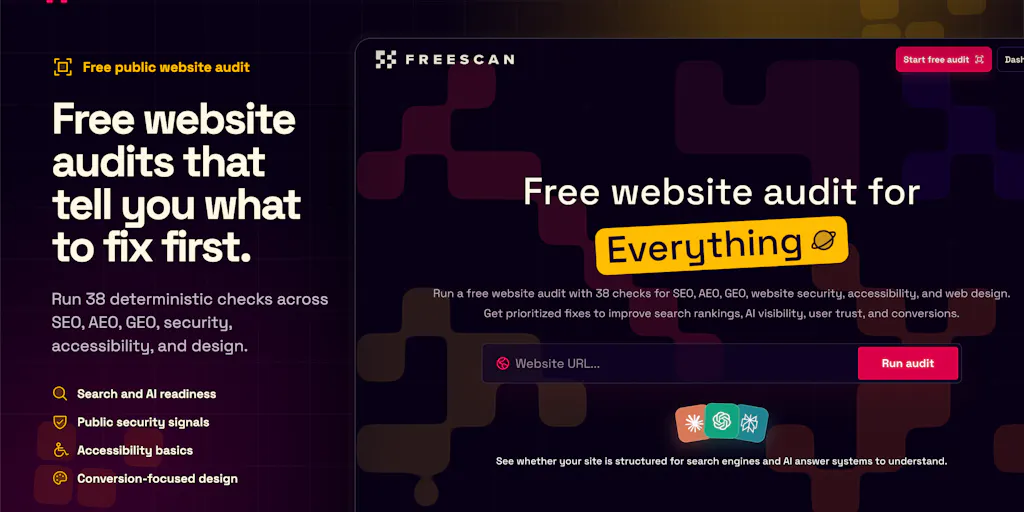
FreeScan’s bet is that the reconciliation is the real product. The free tier audits any public page across SEO, AI visibility, security, accessibility, and design, and every finding ships with evidence, an explanation of why it matters, a recommended fix, and an implementation-ready prompt or Markdown handoff. The Pro tier adds automated site-wide audits, change history, dedicated SEO/AI Visibility/Fixes workspaces, agent-ready artifacts, MCP connectivity for coding agents, uptime monitoring, and weekly reports with downtime alerts — all from one dashboard.
Why the “evidence” line is the actual differentiator
One commenter, Rabnoor Singh, nailed the core value proposition in the thread: “every finding includes evidence is the line that separates this from the category, because the reason nobody acts on audit tools is that a list of 200 findings with no evidence is indistinguishable from noise.” He ran it on his own site and reported an 86 overall score, accessibility as the weak spot at 79, and — the detail that matters — a missing meta description he “had no idea was gone.” The evidence lines, in his words, “did the real work” by naming which of the five security headers he actually had.
That’s the operator’s test, not the SEO’s test. A cross-border seller doesn’t need 200 findings. They need the three that are costing them conversions or indexing, with proof attached, in a format they can hand to whoever maintains the site — an in-house dev, an agency, or increasingly an AI coding agent.
How it stacks up against the incumbents you’re probably already paying for
Let me be direct about where FreeScan sits versus what cross-border sellers actually use today.
Against Ahrefs and Semrush: These are backlink and keyword-intelligence platforms first, site auditors second. If your primary need is competitive research, content gap analysis, or rank tracking across multiple Amazon and Google marketplaces, FreeScan does not replace them — and Counsell doesn’t claim it does. What FreeScan does that Ahrefs’ Site Audit doesn’t is bundle accessibility, security headers, and AI visibility into the same report, and produce an agent-ready handoff. Ahrefs gives you a score and a list. FreeScan gives you a score, a list, evidence, and a prompt.
Against Screaming Frog and Sitebulb: These are desktop crawlers favored by technical SEOs. They’re powerful and cheap, but they’re built for people who already know what they’re looking at. FreeScan’s framing — “why it matters, what to fix first” — is aimed at the operator who doesn’t.
Against WAVE and axe: Accessibility-only tools. Increasingly relevant for cross-border sellers shipping into the EU, where the European Accessibility Act compliance deadlines are tightening. FreeScan folds this into the same audit rather than treating it as a separate project.
Against UptimeRobot and Better Stack: Pure uptime monitoring. FreeScan’s Pro tier includes uptime monitoring and downtime alerts, but I’d treat this as a convenience feature rather than a reason to migrate. Uptime monitoring is a commodity; the audit-to-fix pipeline is not.
Why Amazon sellers should care more than Shopify ones
Here’s a counterintuitive take: if you’re a pure Amazon FBA seller with no off-platform web presence, FreeScan is close to irrelevant. Your “site” is a Seller Central listing, and third-party auditors can’t touch it. But the moment you do any of the following, it becomes relevant fast:
- Run a Shopify DTC store as a brand-defense or margin-expansion channel alongside Amazon
- Push TikTok Shop or Temu traffic to a branded landing page for email capture via Klaviyo or Attentive
- Operate a SHEIN or Etsy storefront with an external link-in-bio or brand site
- Run affiliate or influencer landing pages that need to convert on mobile in multiple locales
In all four cases, the landing page is the conversion event, and a missing meta description, a broken security header, or an accessibility failure on a checkout flow is a direct revenue leak. Amazon sellers who’ve spent years optimizing listing images and A+ content often ship genuinely bad brand sites, because nobody on the team owns web health. That’s the gap FreeScan targets.
Why Shopify operators should care about the MCP angle specifically
This is the part I find genuinely interesting. When Muhammad Ahmed asked whether the MCP integration allows automatic application of fixes or just notifies a developer, Counsell’s answer was unambiguous: “the audit pages are fully readable by agents, via the MCP the agent can pull prompts, markdown files, and actually fix everything. With a Pro account your agent can operate all of the workspaces including the Fixes workspace and pull and fix everything their site-wide / update the workspace and re-audit pages. Your agent can drive everything.”
Read that again. The audit tool is no longer a report — it’s an API surface for an autonomous agent. For a Shopify operator running Claude Code, Cursor, or GitHub Copilot Workspace, that changes the economics of site maintenance. Instead of a quarterly audit-and-ticket cycle, you get a weekly loop where the agent pulls findings, applies fixes to theme code or app config, and triggers a re-audit. That’s the workflow shift worth watching, and it’s why I think the MCP integration is a bigger deal than the free scan itself.
What cross-border sellers can actually borrow from this launch
Three transferable lessons, regardless of whether you adopt FreeScan:
1. Bundle the diagnostics, not just the data. Most cross-border operators I audit run 8–15 SaaS tools, and the overlap is brutal. The winning move in 2025 isn’t another best-in-class point tool — it’s a workflow that collapses five of them into one output. Apply this test to your own stack: how many tools produce a report that nobody on your team reads? That’s your consolidation opportunity.
2. Ship evidence with every recommendation. The reason audit tools get ignored is that they produce findings without proof. If you run an internal QA process for product pages, ad creatives, or email flows, the same rule applies: a finding without a screenshot, a metric, or a reproduction step is noise. Counsell’s insistence on evidence lines is the single most copyable idea in this launch.
3. Design for agent consumption, not human reading. Whether or not you use MCP, the principle holds: your internal reports should be structured so an AI agent can act on them. Markdown handoffs, structured JSON, explicit fix instructions. The operators who win the next 18 months will be the ones whose tooling outputs are machine-actionable, not PDF-decorated.
Where the math breaks
I want to be honest about the limits. First, the free tier audits one URL at a time — Counsell clarified this himself in the thread: “the free audits are only for the link you’re scanning, you can audit multiple links from your website but to truly audit your entire website you should check out the Pro tier.” So the free tier is a taste, not a workflow. Second, pricing for Pro is not disclosed in the source material, which matters because the incumbent comparison depends entirely on whether Pro undercuts the cost of running Ahrefs + WAVE + UptimeRobot + a task board. If Pro lands above $99/month, the bundling argument weakens considerably for small sellers.
Third — and this is my own read, not a sourced claim — the AI visibility category is still mushy. Nobody has a clean, defensible definition of what “AI visibility” means for a cross-border store, and different tools measure it differently. Treat any AI visibility score as directional, not diagnostic.
What I’d watch / test next
Here’s what I’d actually do this week if I ran a cross-border store doing $50K–$500K/month:
- Run the free scan on your three highest-traffic landing pages — not your homepage. Homepages get attention; money pages don’t. Compare what FreeScan flags against what PageSpeed Insights and WAVE flag, and note where the evidence lines change your prioritization.
- Pull your current audit-tool spend into one spreadsheet. Add up Ahrefs/Semrush + accessibility + uptime + task board. If the total exceeds what Pro would cost (once pricing is disclosed), you have a real consolidation case. If not, you have a benchmark.
- Test the MCP handoff on a staging site first. Do not let an agent push fixes to production until you’ve watched it handle three audit cycles on a clone. The “agent can drive everything” claim is exciting and also exactly the kind of claim that needs a sandbox before it touches your checkout flow.
- Watch the changelog, not the launch. Counsell explicitly said he’s “going to be adding a lot of new criteria and scans moving forward while also enhancing the evidence we pull through.” For a tool this young, the roadmap velocity matters more than the launch-day feature list.
- Ask the harder question: does your team actually have a remediation loop, or just an audit habit? FreeScan solves the audit side. If nobody owns the fix, no tool will save you.
The cross-border operators who win the next cycle won’t be the ones with the most tools. They’ll be the ones whose tools talk to each other, produce evidence, and hand work to agents without a human translator in the middle. FreeScan is an early, imperfect bet on that future — and worth a scan on your own site before you decide whether to bet on it too.