Why a Node.js Environment Tool Matters to a Seller Who Has Never Opened a Terminal
If you run a cross-border e-commerce operation, your entire business is a chain of fragile, invisible dependencies. Your Shopify storefront depends on a payment gateway, which depends on a webhook, which depends on a serverless function that reads a secret key from an environment variable. Your Amazon FBA inventory sync tool stops working because someone rotated an API key and forgot to update the staging environment. Your TikTok Shop integration silently fails at 3 AM because a .env file on a production server is missing a variable that your developer added to the repository last week.
This is the mundane, unglamorous hell of modern e-commerce operations. And it is precisely why I spent an hour this week digging into envfix, a tiny open-source tool launched by Gokhan Ozgezer on Product Hunt. On the surface, it is a developer utility for Node.js projects — something your engineering team might use, not something you would ever touch. But for anyone running a DTC brand or an Amazon FBA operation with even a single custom integration, this tool represents a category of problem that costs you real money every quarter: the silent, invisible configuration drift that breaks your stack at the worst possible moment.
The cross-border seller’s edge is speed — launching new storefronts, spinning up new marketplaces, testing new ad channels. That speed is almost always killed by environment configuration friction. You want to launch a new landing page for a Q4 campaign, but your developer is stuck debugging why the production build can’t read a database connection string. You want to add a new payment method, but the sandbox environment is missing a variable that exists only in your developer’s local setup. This is the friction that envfix targets, and understanding it — even if you never run the command yourself — makes you a better operator.
The Problem: Configuration Drift Is the Silent Killer of Cross-Border Launches
Let me paint a scenario that every cross-border operator has lived through. You are running a Shopify store for your US market and a separate Amazon Seller Central account for your FBA business. You hire a freelance developer to build a custom inventory sync between the two platforms. The developer builds the integration on their local machine, where everything works perfectly. They push the code to your staging server, and suddenly the integration fails. The error message says something cryptic about “missing environment variable.”
What happened? The developer had a .env file on their local machine with the correct API keys for your Amazon MWS credentials. But when they pushed the code to staging, they didn’t push the .env file — because that file should never be committed to Git for security reasons. Instead, they expected you to create a new .env file on the staging server with the correct values. They did this manually, but they missed one variable. Or they copied an old .env.example file that was missing a newly added variable. Or they accidentally had a duplicate variable where the production value overrode the staging one.
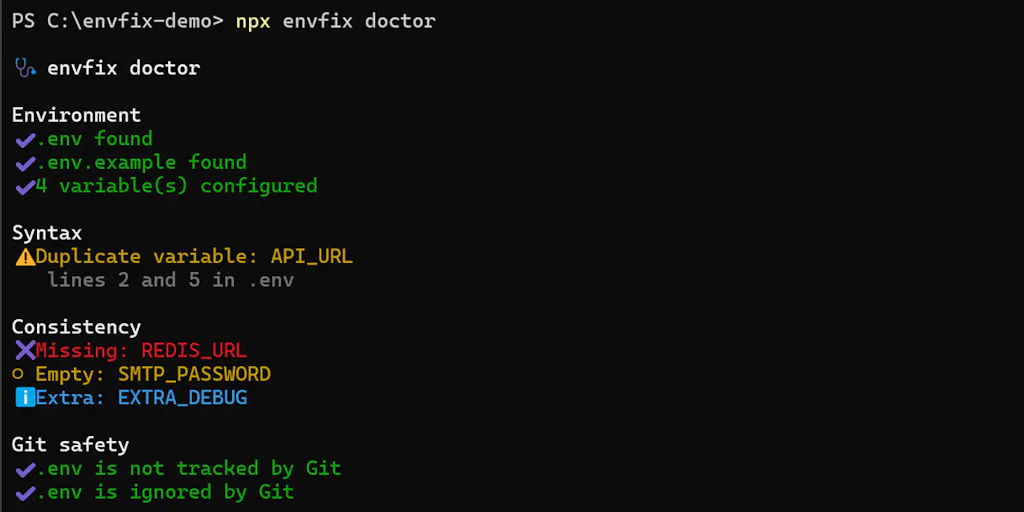
This is the exact problem envfix solves. The maker describes it as a “small environment configuration doctor for Node.js projects” that can detect missing, empty, extra, and duplicate variables, catch malformed environment declarations, check whether .env is safely ignored and untracked by Git, safely fix missing configuration, generate and sync .env.example files, and work in CI with JSON output and GitHub Actions annotations.
For a cross-border seller, the value here is not in the tool itself — it is in the discipline it enforces. Every time your development team adds a new API key for a new marketplace integration, that key needs to be documented in a .env.example file. Every time someone rotates a credential, the .env files across your staging and production environments need to be updated in sync. envfix automates the checking of this process, so that when your developer says “it works on my machine,” you have a tool that can verify whether the production environment actually matches.
The deeper issue is that most cross-border sellers do not treat their integrations as a system. They treat each integration — the Amazon-to-Shopify sync, the TikTok Shop feed, the Klaviyo email automation — as a one-off project. When the integration breaks, they call the developer, pay an hourly rate to fix it, and move on. They never invest in the tooling that would prevent the breakage in the first place. envfix is a $0 investment that prevents a $200-per-hour debugging session.
How envfix Differs from the Existing Options
If you are a developer reading this, you might be thinking: “I already have tools for this. I use dotenv, I have a pre-commit hook, I have a CI pipeline that checks for missing variables.” And you are right — there are existing solutions. But here is where envfix earns its place in the conversation.
The first comparison is with the dotenv npm package, which is the standard way Node.js applications load environment variables. dotenv does one thing well: it reads a .env file and loads the values into process.env. But it does not check whether your .env file is complete. It does not tell you that you are missing a variable that your config.js file expects. It does not tell you that you have a duplicate key where the last value silently overrides the first. It is a loader, not a doctor.
The second comparison is with CI-based validation tools. Many teams use a step in their GitHub Actions workflow that runs a script to compare .env.example against the actual .env file. But these scripts are usually hand-rolled and brittle. They break when someone adds a comment to the .env.example file, or when a variable is intentionally left empty for local development but required in production. envfix is deliberately conservative — it “won’t overwrite existing non-empty values or print environment values into logs” — which means it is safe to run in CI without risking data leakage.
The third comparison is with commercial secrets-management tools like Vault or cloud-native solutions like AWS Secrets Manager. These tools are powerful, but they are overkill for a small cross-border operation. They require infrastructure, IAM roles, and a learning curve. envfix is a zero-dependency CLI tool that you can run with npx envfix without installing anything. That is a significant advantage for a freelancer or a small team that does not have a dedicated DevOps person.
The key differentiator is the Git safety check. envfix can check “whether .env is safely ignored and untracked by Git.” This is a huge deal for cross-border sellers because the most common security breach in small e-commerce operations is accidentally committing a .env file to a public repository. I have seen this happen with a seller who pushed their Shopify store theme to a public GitHub repo and accidentally included their Stripe secret keys. The damage was not immediate — the keys were rotated before any fraudulent charges — but the panic was real. envfix adds a guardrail that catches this before it becomes a headline.
Why Amazon Sellers Should Care More Than Shopify Ones
If you are running a pure Shopify store with no custom integrations, you can probably skip this tool. Shopify handles all the environment configuration for you — you log in to the admin panel, you enter your API keys in the settings page, and the platform manages the rest. But if you are an Amazon FBA seller with any custom tooling — a repricing tool, a review-generation bot, an inventory sync to your ERP — you are dealing with a mess of credentials.
Amazon’s SP-API (Selling Partner API) requires a complex authentication flow involving LWA (Login with Amazon) tokens, refresh tokens, and role ARNs. These credentials are typically stored in environment variables because they are too sensitive to hardcode. When Amazon rotates a token or you create a new marketplace app, you need to update these variables across every environment. If you miss one, your integration fails silently — no error page, no notification, just a broken sync that you discover when a customer complains about a delayed shipment.
The math is brutal. A single missed environment variable can take down your entire Amazon integration. The debugging time is typically 2–4 hours because the error message is generic. At a developer rate of $100–$150 per hour, that is $200–$600 per incident. If this happens once a quarter — which is realistic given how often Amazon changes its API requirements — that is $800–$2,400 per year in pure debugging waste. envfix costs nothing and can catch the problem in seconds.
What Cross-Border Sellers Can Borrow from This Tool
You might be thinking: “I am not a developer. I cannot use npx envfix. Why should I care?” The answer is that envfix is a symptom of a larger operational philosophy that you should adopt even if you never touch the tool yourself.
The philosophy is this: document your configuration, and verify it automatically. Every integration in your e-commerce stack has a set of credentials, endpoints, and settings that make it work. Most sellers keep this information in their heads or in a shared Google Doc that is always out of date. When something breaks, the first question is always “what changed?” and the answer is almost always “I don’t know.”
You can borrow the envfix discipline without using the tool. Create a “configuration manifest” for your e-commerce stack — a single document that lists every integration, every API key, every webhook URL, and every environment where it is used. When you add a new integration (say, a new TikTok Shop feed), add it to the manifest. When you rotate a credential, update the manifest. This is the human version of what envfix does for Node.js projects.
The second thing you can borrow is the idea of a “dry run” or “safe fix” mode. envfix is deliberately conservative — it will not overwrite existing non-empty values. This is a lesson for your own operations. When you make changes to your e-commerce stack, do not do it in “force mode.” Test the change in a staging environment first. Verify that the new API key works before you delete the old one. Have a rollback plan. The most expensive mistakes in cross-border e-commerce are the ones that happen because someone made a change without a safety net.
The third thing to borrow is the CI integration mindset. envfix can run in CI with JSON output and GitHub Actions annotations. This means that every time your development team pushes code, the tool automatically checks whether the environment configuration is valid. You can adopt the same mindset with your own processes. Set up a weekly automated check of your integrations — a script that pings your Amazon SP-API endpoint, a test that verifies your Shopify webhook is receiving events, a scheduled task that checks your Klaviyo list sync. The goal is to catch problems before they become customer-facing incidents.
Where the Math Breaks: The Limits of envfix
I want to be honest about the limitations of envfix, because every tool has them and pretending otherwise is how you get burned.
First, envfix is Node.js-specific. If your e-commerce stack is built on Python, Ruby, or Go, this tool does not apply directly. You can still use the philosophy, but you will need to find an equivalent tool for your language ecosystem. The maker is clear that this is a “small open-source developer tool” — it is not a platform, and it does not aim to be one.
Second, envfix can only check what it can see. It checks the .env file against the .env.example file, but it cannot know whether the values in the .env file are correct. A variable can be present but contain a stale API key that has been rotated. envfix will not catch that. It checks structure, not validity. This is a significant limitation for cross-border sellers because the most common failure mode in our industry is not a missing variable — it is a variable with an outdated value.
Third, the tool does not handle the “human problem” of environment configuration. Even with envfix, you still need a process for who updates the .env file when a credential changes. The tool can tell you that a variable is missing, but it cannot tell you who is responsible for providing the correct value. In a small team, this is often the source of the problem — everyone assumes someone else will update the staging environment.
Fourth, the maker is currently “focusing on building small open-source developer tools” — which means this is a hobby project, not a commercial product with a support team. If you adopt envfix and it breaks, you are on your own. There is no SLA, no roadmap, no enterprise support. For a serious e-commerce operation, this is a real consideration. You can use the tool, but you should not build your entire workflow around it.
Finally, there is the adoption problem. envfix works only if your development team actually uses it. If your team is resistant to new tools — or if you are working with freelancers who each have their own workflow — getting them to run npx envfix before every commit is an uphill battle. The tool is useful, but it is only as useful as the discipline of the people using it.
Where the Math Breaks: The Cost-Benefit for Solo Sellers
If you are a solo seller running a single Shopify store with no custom code, the math does not work in favor of adopting envfix. You have no .env files, no Node.js projects, no CI pipeline. The tool is irrelevant to you. The cost of learning it outweighs the benefit.
But if you are a solo seller who has hired a developer to build even one custom integration — a landing page with a special offer, a custom checkout flow, a scraper for competitor pricing — then you are indirectly affected by the environment configuration problem. Your developer is likely using .env files, and the “it works on my machine” problem is real. You do not need to learn envfix yourself, but you should ask your developer: “Do you have a tool that checks your environment configuration before you deploy?” If they say no, you have found a source of future pain.
The math changes again if you are running a team of 2–5 developers. At that scale, the probability of configuration drift increases exponentially with the number of environments and integrations. A $0 tool that prevents a single $500 debugging session per quarter is a net positive. And the CI integration means you can enforce the check without relying on developer discipline — the pipeline fails the build if the environment is misconfigured.
What I’d Watch / Test Next
If you are a cross-border seller who wants to act on this without becoming a developer, here is what I would do this week.
First, audit your own stack. Make a list of every integration you run — Amazon SP-API, Shopify Admin API, TikTok Shop Partner API, Etsy API, eBay API, payment gateways, email marketing platforms. For each integration, write down the credentials you use and where they are stored. If you cannot find a credential in under five minutes, you have a configuration problem.
Second, talk to your developer (or your development team) about environment configuration. Ask them how they manage .env files. Ask them whether they have a tool that checks for missing variables before deployment. Ask them whether they have ever accidentally committed a .env file to Git. The answers will tell you a lot about your operational risk. If they do not have a tool, point them to envfix and let them decide if it fits their workflow.
Third, set up a “configuration review” as a recurring calendar item — once a month, spend 15 minutes checking whether your integrations are still working. Ping the APIs, verify the webhooks, check the logs. This is the human equivalent of running envfix in CI. It will not catch everything, but it will catch the most expensive problems before they become customer-facing incidents.
Fourth, if you have a development team, ask them to add envfix (or an equivalent tool) to their CI pipeline. The maker explicitly supports “JSON output and GitHub Actions annotations,” which means the tool is designed to fail the build in a way that is visible to the developer. This turns a silent configuration problem into a loud, actionable error. That is the single highest-leverage change you can make.
Finally, watch the project. The maker is building “small open-source developer tools that remove everyday friction.” If envfix proves useful, he will likely build more tools in the same category. For a cross-border operator, the long-term value is not in any single tool — it is in the mindset of reducing friction in the invisible parts of your stack. The tools that win in e-commerce are not the flashy ones; they are the ones that prevent the 3 AM panic when an integration fails and you have no idea why. envfix is a small step in that direction, and it is worth your attention.