Why a Pre-Publish Video Engagement Predictor Might Save Your Ad Budget
Every cross-border seller I know has a graveyard of video ads that looked great in the edit suite and died on the algorithm. You spend $1,500 on a product demo, push it to TikTok Shop, Amazon Sponsored Brands, or a Shopify storefront — and three days later you’re staring at a 12% completion rate and a CPA that would make your accountant weep. The problem isn’t production quality; it’s that you made creative decisions in a vacuum. You don’t know where attention slips until the data comes back from the platform, and by then the budget is spent.
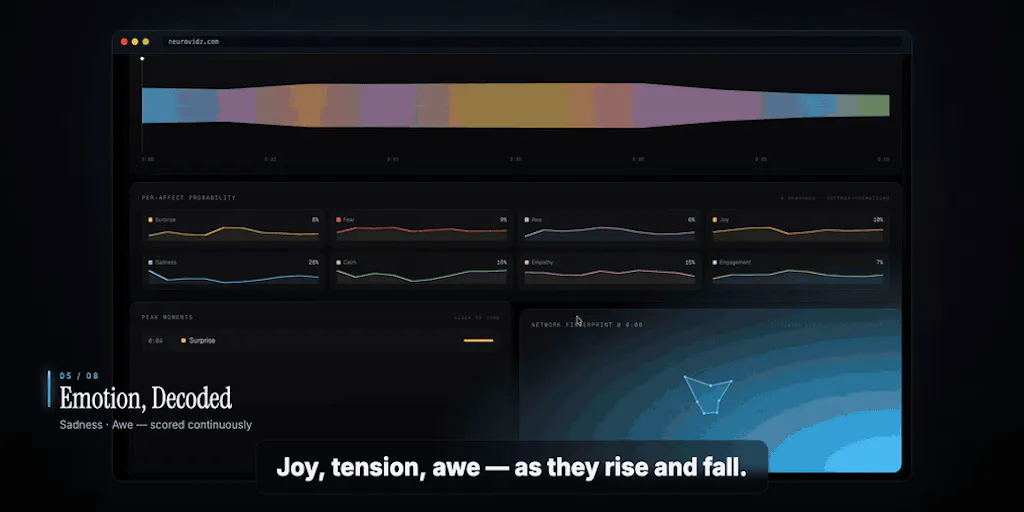
That’s why a tool that claims to predict engagement before you publish — by modeling how a brain reacts to motion, cuts, faces, and audio — should make every e-commerce operator sit up. NeuroVidz is a new AI analyzer that distills each second of a clip into perceptual signals and maps them onto a seven-network cortical model. It returns an engagement score, a second-by-second emotion timeline, and timestamped edit suggestions. No, it’s not validated against real retention curves yet — the makers are refreshingly honest about that — but the concept of a pre-hoc, stimulus-driven attention diagnostic is exactly what sellers need to de-risk video production at scale.
What Problem This Actually Solves (and Why It’s Not Just Another Fancy Dashboard)
The core pain for cross-border operators is that video analytics are always post-hoc. TikTok Shop’s insights tell you drop-off points after 10,000 impressions. Amazon Seller Central’s Brand Analytics shows you your video’s click-through rate after a week. By then you’ve already paid for the media, and creative changes require a new round of spend. NeuroVidz flips that timeline: it analyzes the raw file — before a single human eye sees it — and gives you a relative signal about where attention might wane.
What makes it different from, say, VidIQ or TubeBuddy is the auditory layer. Most tools look at frames: motion, faces, cuts. NeuroVidz also listens — to music, pauses, speech delivery. The maker explains that it measures 25–30 properties of picture and sound per second, including “sound energy, onsets, speech vs silence,” and maps those onto published neuroimaging weights for attention systems, face/voice selectivity, and task-positive vs default-mode dynamics. For a seller running a podcast-style ad or a voiceover-heavy product hook, that audio sensitivity is the difference between catching a lull and missing it.
The second differentiator is honesty: when the signal is too weak for a confident read, the tool returns “no clear read” and refunds the credit automatically. That’s rare in the AI world, where most models force a number even when the input is garbage. For a seller testing a low-light product shot or a clip with no faces — think a jewelry detail reel or a drone flyover of a warehouse — this abstention is better than a misleading score.
Why Amazon Sellers Should Care More Than Shopify Ones
If you’re an Amazon FBA brand owner, video is still underutilized — and the cost of a bad video is higher. Amazon’s algorithm rewards high conversion rates quickly. A poor video in a Sponsored Brands ad can tank your campaign before you’ve even optimized the listing. Shopify sellers, by contrast, can run cheap Meta or TikTok traffic tests with small budgets and iterate fast. On Amazon, the feedback loop is slower and the media spend often larger because you’re bidding on high-intent keywords. A pre-publish diagnostic that flags attention dips in your product demo can save weeks of wasted ad spend.
Shopify operators should care too, but for different reasons: they have more flexibility to A/B test variations. NeuroVidz becomes a rapid iteration tool — drop in two versions, compare the emotion timelines (if they add the side-by-side feature the community is asking for), and pick the one with fewer attention drops before you ever launch an ad set. The refund-on-ambiguity policy is especially valuable when you’re testing assets for different regional markets — a clip that works for US viewers might not “read” well for a German audience, and the tool will tell you it can’t grade it rather than giving a false positive.
How It Differs from Existing Options (and Where the Gaps Are)
The incumbents in the video optimization space fall into two camps: platform-native analytics and content intelligence tools. Platform analytics — TikTok Shop Insights, Amazon Brand Analytics, YouTube Studio — are all post-hoc and aggregated. They tell you what happened, not why. Content intelligence tools like Tubular Labs or Conviva are designed for enterprise media companies, not individual sellers. They’re expensive, require data-sharing agreements, and often ignore audio.
NeuroVidz sits in a new niche: a forward model that doesn’t require any audience data. It’s not fitted to real retention curves — as the frank exchange with commenter Gal Dayan reveals. The weights come from published neuroimaging studies, not from millions of actual viewers. That means the engagement score is internally consistent but externally unvalidated — a risk the makers acknowledge. They explicitly say “it doesn’t predict retention” and invite users to run their own clips with known drop-offs to test correlation.
This is simultaneously the tool’s biggest promise and its biggest limitation. For a seller, it means you can’t blindly trust the absolute score. But you can use it to compare two cuts of the same product video. If version A scores 72 and version B scores 81, and the emotion timeline shows a dip in A at the exact second where you know viewers tend to bounce, that relative signal is actionable — even if the absolute numbers are unvalidated.
Where the Math Breaks (and Why You Should Still Test)
The tool is stimulus-driven, not viewer-specific. That means it doesn’t account for cultural context, platform algorithms, or buying intent. A clip that scores high on attention might still underperform on Amazon if it fails to trigger purchase intent — NeuroVidz can’t measure that. Similarly, a fast-cut, high-motion video might score well on the attention model but alienate a TikTok audience that expects slower, more authentic storytelling.
The maker warns that the model degrades when input lacks usable signals: “no faces, very dark footage, no usable audio.” If your product is a cleaning tool that you shoot in a dimly lit kitchen with no dialogue, the tool will abstain. That’s fine — but it means the tool is best suited for face-driven, voice-driven, or music-driven ads — exactly the kind of content most DTC brands are already making for TikTok and Instagram Reels.
Another blind spot: the model doesn’t know your audience demographics. A clip that holds attention in the US might not hold it in the UK or Japan because of pacing preferences, humor, or cultural cues. For cross-border sellers, this is a serious limitation. You can’t use NeuroVidz to decide whether a joke will land in Brazil. But you can use it to ensure your intro hook is tight, your transitions are clean, and your audio doesn’t have dead spots — universal principles that apply across markets.
What Cross-Border Sellers Can Borrow from This Tool (Right Now)
Despite the caveats, I see a concrete workflow that any seller can start using this week:
Upload your best-performing and worst-performing existing videos. Run them through NeuroVidz and see if the attention dips correlate with your known retention data. The falsification approach the makers advocate is exactly right: “one clip at a time.” If you find that the tool’s attention dips align with the actual drop-offs in your TikTok Shop analytics, you’ve validated the signal for your specific content type.
Use it to A/B test two cuts before spending a dime. Let’s say you have a 30-second product demo. You’re debating whether to lead with the before/after or open with a testimonial. Render both, upload them, compare the emotion timelines. The tool may show a sustained attention peak in one cut and a sharp dip in the other. Pick the one with the better profile and run it as your ad. Even if the absolute scores are unvalidated, the relative difference is a useful heuristic.
Iterate on audio. Most sellers focus on visuals and neglect sound. NeuroVidz’s attention to silence, music, and delivery can help you tighten voiceover pacing. If the tool flags a pause as a “dead air” moment (or as a salience-building beat, depending on context), you can experiment with shortening or extending it. For podcast-style ads or narrated product walkthroughs, this is gold.
Build a falsification log. As the community discussion highlights, the makers maintain a log of documented misses. You can do the same. Keep a spreadsheet of clip scores vs. actual retention data (from TikTok, Amazon, YouTube). Over 20–30 clips, patterns will emerge. You’ll learn whether the tool overestimates attention on high-motion clips, underestimates on low-motion demos, or hits a reliable correlation for your brand’s specific audio-visual style.
The Side-by-Side Feature That Would Change Everything
The most requested feature from the Product Hunt community is a side-by-side comparison — drop in two edits and see how the emotion timeline and score shift. The makers confirmed it’s high on the post-launch list and noted that the plumbing already exists: re-running an unchanged file is free, so the baseline side costs nothing once they build the UI. If you’re testing multiple variations — say, five thumbnails with different hooks — that compare view is exactly what you need to turn NeuroVidz from a curiosity into a daily workflow tool.
Until they ship it, you can approximate by running version A, exporting the timeline screenshot, then running version B and overlaying manually. Not ideal, but workable for a small batch of tests.
My Judgment: Directional Signal, Not a Verdict
I would not base a $10,000 media buy on NeuroVidz’s score alone. The lack of validation against real retention curves — as Gal Dayan correctly pointed out — means the tool could be “confidently wrong” in ways the refund policy doesn’t address. The makers’ honesty about this gap is refreshing, but it doesn’t close the gap.
What I would do is integrate it into a creative iteration loop: rough cut → NeuroVidz → adjust → final cut → launch → compare platform analytics → feed back into the model. Over time, that loop builds a bespoke validation dataset for your brand. For a seller running 20 video variants per month — typical for a mid-size DTC brand on TikTok Shop — the tool pays for itself in editing hours saved even if the correlation is imperfect.
The price is not disclosed beyond the free tier (20 credits for most, 40 for the first 50 founders, no card required). If the paid plan is reasonable — say, $20–50/month for 100 credits — it’s a no-brainer experiment. If it’s closer to $200, the ROI math depends on your video spend.
What I’d Watch / Test Next
Here are four concrete steps you can take this week:
Upload three clips with known retention curves — one high-performer, one medium, one low. Compare the NeuroVidz attention timeline to your actual drop-off points. If the tool catches the same dips, you have a working hypothesis. If it misses entirely, you know the model isn’t useful for your content type.
Run a two-version test on your next product demo. Render a version with a fast intro and one with a slower hook. Upload both. See which gets a higher relative engagement score. Run the winner as your ad. Track real retention. Report back to the makers — they’re actively seeking falsification logs to improve the model.
Watch for the side-by-side comparison feature. If it ships in the next 30 days, that’s the moment NeuroVidz becomes a staple for any seller who does in-house video. Follow the product on Product Hunt or sign up for their updates.
Build a one-page creative testing template. For each clip, log: NeuroVidz engagement score, top three attention dip timestamps, your own notes on audio/visual quality, and the eventual platform metrics (completion rate, CTR, CPA). After 20 clips, you’ll have a proprietary validation set that tells you whether the tool’s signal is worth trusting for your market.
Cross-border e-commerce is a game of margins. Saving 10% of your video production budget by catching bad edits before they hit the ad server is real money. NeuroVidz isn’t the final answer — but it’s a smart step toward a world where creative risk is measured in credit units, not ad dollars.