The Context Tax Is Eating Your Margin — And It’s Not Just a Dev Problem
Every cross-border operator I know is running the same quiet experiment in 2025: how many AI tools can we bolt onto the stack before the seams start showing? A listing optimizer here, a support chatbot there, a translation layer, a creative generator, a forecasting model. Each one works in isolation. None of them remember what the last one learned. The result is a team that re-explains its brand voice, its SKU taxonomy, and its returns policy to a different model every single morning — and pays per token for the privilege. That’s the context tax, and it’s the same disease Dropstone is trying to treat on the developer side. Watching how they frame the cure tells us something uncomfortable about where e-commerce tooling is heading.
What Dropstone Is Actually Selling
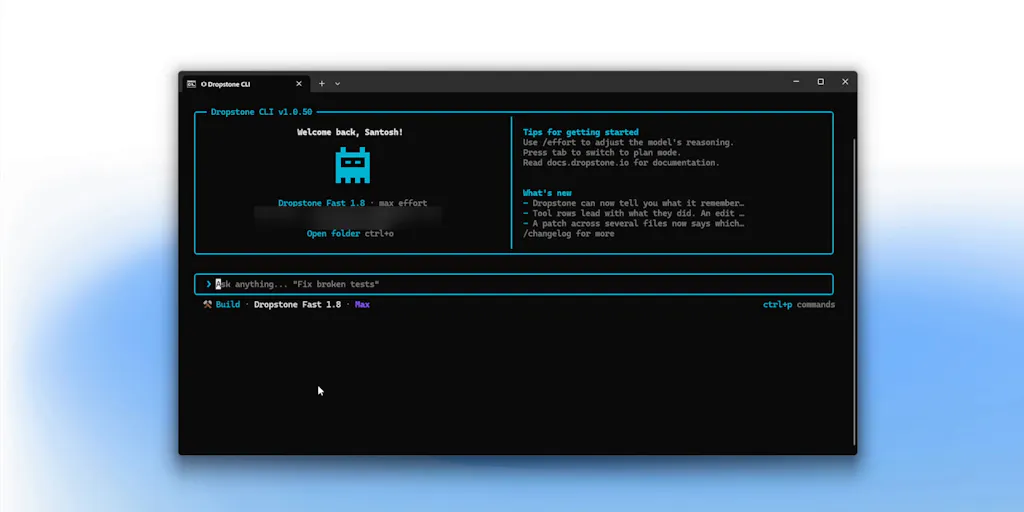
Strip away the launch-day language and Dropstone is a bet on two things: persistent memory and runtime intelligence. The maker, Santosh Arron, describes the origin as a personal frustration — context gets lost between tools, workflows, and projects, and using AI at scale gets expensive. Their answer is an “intelligence layer” that spans Chat, CLI, VS Code, and SDK, so an agent operating in your terminal understands your codebase and builds on prior context instead of starting cold.
The pricing is the tell. You can start free, plans run from $5 to $150, and enterprise deployment is a conversation. That’s not a land-grab number. That’s a utility number — the kind of pricing you set when you believe the value is in being the plumbing everyone forgets about.
Why this is a developer story that e-commerce should read
On its face, none of this touches Shopify, Amazon, or TikTok Shop. Dropstone is for people who write code. But the architecture they’re describing — one memory layer sitting underneath many tools — is precisely the architecture every serious seller will need within eighteen months. Right now your Shopify admin, your Amazon Seller Central dashboard, your Klaviyo flows, and your Helium 10 research all hold fragments of the same truth about your customer. None of them talk. You are the integration layer, and you are expensive and tired.
The Real Problem: Every Tool Starts as a Stranger
Here’s the concrete failure mode. You onboard a new VA in Manila. You spend two weeks teaching them your return-rate thresholds, your ad-spend guardrails, your banned-claims list for supplements. They get good. Then you migrate from one PPC tool to another, and the new tool has no idea any of that happened. You re-teach. The knowledge lives in a Slack channel and a Google Doc nobody opens.
Dropstone’s pitch — “correct it once and it keeps the lesson across sessions” — is the comment that got traction on the launch thread, and it’s the right thing to fixate on. The commenter, Amrani Yasser, frames it as the difference between a teammate and “a fresh intern every morning.” That’s not a developer-specific pain. That’s the exact pain of running a lean DTC team across time zones.
Where the incumbents fall short
Compare the existing landscape honestly. Jasper and Copy.ai are strong at generation but weak at institutional memory — they don’t know your last quarter’s winning angle unless you paste it in. Zapier and Make connect tools but don’t reason across them; they move data, they don’t retain judgment. Gorgias holds support history but doesn’t feed your ad creative. The gap Dropstone names — context lost between tools — is real and unaddressed in e-commerce, which is why I think the pattern matters more than the product.
What Cross-Border Sellers Should Borrow From This
You don’t need to install a CLI to steal the lesson. You need to steal the architecture.
Build a memory layer before you buy another SaaS
Before your next tool subscription, ask a blunt question: does this tool get smarter because of what my other tools already know, or does it start from zero? If it starts from zero, you’re paying twice — once in dollars, once in the human hours of re-onboarding. The operators winning right now are the ones maintaining a single source of truth — a brand brain, a SKU ontology, a claims library — and forcing every new tool to read from it. Dropstone’s persistent-memory bet is the developer version of that discipline.
Treat cost predictability as a feature, not a footnote
The maker explicitly frames the tradeoff as “more from your AI tools without paying more than they need to,” and puts a ceiling on pricing — $5 to $150, with enterprise as an exception. That’s a rebuke of the usage-based spiral that has burned so many sellers. If you’ve ever opened a monthly AI bill and felt your stomach drop because a chatbot ran wild on a Black Friday traffic spike, you understand why flat-ish pricing is a feature. When you evaluate the next tool, model the worst-case month, not the average one.
Why Amazon sellers should care more than Shopify ones
Shopify operators control their storefront, their data, and their customer relationship — they can afford to be picky about integrations. Amazon sellers live inside someone else’s house. Your listing data, your ad data, and your customer messages are scattered across Seller Central, Amazon Advertising, and whatever third-party tool you’ve bolted on. The context tax is higher because the walls between those systems are higher. Any tool that promises to sit underneath and remember across all of them is worth more to an FBA brand than to a DTC one — which is exactly why I’d expect the e-commerce adaptation of this pattern to arrive on the Amazon side first.
Where My Judgment Says This Falls Short
I’ll be direct about the gaps, because launch posts never are.
The translation problem is unaddressed. Dropstone is built for developers who write code in one language. Cross-border sellers operate in six languages, three currencies, and a dozen regulatory regimes. A memory layer that doesn’t handle multilingual nuance — a claim that’s compliant in the US and illegal in the EU — is a liability, not an asset. Nothing in the source suggests they’ve thought about this.
“Intelligence layer” is doing a lot of unexamined work. The pitch promises runtime intelligence and persistent memory, but the launch copy is thin on how memory is scoped, versioned, or corrected when it’s wrong. For a developer, a bad memory is a bug. For a seller, a bad memory is a banned listing. The stakes are asymmetric and the source doesn’t engage with that.
The pricing ceiling may not hold. $5 to $150 is attractive today. But “enterprise deployment for larger teams” is the escape hatch every usage-priced tool uses to eventually reprice you. I’d want contractual caps, not just a launch-day range.
Where the math breaks
Run the numbers on a mid-size seller: two VAs, one PPC specialist, one creative lead, all re-briefing AI tools daily. Even at a conservative hour a day of pure re-contextualization across the team, you’re looking at meaningful labor cost. A $150/month tool that eliminates half of it pays for itself instantly. But that math only works if the tool actually retains context reliably — and reliability is the one thing a Product Hunt launch can’t prove. The math breaks the moment you have to double-check the memory layer’s memory.
What I’d Watch / Test Next
This week, do three things. First, audit your stack for context leakage: list every tool that requires you to re-enter brand voice, SKU logic, or compliance rules, and tally the hours. Second, pick your single highest-value workflow — I’d argue Amazon PPC or cross-border customer support — and document what a persistent memory layer would need to know to make it 20% faster. Third, watch Dropstone’s trajectory not as a tool to buy but as a signal: if a developer-focused memory layer gains traction, an e-commerce-native version is coming, and you want to be the operator who already knows what to ask for. The context tax is real. The question is whether you pay it in dollars or in the slow erosion of your team’s judgment.