Why This Matters to a Cross-Border Seller Before You Read a Single Feature
Stop me if this sounds familiar. You run an Amazon FBA brand with a catalog of 40 SKUs, a Shopify storefront that you update twice a month, and a TikTok Shop that you’re still not sure was a good idea. Your product research lives in a Helium 10 spreadsheet. Your ad copy is in a Google Doc that three contractors have edited. Your competitor teardown notes are screenshots buried in a Slack channel. And your supplier communication history is scattered across WhatsApp, Alibaba messages, and email threads that you last saw in 2023.
Now layer AI agents on top of that chaos. Every week there’s a new tool promising to automate your listing optimization or write your ad creatives. But the dirty secret of the current AI agent wave is that most of them are amnesiacs — they start fresh every session, they can’t remember what you learned about the German market’s packaging preferences, and they certainly can’t collaborate with your VA in Manila or your agency in Shenzhen. The tools don’t fail because the AI is dumb. They fail because your knowledge is fragmented, and the AI has nothing to anchor to.
That’s the cross-border relevance of Cluing’s latest move. The company — which started life as Collabwriting, a browser-based research and annotation tool — has now shipped hosted AI agents that live inside the same workspace where you capture, organize, and share knowledge. It’s not a flashy “generate a listing” prompt tool. It’s an attempt to give AI agents a persistent memory of your actual business context, and then let your whole team work with those agents collaboratively. For operators managing multiple marketplaces, multiple languages, and multiple time zones, that’s a fundamentally more interesting proposition than yet another chatbot wrapper.
The Problem: AI Agents Are Brilliant, But They Have Amnesia
Let me be blunt about the current state of AI tools for e-commerce operators. The hype cycle has produced hundreds of “AI-powered” listing generators, review analyzers, and ad copywriters. Most of them share the same fatal flaw: they treat every session as a blank slate. You upload your product specs, you get a listing draft, you copy it into Seller Central, and then the tool forgets everything you told it. Next week, when you want to iterate on that listing for the UK market, you start from scratch.
The Cluing team clearly hit this wall themselves. In the launch thread, tech founder Ivan Ralic describes the pain of running agent harnesses locally: the laptop had to stay open, cats would shut down agents mid-task, collaboration was nearly impossible, and there was no isolation between agents — 15 Chrome instances eating RAM and disrupting one another. Most damning of all, session handling was so poor that every new comment would trigger the agent to reread everything, hallucinate mid-work, and lose the plot.
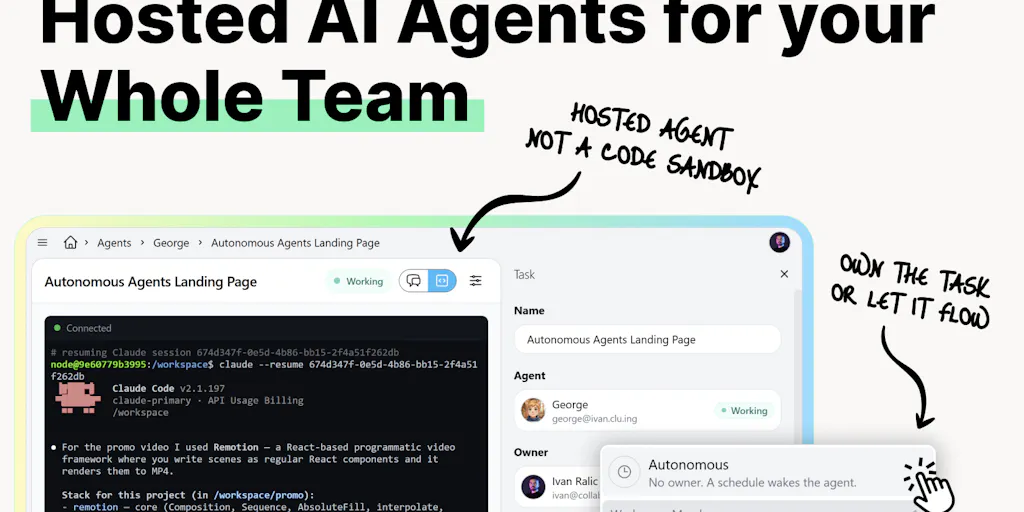
That’s the real bottleneck. Not model intelligence — context continuity. The Cluing answer is to host the agents themselves, give them access to the knowledge base that the team has already built in the workspace, and let them write back into that same knowledge base. The agents don’t just read your saved research; they can create new Topics, organize content, and summarize conversations. It’s a two-way relationship, which the team explicitly contrasts with most AI integrations that are read-only.
For a cross-border seller, imagine what that means operationally. Your team spends weeks researching the competitive landscape for “collapsible dog bowls” across Amazon US, UK, and Germany. You clip competitor pricing pages, save supplier quotes, annotate review screenshots. Now, instead of that knowledge sitting inert in a folder, an agent can pull from it when you ask for a new listing draft — and it can cite exactly which competitor page informed the bullet points. When you learn something new from a supplier call, you save it, and the agent’s future outputs reflect that learning automatically.
How Cluing Actually Works — And What’s Changed
The product lineage matters here. Cluing was previously known as Collabwriting, and the Product Hunt history shows a steady evolution: Collabwriting for PDF launched in February 2023, Collabwriting 2.0 in June 2023, a Growth Mindset Secrets eBook in August 2023, and Collabwriting for Teams in April 2024. The through-line has always been capturing knowledge from the web and collaborating around it. The new hosted agents launch is the logical extension: now that you have a knowledge base, agents can act on it.
The mechanics, as described in the launch materials, are straightforward. Agents are fully hosted by Cluing — no technical setup required. They come with “custom connectors” that handle whatever tech stack you’re running. If a connector doesn’t exist, the agent can build one, storing credentials securely. There’s a mobile app with over 1,000 Android installs, so you can manage agents from your phone. And the agents can publish pages or apps live, even on your own domain.
The demo story from team member Gordana Laskovic is the most instructive part. She gave an agent her Instagram link, and it built her a live website — copy, her actual Instagram posts, engagement data, a full documentary film section pulled from five different sources, and a published URL. When Instagram blocked unauthorized requests, the agent walked her through connecting via the Meta Graph API, explaining what to click and what errors meant, until she had a working token in under 20 minutes. The credentials got stored in a Cluing Connector, encrypted and reusable.
Now, I’m not going to tell you that every cross-border seller needs an agent that can build a website from an Instagram URL. But the underlying capability is exactly what operators need: an agent that can navigate third-party APIs, handle authentication, and persist credentials — without requiring a developer on staff. Think about what that unlocks for marketplace management. Amazon Seller Central’s API is notoriously finicky. TikTok Shop’s integration requirements are constantly shifting. If your agent can figure out the Meta Graph API from screenshots, it can probably figure out how to pull your TikTok Shop sales data into a reporting dashboard.
Why Amazon Sellers Should Care More Than Shopify Ones
Here’s where I’m going to make some readers uncomfortable. Shopify sellers have it relatively easy. The platform’s app ecosystem is mature, the API is well-documented, and most tools integrate cleanly. Amazon sellers, by contrast, operate in a walled garden where data is harder to extract and automation is more constrained. The hosted agent approach — where the agent figures out API connections on the fly and stores the credentials for reuse — is disproportionately valuable for Amazon operators.
Consider the typical Amazon workflow. You’re running PPC campaigns, monitoring buy box share, tracking review velocity, and watching your BSR. Each of those data sources lives in a different Seller Central tab or third-party tool. Your research on keyword opportunities is in Helium 10. Your inventory forecasts are in a spreadsheet. Your competitor price tracking is in a browser extension. An agent that can pull from all of those sources, maintain context across sessions, and write findings back into a shared knowledge base — that’s not a luxury. That’s a competitive advantage in a marketplace where speed of iteration matters more than raw spend.
The Cluing team’s own positioning supports this. They describe the agents as “learning right alongside you” and note that skills stay in sync with Topics so the whole team stays aligned without rewriting prompts. For a brand running Amazon, Walmart, and TikTok Shop simultaneously, that shared context is the difference between an agent that writes generic copy and one that remembers your brand voice, your compliance constraints, and your target market’s cultural nuances.
What Cross-Border Sellers Can Borrow From Cluing’s Approach
You don’t have to adopt Cluing to benefit from the thinking behind it. The hosted agents launch is, at its core, a thesis about how knowledge work should function in a distributed team. Here’s what I’d steal from that thesis, regardless of which tool stack you end up using.
First, your AI tools need a memory layer. The most expensive mistake e-commerce operators make is treating AI as a stateless utility. You wouldn’t hire a content writer who forgets everything you told them after each assignment, but that’s exactly how most AI tools behave. The fix is to build a persistent knowledge base — whether that’s Cluing, Notion, or a well-structured set of documents — and force your AI tools to reference it. If a tool can’t read from your knowledge base, it’s not worth the subscription.
Second, agents should write back, not just read. Most AI integrations are one-way streets. You feed the tool information, it gives you output, and the output lives in a separate system. Cluing’s MCP integration with Claude — which lets Claude create and organize content directly in the workspace — points at a more useful pattern. When your AI learns something, it should be able to update the shared record. That’s how institutional knowledge gets built faster than your team can manually document it.
Third, connectors are the moat. The ability to connect to arbitrary third-party APIs, with credentials stored securely, is what separates a toy agent from an operational tool. The demo showed the agent navigating the Meta developer portal — a genuinely hostile environment for non-technical users — and succeeding. For e-commerce operators, that same capability applied to marketplace APIs, logistics providers, and payment gateways would eliminate an entire category of integration headaches.
Where the Math Breaks
I want to be honest about the limitations, because the launch thread is understandably enthusiastic and you shouldn’t buy based on testimonials alone.
The first concern is performance at scale. The Product Hunt review summary notes “dependence on stable internet and large-team performance” as caveats. For a solo seller or a small team, hosted agents are probably fine. But if you’re running a 50-person operation with agents handling multiple workflows simultaneously, the infrastructure demands are real. The team’s own founder described the chaos of running agents locally — 15 Chrome instances eating RAM — and the hosted version solves that, but hosted solutions introduce their own bottlenecks. Latency, API rate limits, and cost all scale non-linearly.
The second concern is the knowledge quality problem. An agent is only as good as the knowledge base it draws from. If your team’s saved research is messy, duplicative, or outdated, the agent will confidently produce outputs based on garbage. The tool doesn’t solve the underlying problem of knowledge hygiene; it just makes bad knowledge more efficiently accessible. You still need someone responsible for curating what goes into the workspace.
The third concern is the platform risk. Cluing is a relatively small player in a space that includes Notion, Obsidian, and the entire AI agent ecosystem from OpenAI, Anthropic, and others. The MCP integration with Claude is smart — it aligns Cluing with the broader agent ecosystem rather than trying to compete with it — but it also means Cluing’s value is partly dependent on Anthropic’s roadmap. If Anthropic ships native memory that makes external knowledge bases redundant, Cluing’s differentiation erodes.
The Mobile Angle You Shouldn’t Ignore
One detail in the launch thread deserves more attention than it’s getting: the mobile app. The team notes over 1,000 Android installs and positions the app as a way to capture insights on the go. For cross-border sellers, this is actually a bigger deal than it sounds.
Think about your actual workflow when you’re sourcing products in Yiwu or visiting a fulfillment partner in Shenzhen. You’re not at a desk. You’re walking through a factory, looking at samples, negotiating prices. The insights you capture in those moments — a supplier’s minimum order quantity flexibility, a material quality issue, a competitor product you spot on the factory floor — are exactly the kind of context that should inform your agents’ future decisions. If capturing that insight requires opening a laptop and navigating to a web app, it won’t happen. If it’s a two-second save from your phone, it will.
The team’s own framing — “collect insights on the go” — is aimed at individual inspiration capture, but the cross-border application is broader. Your overseas team members can save supplier notes, competitor sightings, and local market observations directly into the shared workspace, and your agents can use that context when generating listings or planning content. That’s a meaningful workflow improvement for distributed teams.
What I’d Watch / Test Next
If you’re intrigued by the hosted agents concept but not ready to bet your operations on it, here’s what I’d do this week.
First, sign up for Cluing and spend 30 minutes capturing your existing product research into Topics. Don’t worry about agents yet. Just get your competitor teardowns, supplier notes, and ad performance screenshots into the workspace. The tool’s core value — fast clipping of quotes and sections from web pages — is worth testing on its own. The review summary highlights “fast clipping of quotes and sections, clean UI, and smooth collaboration with comments and version tracking,” and those are table stakes for any research tool.
Second, test the MCP integration with Claude. If you’re already using Claude for content generation or data analysis, connect it to your Cluing workspace and see what happens when the model can read from and write to your knowledge base. The bidirectional relationship is the most novel part of the offering, and it’s the piece most likely to change your workflow. Ask Claude to summarize a competitor’s pricing page and save the summary to a Topic. Then ask it to draft a listing using that saved summary. The difference in output quality — compared to a cold-start prompt — will tell you whether the memory layer matters.
Third, wait on the hosted agents until you’ve validated the knowledge base. The agents are the flashy part, but they’re downstream of the knowledge problem. If you can’t maintain a clean, organized workspace, the agents will amplify your mess. Start with the capture and organization layer, build the habit of saving everything, and then introduce agents once you have a critical mass of context.
The 25% off launch discount and $25 free credits ($300 for yearly subs) make this a low-cost experiment. The real cost is your time spent organizing knowledge — and that’s an investment that pays off regardless of whether Cluing becomes your permanent stack. The hosted agents launch is worth watching, not because it’s the final answer, but because it’s the first credible attempt to give AI agents a memory that your whole team can share. For cross-border operators drowning in fragmented knowledge, that’s a direction worth exploring.