Why Cross-Border E-Commerce Teams Are Sleepwalking Through the Same Knowledge Crisis That Backdrop’s AI Coworkers Are Trying to Solve
If you run a cross-border e-commerce operation — whether a 10-person DTC brand juggling Shopify, Amazon, and TikTok Shop, or a 50-person team with a logistics hub in Shenzhen and a creative studio in London — you already feel the friction. Customer feedback that gets lost in a WhatsApp group. A product variant that got killed six months ago because of a tariff issue, rebuilt last week by a new hire who didn’t know. Two campaign managers asking ChatGPT the same question about Amazon PPC bid strategies and getting slightly different answers that they never compare. The problem isn’t that your team lacks information. It’s that the information lives in silos — Slack threads, Google Sheets, seller central notes, private ChatGPT conversations, and the heads of people who left. This is the exact problem that Backdrop aims to solve, not for software teams but for any team that ships decisions. And cross-border e-commerce teams, with their insane tool sprawl and time-zone fragmentation, might need this more than the SaaS startups Backdrop was built for.
I’ve been watching the AI “coworker” category mature for the past 12 months. Most tools are personal assistants that make you faster individually. Backdrop is different: it tries to make your company smarter. That distinction matters more for an international e-commerce team than for a seed-stage B2B SaaS. Because in e-commerce, decisions compound or decay based on how well context travels across a supply chain, not just across Slack.
Cross-Tool Context: The One Thing No E-Commerce Tool Stack Provides
Let’s trace a typical failure pattern. Your product research team spots a trend in TikTok comments and drops a note in Slack. Your sourcing manager in Vietnam sees it but doesn’t act because the Slack thread already has six emoji reactions and no clear owner. Meanwhile, your Amazon listing manager runs a separate Helium 10 analysis and decides to launch a variation — not knowing the feedback was already being validated. Three weeks later, the variation flops because the original feedback was about a different price point. This is the “fragmented knowledge” problem that Backdrop founder Akanksha Singh describes: “Customer feedback gets trapped in someone’s ChatGPT. A feature gets rebuilt because nobody remembers why it was killed.”
Backdrop’s solution is to deploy AI “coworkers” that connect to Slack, GitHub, Linear, Notion, Asana, Google Workspace, and more — and carry context across every project and decision. For a cross-border team, imagine an agent that reads customer feedback from a shared Slack channel, cross-references it with your last product meeting notes in Notion, flags that you already tried that exact packaging change six months ago, and surfaces the conflict before anyone wastes time. That’s not a luxury; it’s a margin saver.
The key differentiator, as CTO Caitlin Short notes, is that most tools “reset every session” and “context lives in someone’s head, a Notion page, or a private ChatGPT thread.” Backdrop’s agents “compound instead of reset.” In e-commerce, where product lifecycles are short and margins thin, compounding context is the difference between a team that iterates fast and one that repeats mistakes.
Why Amazon Sellers Should Care More Than Shopify Ones
Amazon sellers face a uniquely fragmented toolchain compared to Shopify DTC operators. A typical Amazon-focused team juggles Seller Central, Helium 10, Jungle Scout, Slack for supplier comms, Trello for launch calendars, and a shared Google Drive for compliance docs. There’s no native connector between Helium 10 and Trello, so when a keyword opportunity surfaces, it often gets lost in a LinkedIn message or a mismatched spreadsheet. Backdrop’s integrations (“connect to Slack, GitHub, Linear, Notion”) aren’t a direct fit for Amazon tools, but the pattern of cross-tool synthesis is desperately needed. A seller who could ask an AI agent “Has anyone on the team previously analyzed the competitive landscape for this ASIN bundle idea?” and get an answer drawn from past Slack discussions, supplier emails, and product research docs would save hours of decision lag.
Shopify sellers, by contrast, often have a simpler stack (Shopify admin, Klaviyo, some ads tools). The value of Backdrop is still real — especially for teams running multiple brand stores — but the pain of fragmented knowledge is acute for Amazon operators who coordinate with multiple third-party logistics providers, customs brokers, and PPC agencies across time zones.
Where the Math Breaks for Most Cross-Border Teams
I’ve read the entire Product Hunt comments section, and the question that resonates most came from Kenneth John Saracho: “Where is the line for a one-person team?” For a solo seller, is there enough fragmented context to justify wiring up a tool like Backdrop? Singh’s answer is honest: “The reconciling everyone’s half knowledge part won’t do much for you solo… But your context is still scattered, just across time and tools instead of people.”
That’s fair, but here’s where the math breaks for many cross-border operators. Backdrop’s pricing is not disclosed in the launch material (I’d expect it to be per-seat, likely $30-60/user/month given comparable tools). For a 3-person team managing a single Shopify store, that might be $150/month — not trivial, especially if you’re already paying for ChatGPT, Zapier, and Notion. The value proposition becomes clearer at 10+ people where the cost of miscommunication (rebuilding a killed variant, duplicating a failed ad test) exceeds the subscription fee.
More critically, Backdrop’s integration set today is heavily skewed to software development tools: GitHub, Linear. E-commerce teams use those less frequently. What would make Backdrop a no-brainer for cross-border sellers is native connectors to Seller Central, Shopify Admin, TikTok Shop API, and logistics platforms like ShipStation or Flexport. Without those, a cross-border operator would need to route everything through Slack and Notion manually — which kind of defeats the purpose of “just works out of the box.”
The Traceability Question That Applies to Every E-Commerce Decision
One of the sharpest comments came from Hazy: “When it synthesizes customer feedback into a spec, does it cite the source threads so I can trace a claim back before acting on it?” Short’s response: “When an agent turns feedback into a plan or spec, the conversations, links, and comments also show up in one place on the dashboard. So you can see what happened and trace claims before you act on them.”
This is critical for e-commerce. Imagine an AI agent suggests raising your minimum order quantity based on aggregated feedback from supplier Slack messages. If you can’t trace that recommendation back to the specific negotiation thread and the original buyer’s reasoning, you’re trusting a black box. In a high-margin business, one bad supply chain decision can wipe out a quarter. Backdrop’s traceability is a step in the right direction, but I’d want to see it surface conflicting sources too — not just one authoritative plan. When Slack, Linear, and a doc disagree, Backdrop flags the mismatch and asks clarifying questions. That’s the gold standard for distributed teams.
What Cross-Border Sellers Can Borrow From Backdrop’s Philosophy (Even If You Never Buy It)
You don’t have to subscribe to Backdrop tomorrow to apply its core insight. Here are three principles any e-commerce operator can steal:
Create a company memory, not a personal notebook. Most sellers use ChatGPT or Claude for individual tasks — writing a listing copy, analyzing a competitor’s pricing, drafting a return policy. That knowledge evaporates. Instead, designate a central Notion or Confluence database where every AI-generated insight gets logged with source attribution. Enforce a rule: “Before asking a question in Slack, search the memory.”
Build role-specific AI assistants. Backdrop’s CTO Short mentioned that “a PM reviewing a design and drafting a plan is a completely different job than an engineer implementing from that same file.” The same applies to e-commerce: a PPC manager’s AI agent should be wired to campaign data and cost-of-goods, while a product development agent should read supplier emails and trend reports. Use custom GPTs or Zapier bots with different contextual permissions.
Audit your tool integration gaps. Backdrop’s hardest integrations were Google Workspace and Figma because “generic read the file integration doesn’t cut it.” For e-commerce, the hardest connectors are typically between purchase order systems and inventory management, or between ad platforms and accounting. Map where your context breaks — where a decision in one tool doesn’t reflect in another. That’s where you need either a better stack (like Airtable as a central source of truth) or a human process to manually reconcile.
What I’d Watch / Test Next
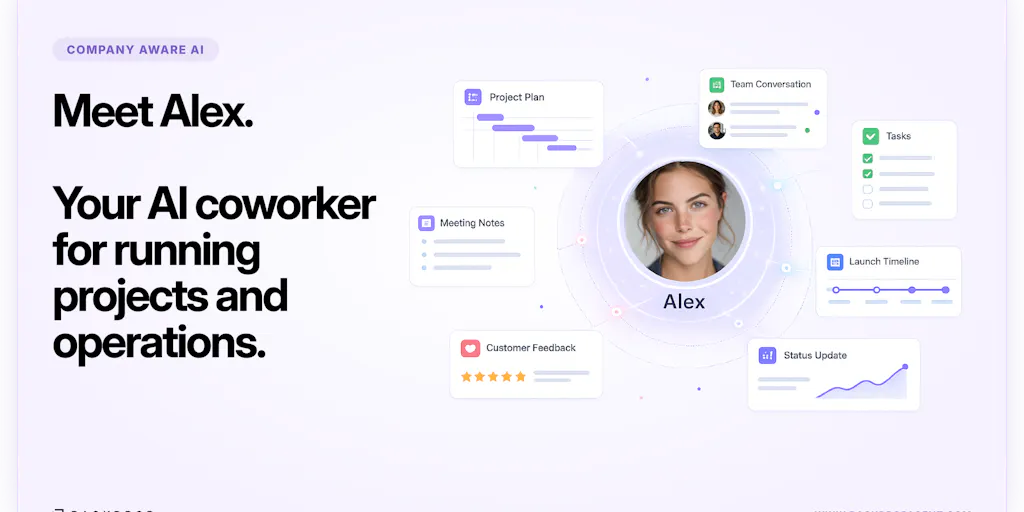
Backdrop is launching with “Alex” for projects and operations and “Sam” for engineering. For e-commerce, I’d want a “Mia” for supply chain and a “Jake” for content operations. That doesn’t exist yet, but the underlying framework — role-specific agents carrying context across tools — is the right architecture.
Here’s what I’d test this week if I ran an e-commerce team of 5+ people:
Pilot Backdrop on one non-critical project — say, launching a new bundle on Shopify. Connect Slack (where your team discusses the bundle), Notion (where your product spec lives), and Asana (your task tracker). See if the AI agent can synthesize feedback from a Slack poll into a prioritised task list in Asana without you manually copy-pasting. Focus on traceability: can you click back from a task to the original Slack message?
Run a “knowledge audit” — compile the last three product decisions you made where the team disagreed or repeated work. Identify where the context existed but wasn’t accessible. If those patterns involve Slack + Notion + a task tool, Backdrop has a shot. If they involve Amazon Seller Central + a PDF customs document + a WeChat conversation, wait for broader integrations.
Consider the solo operator case — if you’re a single-person Amazon seller, skip Backdrop for now. Instead, implement a simple “knowledge log” in Notion where you document every product decision, the source of the data (a Helium 10 report, a supplier quote), and the outcome. That’s 80% of the value for free.
Watch the pricing page — Backdrop’s Product Hunt launch doesn’t disclose cost. When they release it, calculate the cost of one “rebuilt-from-scratch” mistake in your operation. If Backdrop costs less than that mistake per month, it’s worth a trial.
Bottom line: Backdrop is solving a real problem that most AI tools ignore — not making individuals faster, but making organizations smarter. For cross-border e-commerce teams that have grown past the “two people and a Shopify store” stage, the cost of fragmented knowledge is real and growing. The tool isn’t built for your stack yet, but the philosophy is worth adopting today. Start by building your own company memory before you decide whether to buy it.