When Your Brand Voice Is the Product, Don’t Let AI Flatten It
Cross-border sellers obsess over product-market fit, ad creative, and supply chain resiliency, but most of us neglect the one asset that compounds across every channel: a genuine, repeatable brand voice. We pour hours into Amazon listing copy, Shopify blog posts, TikTok scripts, and Klaviyo newsletters — yet the output often reads like it was assembled by the same anonymous GPT prompt that every competitor used last night. The result is a sea of interchangeable content that algorithms reward and customers scroll past. What if the bottleneck isn’t writing skill but the input method itself? A tool called Bono AI just launched on Product Hunt, and while it’s aimed at personal-brand thought leadership, its core insight — talk instead of type — has direct implications for how any e-commerce operator can produce authentic, scalable content that actually sounds like the founder or brand behind the store.
The “Doesn’t Sound Like Me” Problem Every Seller Knows
I’ve been in enough DTC Slack groups and Amazon seller forums to recognize a silent crisis: brand owners are spending $500–$1,500/month on AI writing subscriptions (Jasper, Copy.ai, Writesonic) or hiring VA content mills, yet 8 out of 10 pieces get rejected because “this doesn’t sound like us.” The Bono founder Zeeshan Rasool recounts exactly that feedback from his previous website builder: users scrolled past all the features and fixated on an AI-written blog post, then told him repeatedly it didn’t sound like them. That anecdote should land hard for any cross-border operator who has ever had to re-edit an A+ Content module three times because the tone was too corporate, or scrapped a TikTok script because it used vocabulary no one on the team would ever say.
The problem isn’t the AI — it’s the prompt. Typing a prompt forces you to think like a writer, not like a founder. You condense, formalize, lose the colloquialisms and odd phrasings that make your brand distinctive. Bono flips the input: you talk for ten minutes about your product, your customer insights, your frustrations — and the tool extracts the signal, separates it from throat-clearing, and generates platform-specific drafts (blog, LinkedIn, X, newsletter) in a voice that the system learns over time.
Why Amazon Sellers Should Care More Than Shopify Ones
Amazon’s ecosystem compounds this problem. Product detail pages are notoriously rigid in copy length and keyword placement, yet the best-performing listings have a distinct “voice” — think Anker’s crisp clarity or the irreverence of brands like Liquid IV. On Shopify you own the domain and can iterate freely, but Amazon’s algorithm and the Amazon Seller Central review system penalize inconsistency and reward relevance. If you’re selling across both, you need a core brand voice that adapts to each platform’s constraints without losing identity. Bono’s format-specific generation — one raw conversation turned into a 200-character X post and a 2,000-word blog on separate structural passes — mirrors exactly what a seller needs: one session about “why we changed the charger port” could yield a short ASIN-bullet translation, a longer “Story Behind the Product” blog, and a social clip for TikTok Shop. The differentiated pass (not just chunked transcript) is the part I find credible.
How Bono Differs from the Incumbent AI Stack
Most AI writing tools are prompt-to-text machines. You feed them a headline, a few bullet points, a tone label (“friendly,” “professional”), and they return a draft that often requires heavy editing to strip out generic filler. Bono’s differentiator is the input modality and the iterative voice training.
- Voice input instead of text prompt: You talk freely, the tool asks follow-up questions during the “interview” to surface the actual point, then extracts core claims and examples. In the comments the founder clarifies: “It’s not transcribe-then-polish”. The extraction separates filler from signal, sometimes even pulling a tangent that wasn’t meant to be the headline.
- Per-format generation: Each channel gets its own generation pass built around format best practices — not one draft resized three ways. This matters hugely for a cross-border operator distributing to Amazon (bullet points + description), Shopify (blog + meta description), and email (newsletter subject line + body). Most tools produce one “rich text” blob that you have to re-format manually.
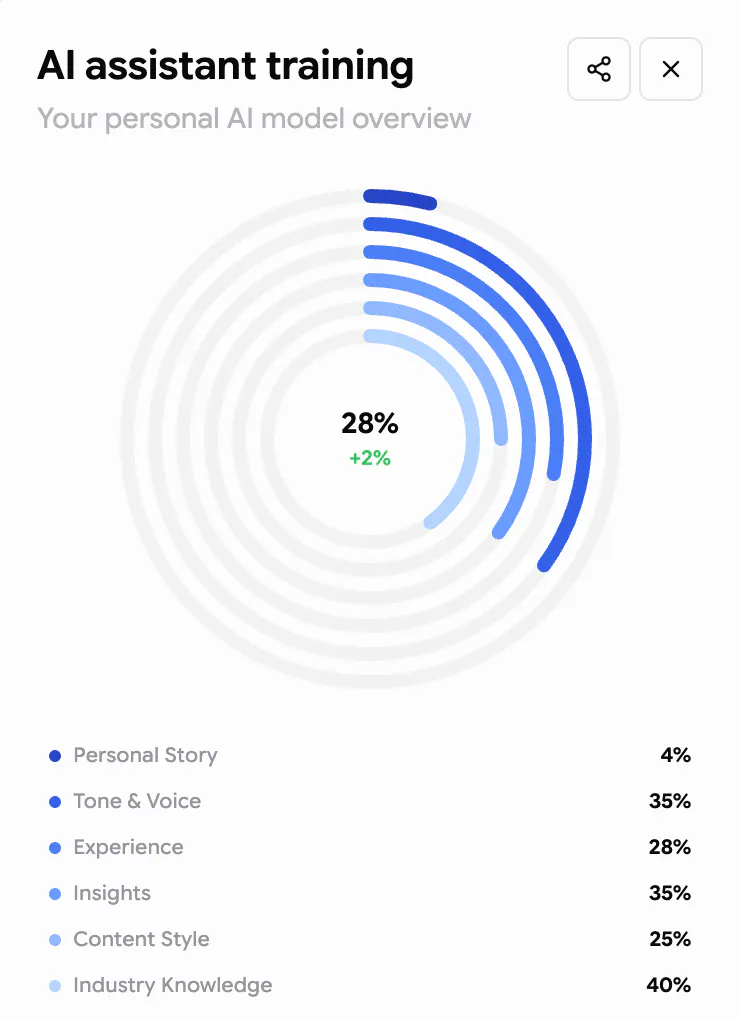
- Voice learning over time: The system adapts from your edits, approvals, and direct feedback (“too formal,” “wouldn’t say it that way”). Rasool shared a screenshot showing a human-vs-AI score jump from ~65% to 80%+ by the third call. In e-commerce, where you often have multiple content creators (in-house copywriters, agencies, AI), a tool that “gets sharper the more you use it” could reduce the endless rounds of brand-guideline briefings.
Where the Math Breaks for High-Volume Operators
Let’s be honest about the limitations before we get carried away. Bono is currently optimized for personal brand thought leadership — the kind of content a founder puts on LinkedIn, X, and a personal blog. For a typical cross-border e-commerce brand running 10–20 new product launches a month, the content volume is immense: each SKU needs an Amazon title, five bullet points, a description, a Shopify product page, an email flow sequence, social media posts, and maybe a TikTok hook. Ten-minute conversations per product would become a bottleneck if scaled linearly. The tool doesn’t yet integrate with e-commerce platforms — no direct push to Shopify drafts, no Amazon listing feed, no Klaviyo template insertion. You’d still copy-paste and format.
Moreover, the “in your voice” success depends heavily on the speaker. Commenters noted that rambling or clipped answers reduce output quality. Rasool acknowledged that “very short, clipped answers with little elaboration” provide less material to learn from. If you’re a non-native English speaker running a cross-border operation — say a Chinese seller creating English content for Amazon US — your speaking voice might not translate into natural English prose without heavier editing. The tool pulls from word choice and phrasing, not vocal energy, but a flat delivery with limited vocabulary may still produce a “generic-sounding” draft. The learning curve might be slower for ESL sellers.
What Cross-Border Sellers Can Borrow Right Now
Even if Bono isn’t a drop-in replacement for your content stack, the underlying workflow — record a conversation, extract signal, generate platform-specific output — is worth testing as a supplement.
Brand voice documentation: Use Bono to record a 10-minute session where you describe your brand’s origin, your customers’ biggest pain point, and how you solved it. The output becomes a “voice seed” you can refer back to when training other writers (human or AI). Treat it as a living brand guidelines document.
Product story blog posts: Instead of staring at a blank Shopify blog editor, talk through the “why” behind a product change. The resulting post will likely read more authentically than a bullet-point list rewritten by an intern. Publish to your Shopify blog or Etsy shop updates.
Social proof scripts: For TikTok Shop or Instagram Reels, you need short, punchy scripts that sound conversational. Record a 2-minute audio note about a customer win, let Bono generate a 30-second video script and a text overlay. The tool’s format-specific pass can respect character limits better than you’d expect.
Email newsletter hook: The newsletter format generation is particularly strong because it forces a narrative arc from your raw thinking. If you run a Klaviyo flow for post-purchase engagement, test using a Bono-generated newsletter intro as the first touch — it feels more personal than a template.
Where the Math Breaks (Cost vs. Time)
Bono’s pricing wasn’t disclosed except for the 50% off Pro code (PH50BONO, expires July 14). Assuming a SaaS subscription comparable to Jasper or Copy.ai ($39–$99/month), the ROI equation is: how many hours does it save you per content piece? If your brand manager spends 2 hours per blog post (drafting + editing) and Bono reduces that to 30 minutes of talking + 10 minutes of review, you free up 1.5 hours. At an internal rate of $50/hour, that’s $75 saved per piece. If you publish 10 pieces per month, the tool pays for itself quickly. But if you have a VA doing bulk rewriting at $5/hour, the math is less compelling. The real value is in quality lift — better conversion from more authentic copy — not just speed.
What I’d Watch / Test Next
I’d run a three-week experiment before committing to a subscription.
Week 1 – Record three conversations: one about your brand origin, one about a recent product improvement, one about a customer objection you frequently hear. Use Bono to generate all four format outputs (blog, LinkedIn, X, newsletter) for each conversation. Review each draft and track two metrics: 1) how many sentences needed manual rewriting vs. how many you published as-is, and 2) how many “flattened” phrases (sounds like generic AI) remain.
Week 2 – Compare the best output to a piece written via your current workflow. A/B test it in one channel — send the Bono-generated newsletter to 20% of your Klaviyo list and your standard version to the rest. Measure click-through rates. If the Bono version outperforms, you have a signal worth scaling.
Week 3 – If results are positive, start using Bono for your own founder content (LinkedIn, personal brand) and train a VA to do the same for product descriptions. The tool’s learning mechanism means every session improves future outputs. I’d also watch for integrations: if the team adds direct Shopify or Amazon feed publishing, this becomes a much stronger contender for the e-commerce content stack.
Finally, keep an eye on the Bono community feedback. The Product Hunt launch comments reveal an engaged team iterating fast on format-specific generation — exactly the kind of responsiveness cross-border operators need from a tool that claims to “get out of your way over time.”